
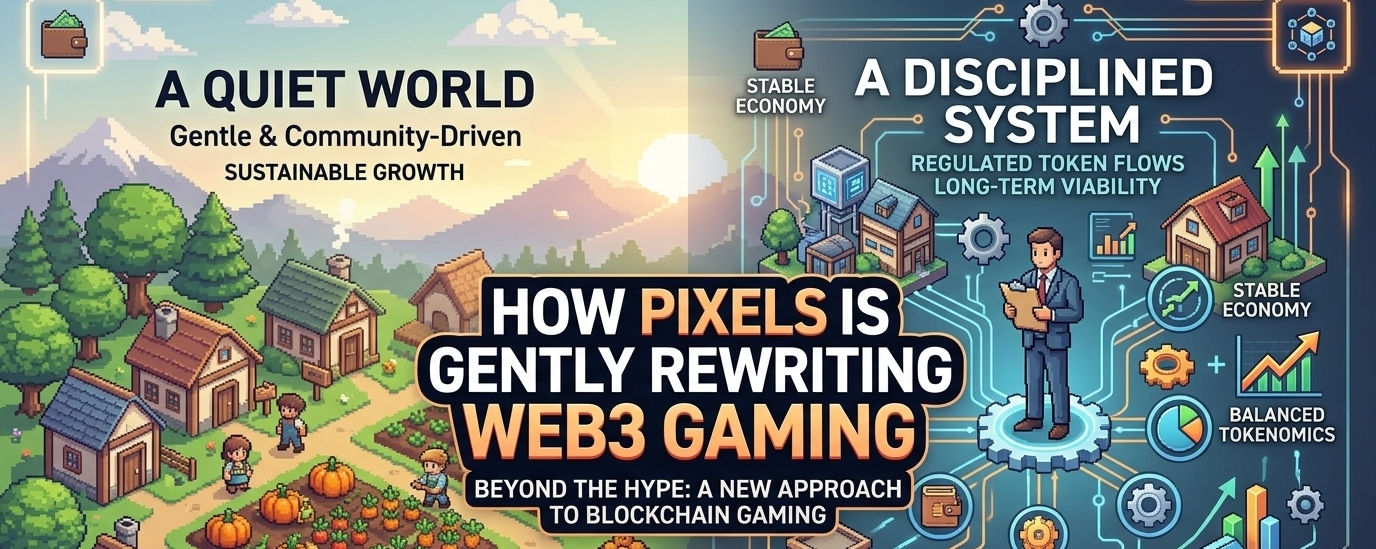
There’s a quiet fatigue that settles in after spending enough time around most Web3 games. Not because they fail loudly but because they often succeed in the wrong direction. Systems get optimized for extraction before they’re understood as places. Players arrive curious and leave transactional. Over time the games stop feeling like worlds and start behaving like dashboards. It’s in that gap between what a game promises emotionally and what it delivers structurally that something like Pixels begins to make more sense.
Pixels didn’t emerge as a sudden correction to that pattern. It feels more like a slow response to accumulated mistakes both its own and those of the broader ecosystem. If you spend time observing how the game has evolved you notice restraint more than ambition. Features aren’t layered on top for novelty; they tend to arrive after the underlying behavior has been studied. That pacing matters. It suggests the builders are less interested in being early and more interested in being right or at least less wrong over time.
At its core Pixels revolves around simple loops: farming gathering crafting exploring. None of these are new ideas. What’s different is how they’re framed. Early players didn’t approach the game as a yield engine. They approached it like a place worth figuring out. That distinction shaped early behavior in subtle ways. Instead of optimizing immediately players experimented. They planted inefficient crops. They wandered without purpose. They interacted because the environment invited curiosity, not because it demanded output.
Later users behaved differently. As the game gained attention, a second wave arrived with a more defined objective: efficiency. They brought spreadsheets strategies and expectations shaped by other Web3 systems. The same mechanics began producing different outcomes. Farming became less about rhythm and more about throughput. Exploration narrowed into route optimization. This shift wasn’t inherently negative but it exposed a tension that the system had to absorb: how do you preserve a sense of place when users increasingly treat it as a system?
The response from the Pixels ecosystem hasn’t been to block efficiency but to complicate it. Systems have been adjusted to reward presence and engagement in ways that aren’t easily abstracted. Social interactions, land usage and resource coordination began to matter more over time. These aren’t flashy features but they subtly reshape incentives. They make it harder to fully detach from the world itself which in turn nudges behavior back toward participation rather than pure extraction.
One of the more interesting aspects is how risk is handled. In many Web3 games, risk is externalized pushed onto users through volatile economies or unsustainable reward structures. Pixels takes a quieter approach. Risk shows up in time investment in decision-making around land usage in how players allocate effort across activities. There’s less emphasis on sudden loss and more on gradual consequence. This creates a different psychological environment. Players aren’t constantly guarding against collapse; they’re managing trade-offs.
That trade-off mindset becomes especially visible in how features are introduced or delayed. Some systems that would increase short-term engagement particularly those tied to rapid reward cycles have been noticeably restrained. This can be frustrating for users expecting constant expansion but it reflects a longer-term concern: once a behavior is introduced, it’s hard to reverse. The team appears to treat new mechanics as commitments not experiments. That slows development but it also prevents the ecosystem from drifting too quickly into instability.
Community trust in this context, doesn’t form through announcements or incentives. It forms through observation. Players watch how the system reacts under pressure during surges of new users, during economic shifts during periods of imbalance. Over time patterns emerge. If adjustments are measured rather than reactive trust accumulates. Not because everything works perfectly but because nothing feels reckless. That consistency is rare and it tends to matter more than any individual feature.
Usage patterns reveal a lot about the underlying health of Pixels. Retention isn’t driven by novelty spikes; it’s tied to routine. Players log in not because something new happened but because the existing loop feels stable enough to return to. That kind of retention is quieter but more durable. It also suggests that the game is transitioning from being an experiment to something closer to infrastructure a place that supports ongoing activity rather than episodic attention.
Integration quality plays a role here as well. Being built on Ronin gives Pixels access to an ecosystem that already understands gaming behavior at scale. But integration isn’t just about infrastructure; it’s about coherence. Wallet interactions asset ownership and in-game actions need to feel continuous rather than fragmented. When that alignment works the Web3 layer fades into the background. Players stop thinking about the chain and start thinking about the game. That’s a subtle but important shift.
The token PIXEL sits within this system as a coordinating mechanism rather than a focal point. Its role isn’t to drive excitement, but to align participation. It connects effort to ownership in a way that can persist over time if handled carefully. The challenge as always, is preventing it from becoming the sole lens through which the game is viewed. When players begin to see every action as a financial decision the world itself starts to thin out. Pixels seems aware of this risk which is why the token’s integration feels deliberate rather than dominant.
What’s most notable is how the ecosystem has moved from curiosity to habit without collapsing into monotony. That’s a difficult balance. Too much structure and the game becomes rigid. Too little and it loses meaning. Pixels navigates this by allowing patterns to emerge organically and then reinforcing them once they prove stable. It’s less about designing behavior upfront and more about shaping it over time.
If discipline holds, Pixels could quietly become something that many Web3 games have aimed for but rarely achieved: a persistent environment where economic activity exists, but doesn’t define the experience. Not a spectacle, not a trend, but a place people return to without needing a reason beyond familiarity. That outcome isn’t guaranteed, and it won’t come from rapid expansion or aggressive incentives. It will come from continuing to make small careful decisions that prioritize coherence over growth.
In a space that often confuses movement with progress that kind of restraint might be the most important signal of all.
