

I’ve been looking at PIXEL the same way I look at most new Web3 game tokens—interested, but not rushing to conclusions. Early hype is easy to generate in this space. What’s harder, and far more important, is seeing what actually holds up once things slow down a bit.
Right now, PIXEL is still in that early phase where price and attention are moving quickly. You can see it in the trading behavior—bursts of volume, sharp reactions, and a market cap that feels like it’s being shaped more by expectations than by anything fully proven yet. With circulating supply still finding its place in the market, it doesn’t take much for sentiment to swing things in either direction. I’ve seen this setup many times before—it’s where narratives tend to run ahead of reality.
But what makes me keep an eye on Pixels isn’t the chart—it’s the idea behind it.
At a simple level, it’s a farming and exploration game. Nothing groundbreaking there. But underneath that, it’s trying to do something more interesting: turn everyday in-game actions into something that actually has value outside the game itself. Time spent playing isn’t just “time spent”—it becomes something recorded, tracked, and potentially tradable.
That’s where things get tricky.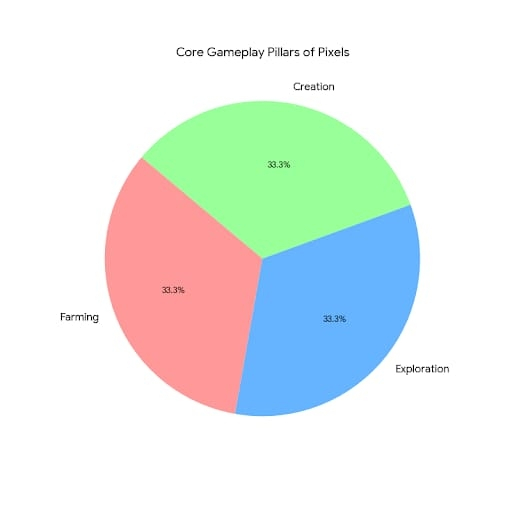
We’ve already seen what happens when games focus too much on rewards. People don’t play because they enjoy it—they play because they’re trying to earn. And when the rewards slow down or the token price drops, they leave. It turns into a short-term cycle instead of something sustainable.
Pixels looks like it’s trying to avoid that by leaning more into social interaction and player-driven activity. The goal, at least from the outside, seems to be creating a small digital economy where players aren’t just extracting value—they’re part of it. Farming, trading, building… all of it feeding into a system where players rely on each other in some way.
A good way to think about it is like a small town. If everyone is just trying to take money out, the system falls apart. But if people are actually producing things, trading with each other, and staying active, it starts to feel more real—and more stable.
The question is whether Pixels can actually reach that point.
Right now, it’s still hard to tell how much of the activity is genuine. Early on, numbers can look strong—lots of players, lots of transactions—but that doesn’t always mean much. Some of that activity can be driven by rewards, speculation, or people just trying to get in early. The real test comes later: do people stick around when things are quieter?
I’m also paying attention to how balanced the in-game economy becomes. Are players actually using what they earn, or just collecting and waiting to sell? Is there real demand between players, or is most of the value flowing in one direction? These are small details, but they say a lot about whether the system is working or not.
Another thing I’m cautious about is depth. Games like this are easy to start, but staying interesting is a different challenge. If everything feels repetitive, people lose interest. But if it becomes too complicated, new players might not even get started. Finding that middle ground isn’t easy, especially when there’s a token involved adding extra pressure.
From a market perspective, PIXEL still feels like it’s being priced on potential. The story is there, the attention is there—but the proof is still forming. That doesn’t mean it won’t succeed. It just means it hasn’t fully shown it yet.
So for now, I’m just watching.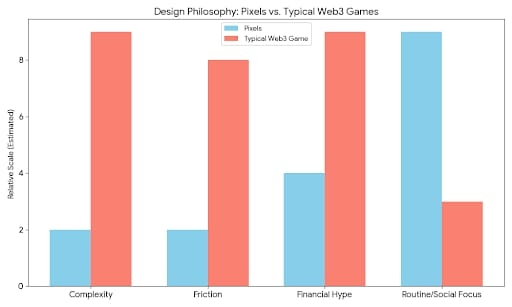
I want to see if players keep showing up when there’s less incentive to do so. I want to see if the economy starts to feel natural instead of forced. And I want to see if the game itself becomes something people enjoy—not just something they use.
Because in the long run, the projects that last aren’t the ones that launch with the most hype. They’re the ones that quietly build real activity over time—something you can actually point to and say, “this works.”
That’s what I’m waiting to see with Pixels.