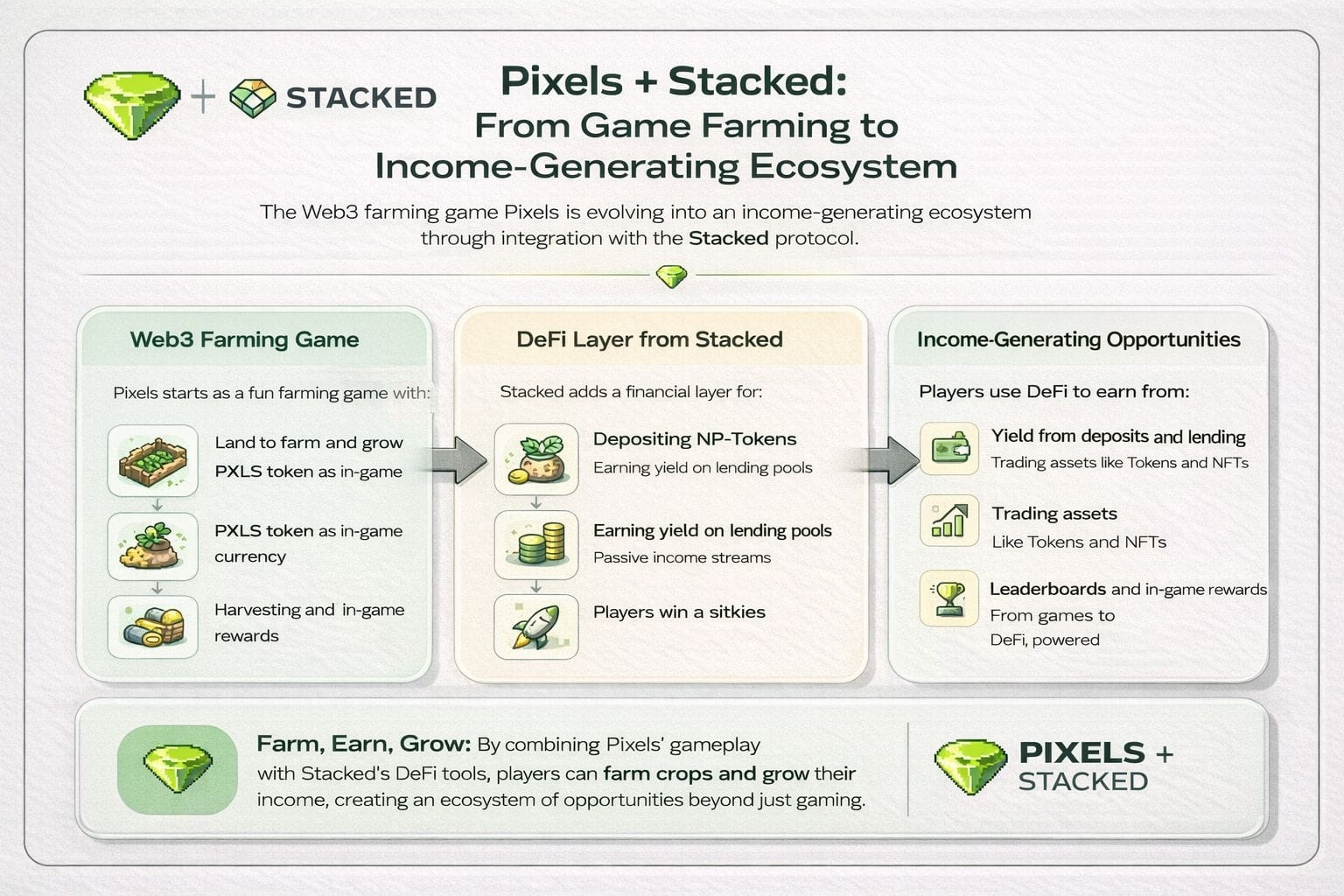
At first, I saw Pixels as just another farming game with a strong reward loop.
Plant crops, harvest resources, repeat the cycle.
It looked like a familiar Web3 model where gameplay and rewards were tightly connected. But the more I followed the project—especially after understanding the role of Stacked—the more I realized Pixels is building something much larger than a typical farming game.
In my view, Pixels succeeds because it creates a very accessible user loop.
The gameplay is simple to understand.
Progress feels clear and rewarding.
And incentives bring new users in quickly.
This makes growth fast.
But it is also the weakness of many Web3 games.
If the only source of value is playing and receiving rewards, the system eventually reaches saturation. Users come because rewards are attractive, and they leave just as easily when those rewards become weaker.
This is where Stacked becomes important.
It does not change the gameplay of $PIXEL.
Instead, it changes how value is managed behind the gameplay.
Rather than letting rewards flow through basic and fixed rules, Stacked turns rewards into something strategic—deciding who should be rewarded, when incentives should be activated, and whether the objective is retention, revenue growth, or stronger long-term user value.
For me, this is a major shift.
Rewards stop being simple in-game prizes and start becoming an economic tool.
And once rewards are treated as an economic mechanism, Pixels is no longer just a farming game.
It starts becoming a system capable of generating income in a more structured and sustainable way.
What stands out most to me is the quality of income.
In the old model, income is direct: enter the game, complete activities, receive tokens or assets.
It is simple, but usually short-term.
With a system like Stacked underneath, rewards are no longer tied only to doing more.
They can be connected to deeper participation, stronger retention, and better value creation for the ecosystem itself.
That is the difference between a game with earning mechanics and an ecosystem designed to generate income.
One rewards activity.
The other distributes value through a more sustainable economic logic.
I also noticed that once Stacked became part of the picture, Pixels was no longer fully dependent on constantly bringing in new users just to keep the system running.
This is a very important shift.
Most farming games perform best at the beginning of the cycle—when curiosity is high and rewards are still exciting.
But if the goal is long-term growth, the system must create more value from the users who stay.
In my opinion, Stacked supports exactly that.
It does not replace Pixels in user acquisition.
It increases the long-term value of every user already inside the system.
That means income no longer depends only on how many new players arrive, but also on how effectively the platform can retain, activate, and grow the value of existing users.
Another reason I find this direction credible is that systems powered by Stacked have already contributed more than 25 million USD in revenue to the Pixels ecosystem.
That number matters not because it sounds impressive, but because it proves the model creates real business value—not just a good narrative.
When a reward infrastructure performs at that scale, I stop seeing it as a support feature.
I start seeing it as a real economic engine.
Another interesting point is the clear two-layer structure that Pixels and Stacked create together.
Pixels acts as the front layer: gameplay, community, user experience, and engagement.
Stacked acts as the back layer: incentives, reward coordination, retention optimization, and revenue management.
To me, this is what makes the transition from farming game to income-generating ecosystem feel realistic.
Because a digital economy cannot survive on activity alone.
It also needs a strong system for distributing value behind it.
Of course, simply having Stacked does not automatically make Pixels a complete economic ecosystem.
The hardest challenge is still preventing reward abuse, controlling bots, and protecting the long-term balance of the economy.
But compared to projects that only add more rewards to maintain short-term hype, Pixels feels like it is moving in a much stronger direction.
They are not just extending the old reward loop.
They are building the operational layer that helps value stay inside the system longer.
If I had to summarize it in one sentence, I would say this:
Pixels + Stacked represents the transition from a reward farming game into an ecosystem where income comes not only from playing, but from how effectively the system creates, retains, and distributes value.
For me, that is the most important part.