
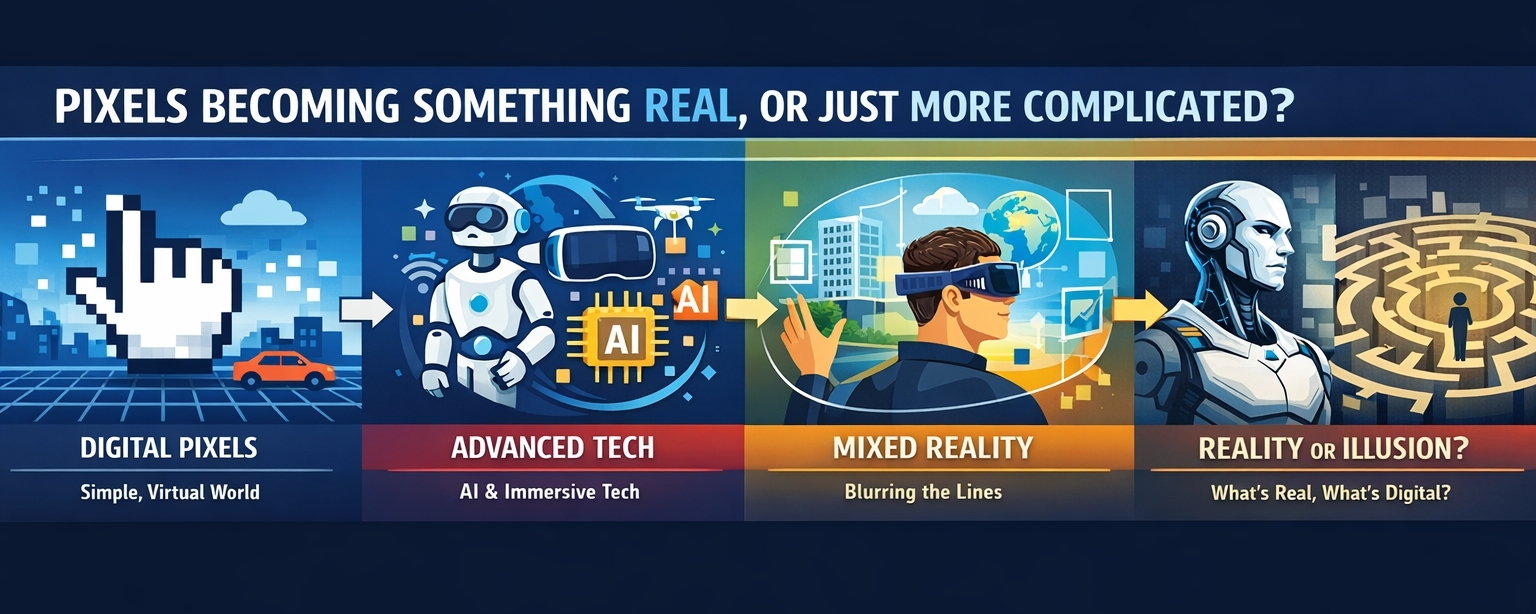
I came back to Pixels after a few weeks expecting the usual—minor tweaks, some token noise, maybe a feature that sounds bigger than it actually is. But this time felt different. Not because everything suddenly works, but because a few parts are starting to connect in a way that forced me to rethink how the whole system operates.
The main question in my head hasn’t changed though: is this becoming something people can actually use, or is it just a more complex loop dressed up as progress?
The biggest shift for me is how the PIXEL token is now tied directly into gameplay. Before, it felt like a reward sitting on top of the game. Now it’s shaping how you play. It affects how fast you progress, what you can access, and even how you make decisions moment to moment. That changes everything.
Once a token starts controlling progression, you stop thinking only like a player. You start thinking economically. Every action has a cost, every reward has a value, and suddenly the game depends on how stable that system is.
And right now, it’s not stable.
The token has been volatile—big price swings, sudden spikes in activity, and no clear reason why. That kind of instability doesn’t stay in the market, it leaks into the game itself. If the price goes up, playing becomes expensive. If it drops, rewards feel pointless. Either way, different types of players start losing interest.
So yes, the token layer feels more “real” now—but also more fragile than anything else in the system.
At the same time, something much quieter happened that might matter more long term: payments got easier. The Binance Pay integration through Ronin removes a lot of friction. You don’t have to think as much about wallets, transfers, or technical steps just to get started.
That might not sound exciting, but it changes behavior. It makes it easier for someone to go from curious to active. It shortens the gap between joining and actually participating. And in a system like this, that’s huge.
But it also creates a new risk. If it’s easier to put money in, but still hard to understand what you’re doing, then you’re just speeding people into confusion instead of helping them.
There’s also clearly more activity now. Player numbers are up, wallets are active, and on the surface it looks like real growth. Normally I’d ignore those metrics, but here they actually matter. This kind of economy needs scale to function. Farming, trading, social systems—all of it depends on enough people being involved.
Even so, I’m not fully convinced it’s strong growth. It still feels driven by incentives rather than real engagement. I don’t know what happens when those incentives slow down. I don’t know if people stay because they want to, or because it’s still profitable.
The two-currency system is another piece that’s starting to show its importance. BERRY handles the everyday stuff, while PIXEL sits on top as the premium layer. From a design perspective, it makes sense. It gives control, helps manage inflation, and creates different types of value.
But from a player’s perspective, it adds friction. You constantly have to think about what to spend, what to save, and what actually matters. It can feel less like playing and more like managing resources in a system you don’t fully understand yet.
That gap—between what designers intend and what players feel—is still there.
There are also areas that haven’t really proven themselves yet. Guild systems, the idea of creating your own world, the broader play-to-earn vision—they all sound promising, but they’re not fully working parts of the system right now. They feel like potential, not reality.
So where does that leave things?
I think Pixels is closer to being something real than it was before. Payments are smoother, the token actually affects behavior, and there’s enough activity to make the system feel alive.
But it’s still not stable.
The biggest issues are still there: the economy is too sensitive to token swings, the complexity is starting to show, and too much of the engagement still depends on rewards instead of actual enjoyment.
What would change my mind isn’t another feature or announcement. I’d need to see the system survive a full cycle—when the token pumps and when it crashes—and still function in a way that feels fair and usable. I’d need to see players stick around even when the rewards aren’t as strong. And I’d need a clearer separation between playing for fun and playing for profit.
Right now, it feels like Pixels is trying to become something real—and running into the reality of how difficult that is.
My confidence has gone up, but only slightly, and only conditionally.
The next real test won’t be when things are going well. It’ll be whether the system still works when they’re not.
And maybe that’s the part that stays with me the most—the feeling that Pixels is standing right on the edge of becoming something meaningful or slipping back into noise. It’s not just about tokens or features anymore, it’s about whether this world can hold together when the excitement fades. Because if it can survive doubt, boredom, and a little bit of chaos, then it earns its place. But if it can’t, then all of this was just momentum pretending to be progress. And somewhere in that uncertainty, I’m still watching—waiting for the moment it either proves itself… or quietly breaks.
