
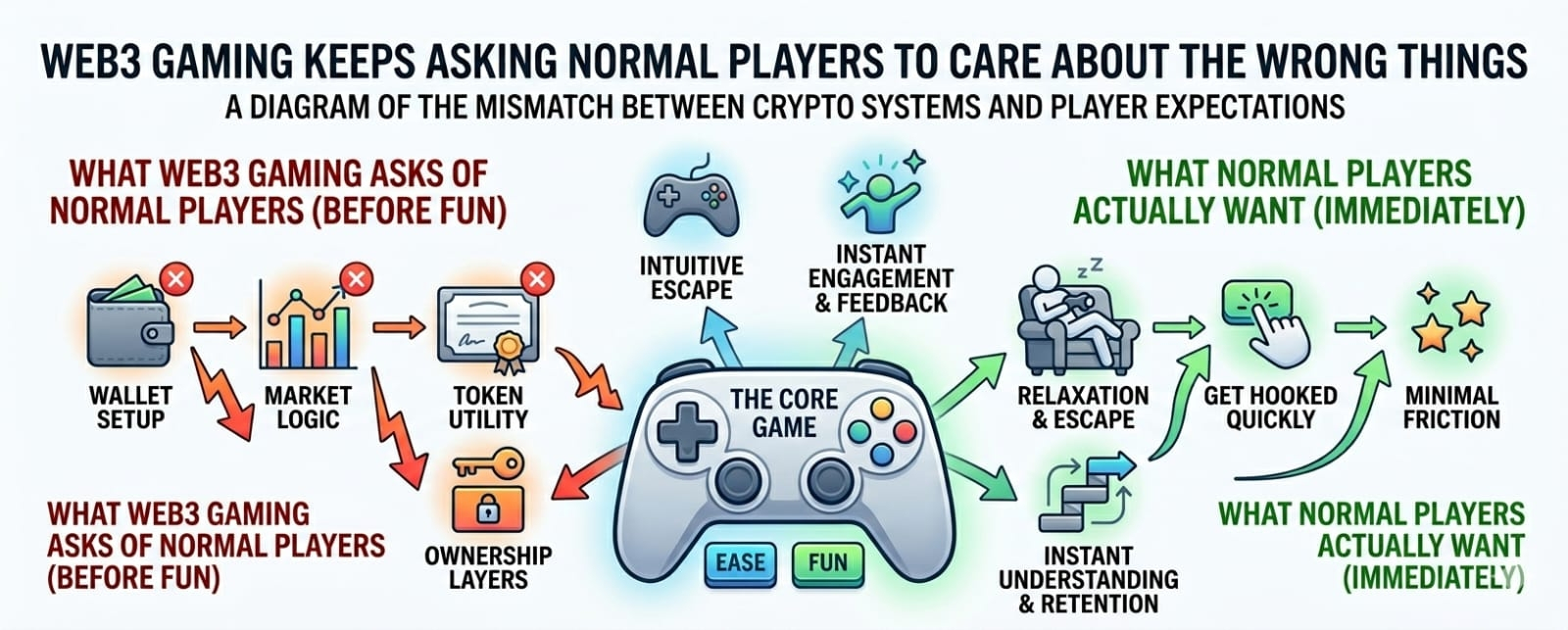
One thing that keeps killing Web3 games for me is how badly they read normal people. Not crypto people. Not the guys who live on X all day posting charts and calling everything alpha. Normal people. The kind of person who opens a game because they want to relax for a bit, waste an hour, maybe get hooked if the loop is good. Web3 gaming still has no idea how to talk to that person. Worse, it barely seems interested in that person at all.
It keeps asking them to care about stuff that should stay in the background. Wallet setup. token utility. ownership layers. market logic. on-chain identity. community governance. Most normal players do not wake up wanting any of that. They want the game to feel good fast. That is it. They want the first few minutes to make sense. They want to know what they are doing and why they should keep going. If the game earns their attention, then maybe they will learn the extra systems later. But Web3 games keep flipping the order. They dump the baggage up front and act surprised when people leave.
That is such a huge part of the problem.
The space keeps thinking resistance comes from ignorance. Like if people just understood the tech better, they would suddenly care. I do not buy that anymore. A lot of people understand perfectly well what is being offered. They just do not think it improves the experience enough to justify the friction. That is not ignorance. That is a reasonable reaction.
And honestly, the industry has made this worse by talking like every feature is a history-changing event. Everything has to sound massive. Revolutionary. Game-changing. The future of digital economies. The next evolution of player ownership. It is exhausting. Most players are not looking for an evolution. They are looking for something that is fun tonight. Something that works without a tutorial video and a sermon. The more Web3 gaming tries to sound important, the more it forgets how ordinary good games actually win people over.
They win through ease.
Ease is underrated because it sounds boring. But ease is everything. Good games lower your guard. They pull you in before you have time to question the whole setup. The controls make sense. The loop clicks. The feedback is clear. You stop thinking about whether the game deserves your time because you are already in it. Web3 games rarely manage that because they keep interrupting themselves with systems they are too proud of.
That pride is expensive.
You can feel it in the design. So many projects seem built around proving a point instead of building a place. Look how open this economy is. Look how composable this asset is. Look how players can own the value they create. Fine. Cool. But is the world worth being in? Is the minute-to-minute experience actually good? Is there tension, charm, rhythm, curiosity, surprise? Or is the whole thing just a stack of ideas waiting for players to do the emotional labor of making it interesting?
That is what normal players reject. Not just crypto. Emotional labor.
They do not want homework before fun. They do not want to study why the system matters. They do not want to sit through a philosophy lecture about ownership before they can enjoy clicking on something. The game has to carry itself first. It has to stand up without a giant explanation attached to it. If it cannot do that, then the extra features are not a strength. They are camouflage.
And the truth is, this space has leaned on camouflage for way too long.
A weak game with token rewards can look alive for a while because incentives create noise. People show up. People post. People grind. Numbers move. Communities form around the possibility of upside. But noise is not the same as attachment. Once the numbers cool off, you find out very fast whether people were there for the world or just hanging around the reward machine. Usually it is the second one. Then everybody acts disappointed in the players, which is always funny to me, because players are just responding to the structure they were given.
If you build a system that teaches people to care about extraction first, they will care about extraction first. That is not a moral failure. That is design.
And that gets to the bigger issue. Web3 gaming keeps claiming it empowers players, but most of the time it just burdens them. More setup. More uncertainty. More self-awareness. More stuff to monitor. More reasons to think about the system instead of disappearing into it. That is not empowerment in any meaningful everyday sense. It is just added weight.
A lot of the best gaming experiences are light on your brain in the right way. Not stupid. Not shallow. Just smooth enough that you can settle in. Web3 keeps mistaking extra layers for extra value. It assumes more moving parts automatically make the experience richer. Usually they do not. Usually they just make it harder for the core loop to breathe.
That is why I think the future of this space, if it has one, depends on humility more than innovation. A weird sentence, maybe, but I think it is true. The teams that have a chance are the ones willing to stop worshipping their own infrastructure long enough to ask a simpler question: would anyone care about this if the chain disappeared into the wall and stopped asking for applause?
That is the test. A brutal one. But a fair one.
Because normal players are not hostile by default. They are not sitting around plotting against Web3 gaming. They are just impatient, which is completely reasonable. Entertainment competes with everything now. Games, videos, group chats, real life, sleep, doomscrolling, all of it. If your product needs ten extra steps and a worldview adjustment before it becomes enjoyable, you have already lost most people.
That is what this sector keeps refusing to accept. Attention is hard to earn and easy to waste. You do not get bonus points for complexity. You do not get sympathy because the tech is impressive. The player does not owe the system curiosity. The system owes the player a reason to stay.
Until Web3 gaming gets that through its head, it is going to keep building for an audience that mostly exists inside its own mirror. And that is why so many of these projects feel louder than they feel alive.
