
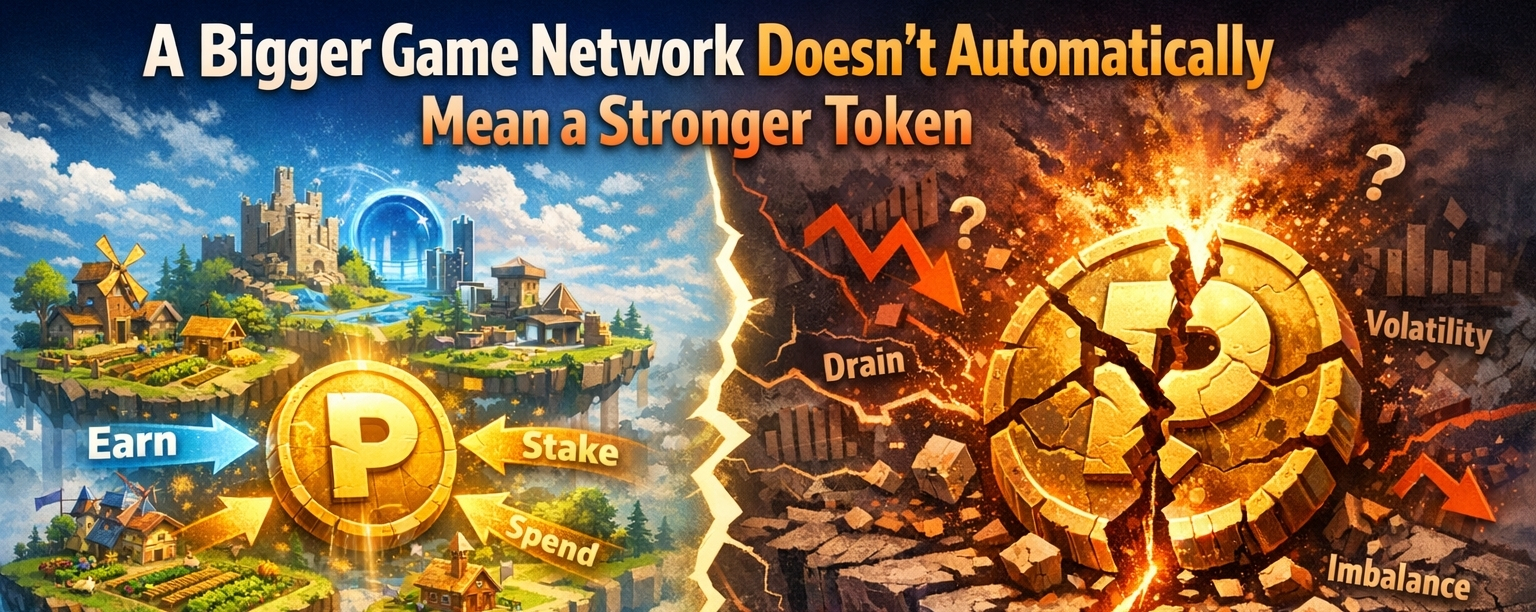
What keeps catching my attention about Pixels is not the expansion itself. Plenty of projects want to become “more than one game.” That part is almost expected now. What stands out is the confidence with which multi-game growth gets presented as if the token side will naturally become healthier just because the product side becomes larger.
I do not think that conclusion is automatic.
On the surface, the idea is attractive. If PIXEL is used across several games instead of living inside one title, then the token looks less fragile. It is no longer tied to one gameplay loop, one player base, or one retention chart. That is a real advantage in theory. A shared token can look more durable when it has more places to matter.
But this is also where the story becomes a little too clean.
A game studio can expand its portfolio without much confusion. More titles can simply mean more ways to attract players. A token does not work that way. The moment the same asset is being rewarded, spent, locked, and recycled across multiple games at the same time, the system becomes harder to read. Not just for outsiders, but probably for the team too.
That is the part I wish people would sit with longer.
Because once five games are connected to one token, you are not just looking at broader utility. You are looking at several separate incentive systems pushing on the same supply. One game may need aggressive rewards to keep momentum. Another may have a stronger spending loop. Another may be early enough that staking is being used to hold attention while content catches up. Each of those choices might make sense on its own. Together, they can create pressure that is much less predictable.
And when that happens, the token stops behaving like a simple ecosystem asset and starts behaving like a shared economic fault line.
I am not saying the model cannot work. I am saying the burden of proof gets heavier once the token has to serve several live environments at once.
That is especially true with staking.
Staking always sounds neat in announcements because it suggests commitment. Lock tokens, reduce sell pressure, reward long-term participation. Fine. But the effect depends on what kind of rewards are being emitted back into the system, how often, under what conditions, and in response to what player behavior. If staking incentives are growing while several games are also creating fresh reward flows, then “locked supply” does not tell the whole story. It only tells the calming part of the story.
The uncomfortable part is whether the emissions underneath that lockup are actually being offset by real demand, real sinks, and real reasons for players to keep the token instead of eventually exiting it.
That is where I feel the current conversation is weak.
Pixels clearly deserves credit for actually building. This is not one of those projects living off vague ecosystem language with nothing behind it. The expansion is happening. The staking framework exists. The broader network strategy looks intentional rather than decorative. That matters. It is much easier to take the economic question seriously when the product effort itself appears genuine.
At the same time, execution on the product side does not remove the unanswered questions on the token side.
In some ways, it makes those questions more urgent.
A single-game token economy can at least be observed in a relatively focused way. You can track how players earn, how they spend, where the leaks are, where the sinks are weak, where the incentives are too generous or too cold. Once several games are attached to the same token, that clarity starts to disappear. The imbalance from one title does not stay inside that title. It spills into a shared asset that every other title depends on.
So the real issue is not whether multiple games sound exciting. Of course they do. The real issue is whether one token can absorb the behavior of several different game economies without becoming harder and harder to stabilize.
That is the question I do not see modeled clearly in public.
And maybe that is what makes this moment interesting. Pixels may be building the kind of network many Web3 gaming teams claim they want but never reach. That alone makes it worth watching. But the more real the ecosystem becomes, the less I care about the headline version of expansion and the more I care about the hidden arithmetic underneath it.
Because once a token becomes shared infrastructure, growth is no longer the only signal that matters.
Coordination starts to matter more.
Discipline starts to matter more.
And the difference between a useful token and an overstretched one gets much smaller than people think.