
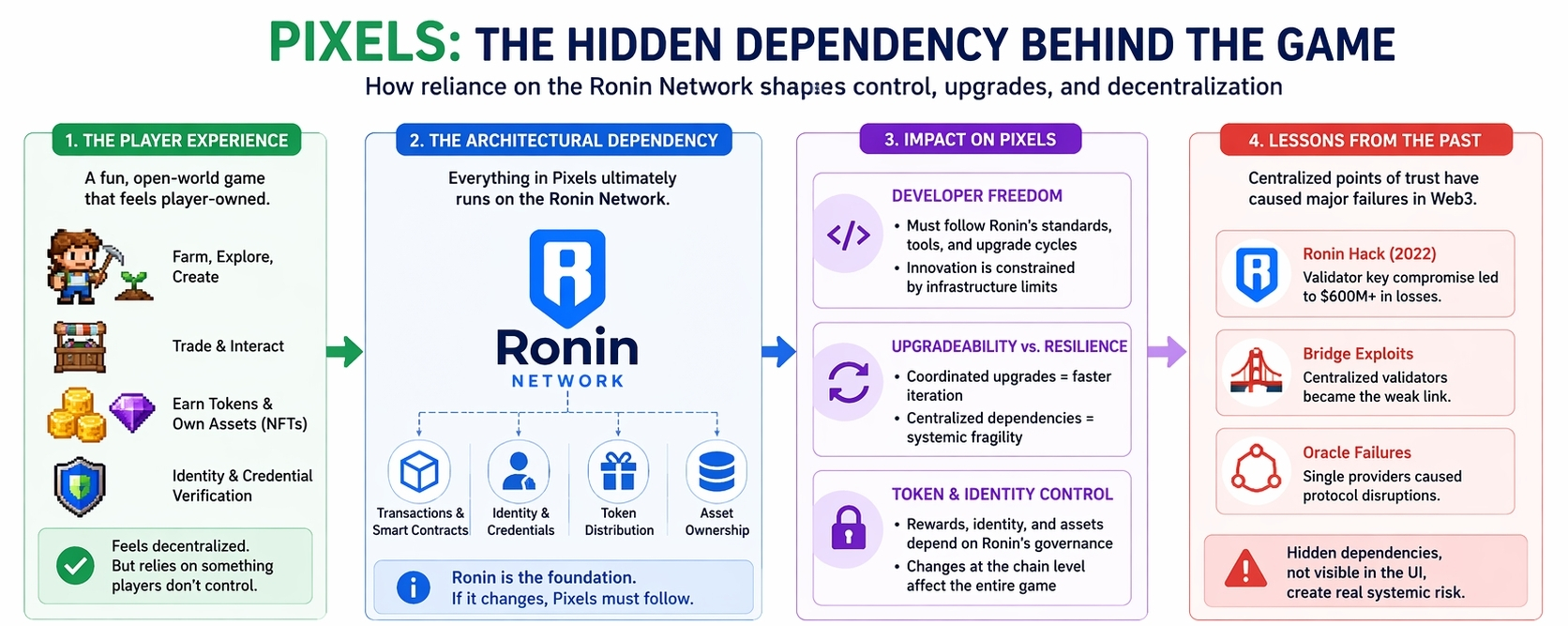
There’s something quietly beautiful about Pixels. You plant, you harvest, you explore, and somewhere along the way it starts to feel like a world that belongs to you. Not rented, not controlled—yours. That’s the promise of Web3, after all. Ownership, freedom, participation. But when you look a little closer, that feeling starts to blur, because the world you’re building in depends on something you don’t control at all: the Ronin Network.
Most players never think about it, and honestly, why would they? The game works, it’s smooth, transactions are cheap, everything feels seamless. But that smoothness comes from a very specific design choice—Pixels isn’t floating freely across a decentralized universe, it’s anchored tightly to one network. And that network has its own rules, its own structure, and its own gatekeepers. So even if your land is yours, even if your tokens are yours, they only exist as long as the system underneath keeps running the way it’s supposed to.
For the developers, this dependency is both a gift and a limitation. It gives them speed, stability, and a ready-made ecosystem. But it also quietly draws a boundary around what they can and cannot do. They’re not building in an open vacuum; they’re building inside someone else’s framework. Every deep change, every ambitious upgrade, every shift in how value flows through the game has to fit within the limits of that infrastructure. Freedom exists, but it’s shaped—sometimes invisibly—by what the underlying system allows.
And that’s where things start to feel fragile. Because history has already shown what happens when these foundations crack. The Ronin Network hack wasn’t just a technical failure, it was a reminder that even systems designed for decentralization can hinge on very centralized points of trust. When those points fail, everything built on top feels it instantly. In a game like Pixels, that doesn’t just mean downtime—it means the economy, the rewards, the sense of ownership itself can be shaken.
Pixels tries to move in the right direction. It invites players into its economy, gives them a role in shaping the world, lets them earn and participate. That matters. It creates a sense of community and shared value. But most of that influence lives on the surface. The deeper layers—the ones that decide how the system actually runs—are still out of reach. Players can suggest, engage, and adapt, but they don’t ultimately decide how the foundation evolves.
That creates a strange emotional tension. You feel like a citizen of this world, but not quite its owner. You invest time, energy, maybe even money, and yet the most important decisions exist somewhere beyond your influence. It’s not that control is completely centralized—it’s that it’s unevenly distributed. Some parts are open, others are quietly closed.
So the question lingers in the background, even if no one says it out loud: who really holds the power here? The players who bring the world to life? The developers who shape it? Or the network that everything depends on?
Maybe the honest answer is all three—but not equally. And until that balance shifts, Pixels will remain something in between: a world that feels like it belongs to its players, but still rests on a foundation they can’t fully touch, change, or walk away from.