
I keep looking at Pixels a little differently than most people seem to. A lot of the attention goes to the farming, the social layer, the world itself, or just the token price, but honestly that is not the part that stays in my head. What stays with me is the economy. More specifically, the feeling that Pixels is trying not to treat its economy like something fixed. It feels like a system that knows it has to keep adjusting while people are inside it.
To me, that matters more than people think.
I have started feeling that many game economies do not really die because rewards are too small. They die because the system becomes too easy to read. Once players figure out the most efficient loop, everything starts shrinking around that loop. People stop playing naturally and start optimizing mechanically. After that, even a busy game can feel strangely empty. It still has movement, but not much life.
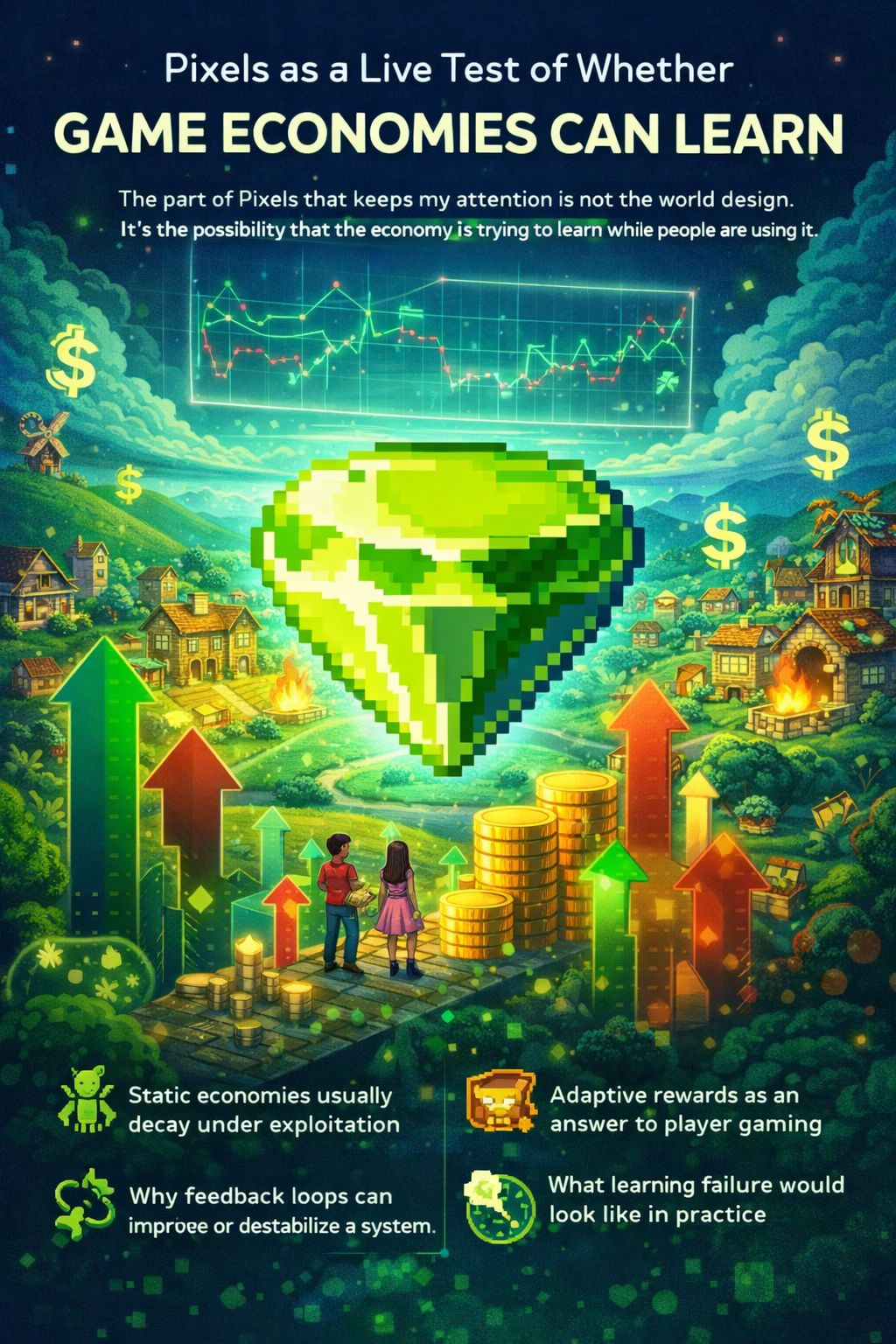
That is why my view on Pixels is a bit different. I do not really see it as just a social Web3 farming game with a token attached. I see it more as an experiment in whether a game economy can keep adapting before players turn it into something purely extractive. For me, that is the real question hanging over the project. Can the system keep learning while the players are learning too.
I think the way PIXEL is used says a lot about that. What stands out to me is that PIXEL is not framed as something needed for every normal action in the game. It sits more around upgrades, boosts, recipes, pets, land related functions, and staking linked benefits. In my opinion, that is not just a design detail. That is the project trying to be careful. It seems to be saying that not every action should become a token reward, because once that happens, players stop seeing the world and start seeing only payouts.
I also think the reputation requirement is more important than it looks. Some people may see it as friction, and I understand that reaction, but I read it differently. To me, it feels like Pixels is trying to slow down the jump from participation to extraction. It is almost saying that being active is not automatically the same as being trusted economically. I actually think that is a smart instinct, even if it annoys some users. Most crypto game economies get damaged when value becomes too easy to pull out too quickly.What makes Pixels more interesting to me now is that it seems to be leaning further into this adaptive mindset. That is why the recent Stacked direction caught my attention. I do not just see it as another reward tool. I see it as proof that Pixels understands a basic problem most tokenized games run into. Fixed incentive systems get solved by users very fast. Once that happens, the economy starts rewarding behavior that may be efficient but not actually healthy for the world. So if Pixels is trying to build something more durable, then the economy almost has to watch behavior and keep adjusting.
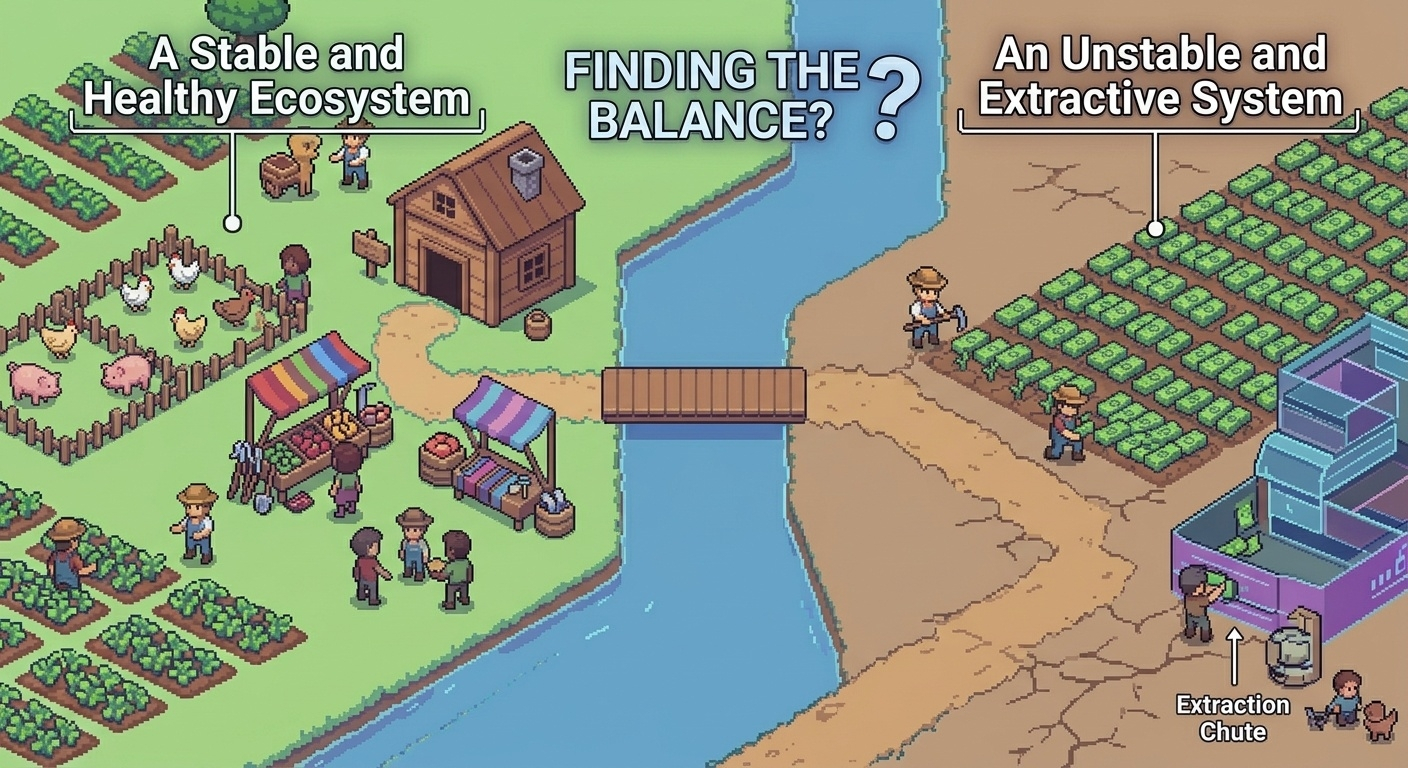
Still, I do not think that automatically makes it good. In my opinion, a learning economy can fail in a new way. It can become too reactive. If the system changes too slowly, players exploit it. If it changes too fast, people stop trusting it. And if the project starts chasing metrics too aggressively, it can end up optimizing for activity that looks impressive in numbers but feels hollow in practice.
That is probably where I land with Pixels overall. I find it interesting not because I think it has solved the problem, but because I think it is at least pointed at the right one. The hard part is not creating rewards. Plenty of projects can do that. The hard part is keeping an economy flexible without making it feel unstable or arbitrary.
So personally, when I think about Pixels, I do not really think first about farming or even the token itself. I think about whether this kind of game economy can stay alive without eventually teaching its users to drain it. That is the part I find worth watching. Not the promise of the system, but whether it can keep its balance once people really learn how to use it.