
Let’s talk about how games usually reward us. The classic formula is pretty simple: do a thing, get a thing. Complete a quest, earn some tokens. Log in three days in a row, get a bonus. The idea is that getting stuff motivates us to keep playing. But behavioral economics tells a slightly different story. Sure, we like getting things, but the thrill wears off. That first login bonus feels great, but by the hundredth time, it's just background noise. The magic fades.
Here is a wild psychological fact: humans hate losing things way more than we like getting them. Losing $10 stings about twice as much as finding $10 feels good. Game designers already use this against us, and usually, it works. Think about daily streaks. You aren’t really playing to get the reward; you’re playing because you can't stand the idea of your streak resetting to zero. The same goes for limited-time events, where the fear of missing out on an exclusive skin is way stronger than the joy of actually getting it. Even social proof plays into this—seeing your friends with better gear makes you want to catch up, mostly because being left behind is just annoying.
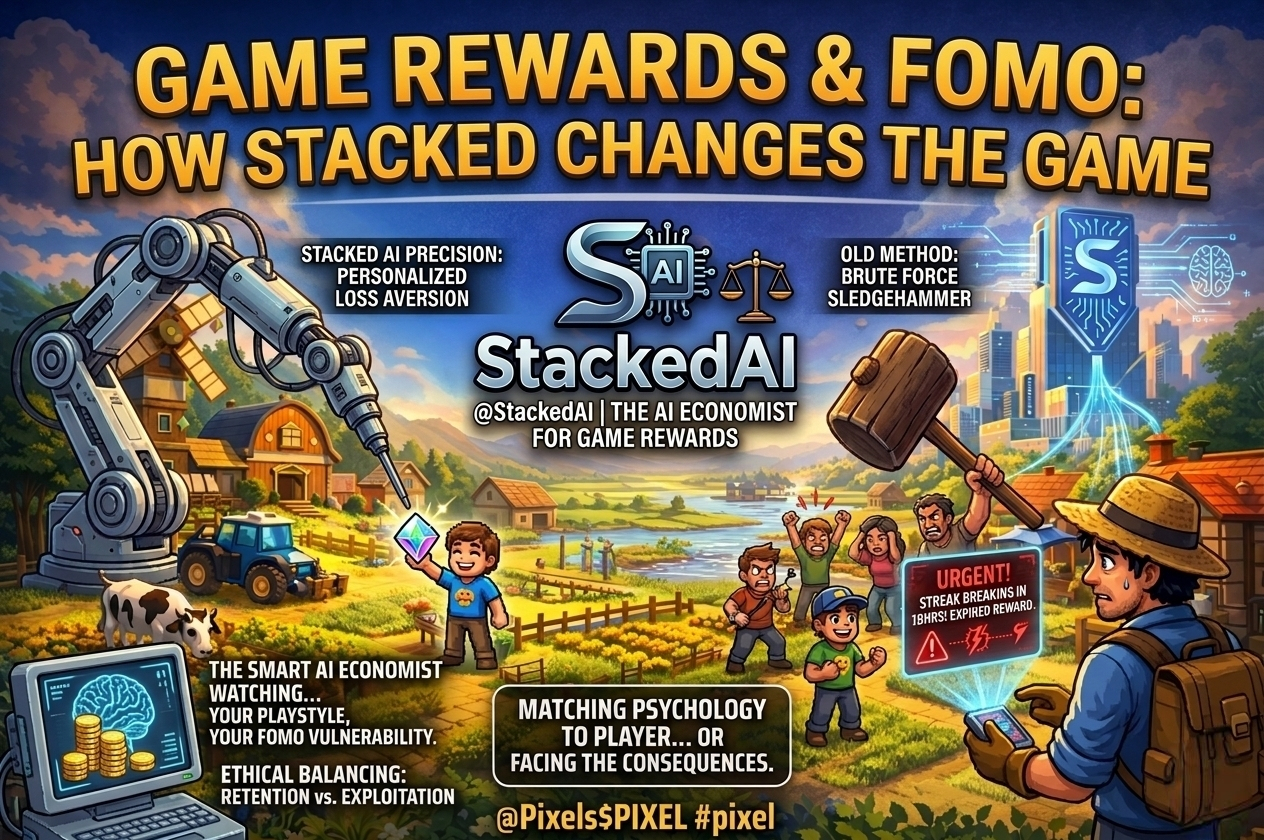
These mechanics work, but right now, they’re applied like a sledgehammer. A brutal streak mechanic might perfectly hook a highly competitive player, but it’ll just stress out a casual player until they quit entirely. This is where a platform like Stacked could be a massive game-changer. Instead of dropping these heavy-handed mechanics on everyone, imagine an AI economist that watches how you play. If it notices you’re the type of player who immediately logs back in when your streak breaks, it knows you respond to loss aversion. It can then tailor specific, expiring rewards just for you.
Precision is everything here. Imagine getting a notification that your weekly engagement bonus expires in 18 hours, and you are only one day away from finishing it. For a high-intensity player, this is the ultimate hook. But for a casual player, it just feels like unnecessary pressure. If they’re already annoyed with the game, that notification might be the reason they finally hit uninstall. The stakes are much higher with these mechanics. If a standard "gain" reward misses the mark, the player just ignores it. If a "loss" reward hits the wrong player at the wrong time, it actively ruins their experience.
We also have to talk about the ethics of this. Using psychology to make players afraid of losing their progress has always been criticized as manipulative. If Stacked’s system gets incredibly good at pinpointing exactly which players are most vulnerable to this kind of pressure, it could easily cross the line from clever game design into downright psychological exploitation. The Stacked team spent years watching how reward systems affect player behavior, and they know what happens when you attract players for the wrong reasons. The real test will be whether their design philosophy focuses on the long-term health of the player community, rather than just juicing retention numbers at any cost.
If you're a studio using Stacked, the tech is only half the battle. You can’t just hand out rewards blindly anymore. You have to match the psychology to the player. Sending a high-pressure alert to a relaxed player, or a boring standard reward to a highly competitive player, is just a waste of good AI. Ultimately, Stacked’s platform will only be as powerful as the guidance it gives studios on how to actually design these economies humanely and effectively.
