
A few weeks ago I was reviewing a Tiger Research report on Sign Protocol and stopped at a line that had nothing to do with Sign.
The report mentioned, almost in passing, that Binance AI Pro's output quality is significantly shaped by the specificity of the input. Broad questions return broad answers. Narrow questions with clear context return something closer to genuine analysis.
I read that twice. Then I went back and looked at the last twenty sessions I had run on $XAU.
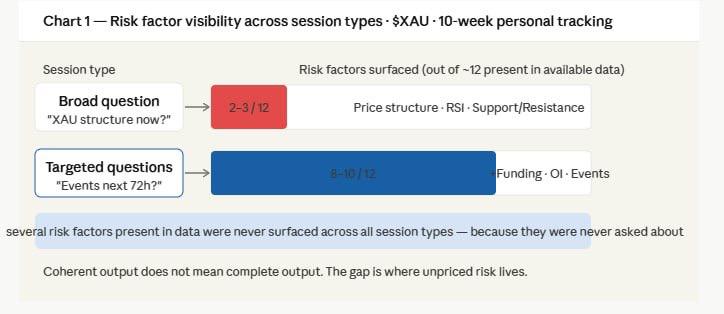
Seventeen of them had asked some version of: "what does the $Xau structure look like right now?"
That is not a narrow question. This is a request for general orientation. And what I had been getting back was general orientation — useful, coherent, but stripped of the specific risk flags that would only emerge if I had asked for them directly.
This is what I now call the unpriced risk problem. AI Pro processes available data and surfaces analysis relevant to what you asked. What it does not do is volunteer the risk factors you did not ask about. Those stay in the data, readable in principle, invisible in practice because your question did not open the door to them.
The chart below shows what this looks like in practice across 10 weeks of $Xau sessions I tracked personally.
 To understand what I mean, let me be specific about the session that changed how I run AI Pro.
I had a $XAU long position open. I asked AI Pro the usual structure question. Got back a clean response. Support holding, momentum neutral to slightly positive, no immediate technical reason to exit. I held.
The position moved against me the following day on a CPI print that I had not checked was scheduled. Not a surprise event. A scheduled data release that I had simply not looked at. The macro calendar was available. AI Pro had access to it. I had not asked about upcoming scheduled events, so the output did not mention them.
That is the unpriced risk in its clearest form. The information existed. The tool could have surfaced it. My question did not give it the opportunity.
The CPI release was not hidden. It was simply unasked for.
After that session I started cataloging the specific risk categories that a broad structure question consistently fails to surface. The list was longer than I expected. Scheduled macro events in the next 48 to 72 hours. Options market positioning — specifically whether there was significant open interest at nearby strikes that might act as a magnet or barrier for $Xau price. Funding rate direction and whether it had been drifting in a way that created structural pressure on one side. Correlation with other assets that might be moving for reasons unrelated to gold's own fundamentals but could drag price anyway. Central bank commentary scheduled for the week that had not yet been priced in.
None of those categories appeared in a standard structure question response. All of them were surfaced when I asked directly. The data was present in both cases.
The deeper issue is about what "complete" feels like. A well-written AI Pro response to a broad structure question feels thorough. It covers technical levels, momentum, and general context. It is organized. It uses clear language. It does not feel like it is missing anything.
That feeling is not a reliable indicator of completeness. It is an indicator of consistency. The output is consistent for what it was asked. Coherent and complete are not the same thing.
What I had been calling a thorough session was actually a thorough answer to a narrow question. The unpriced risks were absent not because AI Pro could not see them — but because I had not opened the door.
The five questions I now run before entering any $Xau position:
One — what macro events or data releases are scheduled in the next 72 hours that could affect $XAU?
Two — is there significant options open interest clustered near the current price that could act as a magnet or barrier?
Three — has the funding rate been drifting in one direction over the past several sessions, and what does that imply about positioning?
Four — what correlated assets — DXY, real yields, equity risk appetite — are moving in ways that could drag $XAU regardless of gold's own fundamentals?
Five — are any central bank officials scheduled to speak this week, and what is the current market sensitivity to rate commentary?
The diagram below maps each of those five categories against what a standard session misses and the exact phrasing that unlocks each one.
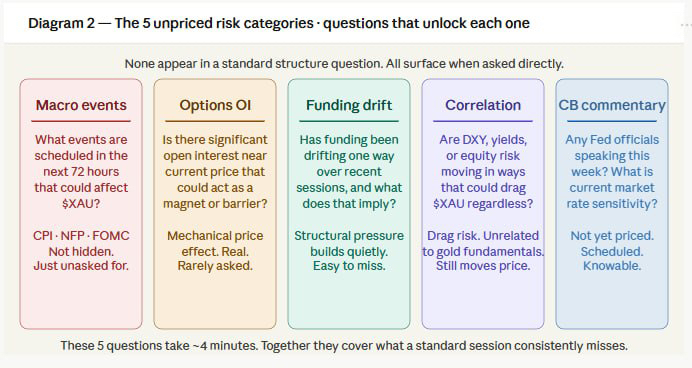
These five questions take about four minutes to run. Together they surface the category of risk that a standard session consistently misses — not because the risk is hard to find, but because the question never goes looking for it.
AI Pro does not volunteer what you do not ask for. That is not a limitation of the tool. It is the correct design for a system that should not be generating unsolicited analysis across every possible risk category on every session.
The responsibility for asking is yours. And asking the right questions — not just asking — is the skill that determines whether a session is genuinely useful or just coherent.
The CPI release that moved my position was not a surprise. It was scheduled. The data existed. The analysis was available. The session I ran that day was thorough for what I asked. What I asked was not thorough enough.
That gap — between what the tool can surface and what your question actually requests — is where most of the unpriced risk lives.
@Binance Vietnam $XAU #BinanceAIPro
Giao dịch luôn tiềm ẩn rủi ro. Các đề xuất do AI tạo ra không phải là lời khuyên tài chính. Hiệu quả hoạt động trong quá khứ không phản ánh kết quả trong tương lai. Vui lòng kiểm tra tình trạng sản phẩm có sẵn tại khu vực của bạn.