
It cannot.
A team can say the right things about community, ownership, sustainability, and long-term alignment. The deck can look clean. The roadmap can sound responsible. The mechanics can even appear balanced when explained one by one. But the economy players actually live inside is never the one described in the announcement. It is the one created by behavior after people figure out what is worth doing, what is worth repeating, and what is worth extracting.
That difference is where most projects start slipping.
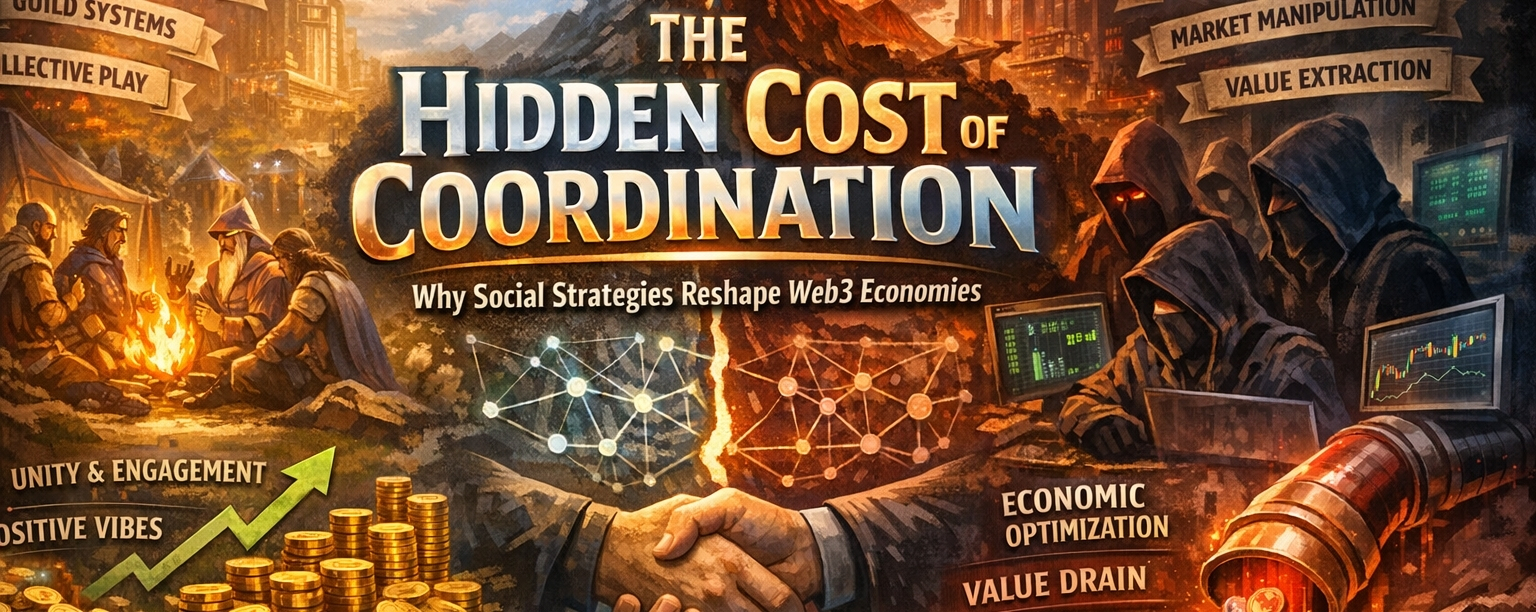
I think this is why some updates feel more important than they first appear. On the surface, a new social feature looks harmless, maybe even healthy. Guild systems, shared objectives, coordinated play, collective progression — these are the kinds of things that make a game feel less empty. They give players reasons to return beyond pure reward chasing. And honestly, that matters. A world people build together usually has a stronger emotional hold than one built around isolated grind loops.
But once a game has a token economy attached to it, social coordination stops being just a community feature.
It becomes market behavior.
That is the part people keep softening in the language. They describe cooperation as if it only improves retention. They talk about collective play as if it simply deepens engagement. Sometimes it does. But it also increases economic precision. A coordinated group does not move like a random set of individuals. It learns faster, allocates effort better, shares information more efficiently, and reacts with more discipline than a scattered player base ever could.
And that changes the stress placed on the system.
If rewards were originally balanced around individual decision-making, then organized groups can break the assumptions without technically breaking the rules. A guild does not need an exploit to outperform the economy’s expectations. It only needs structure. One group can split responsibilities, optimize routes, concentrate labor, and compress outcomes that used to be spread across many separate players making imperfect choices on their own.
That may still look healthy in the aggregate for a while. Tokens may remain staked. Activity may rise. Completion rates may improve. Retention may even look stronger. But headline numbers can be deceptive when the underlying behavior shifts from independent participation to coordinated economic action. Similar metrics do not always mean similar conditions.
That is where I get cautious.
Not because collective systems are bad. They are probably necessary if a game wants to feel alive for longer than a single reward cycle. The issue is that Web3 projects often celebrate the social upside before they fully account for the economic side effects. They introduce stronger coordination tools into systems that were already sensitive to extraction, then act surprised when the pace of value capture changes.
And this is also why I think the anti-bot conversation is usually too shallow.
Bots are easy to blame because they are visible. They create clean villains. But many game economies do not weaken because automation exists. They weaken because the incentive structure is too easy to harvest and too unattractive to commit to. Remove one farm loop and another shows up. Ban one cluster of accounts and a smarter pattern replaces it. The underlying issue is rarely just enforcement. It is that the system keeps rewarding behavior that takes more out than it puts back in.
That is a design problem before it is a moderation problem.
The projects that stand out are usually the ones that learn this the hard way, in public, while the game is live. Not in theory. Not in a polished diagram. In production, where every reward path is tested by real people with real patience and very little sentimentality. Players are incredibly good at discovering what a system truly values. Better than most teams, honestly.
So when a Web3 game adds new social layers, new reward structures, or new coordination mechanics, the real question is not whether the feature sounds good. Usually it does. The real question is whether the economy underneath has been recalibrated for the kind of behavior that feature will unlock.
Because that is where things become real.
Not in the promise of community.
In what community, once organized, is actually able to do.