
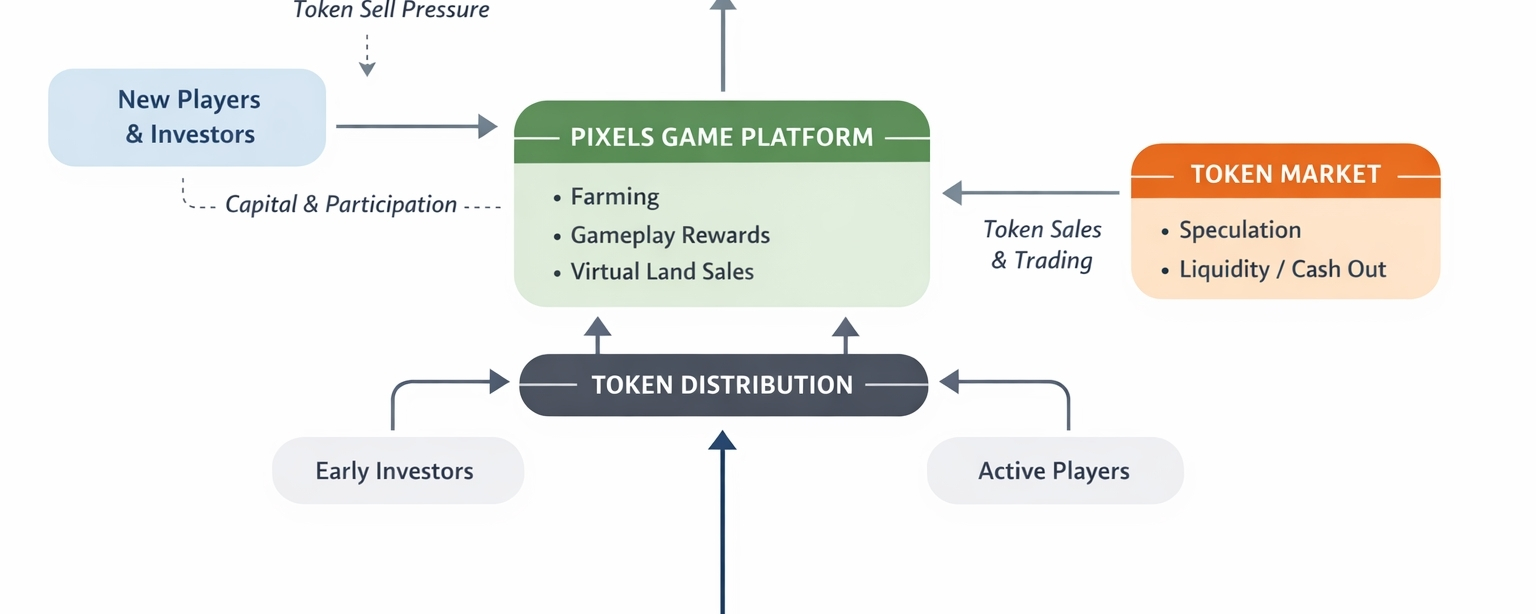
Start With the Truth: This Isn’t a Game, It’s a Financial System
Let’s drop the pretense early. Pixels is not a casual farming game with a token attached. It is a token system dressed up as a casual farming game.
The order matters. It always does.
You can wrap it in soft visuals and low-stakes gameplay, but the moment you introduce a tradable asset with speculative value, the centre of gravity shifts. The game becomes secondary. The economy takes over.
I’ve watched this play out too many times to take the aesthetic seriously. The prettier the interface, the more cautious you should be.
Ronin’s Clean-Up Job Disguised as Innovation
Pixels sits on Ronin, a blockchain still carrying the stain of one of crypto’s most spectacular failures. Billions lost. Trust evaporated.
Now we’re told this is a fresh chapter. A new ecosystem. A revival.
No. It’s a rebuild financed by user activity.
Ronin doesn’t just need games. It needs credibility. Pixels provides a narrative that attracts users, activity and, crucially, liquidity back into the system.
That’s the real function here.
Players aren’t just playing. They’re underwriting a recovery story they didn’t sign up for.
Follow the Incentives, Not the Story
The marketing leans on community, creativity, ownership. It’s familiar language. It’s also a distraction.
What matters is who benefits when the system grows.
Early investors hold the advantage. They always do. Tokens are allocated before the public arrives. Prices are low. Risk is limited. Upside is asymmetric.
Then the wider player base enters. They provide time, engagement and, often, capital. In return, they receive rewards that look like earnings but behave like emissions.
This isn’t wealth creation. It’s a transfer mechanism.
And it flows in one direction.
The Old Play-to-Earn Problem, Repackaged
We’re told this is not the crude “play-to-earn” model of the past. It’s more balanced. More sustainable.
That’s the claim. The structure says otherwise.
Rewards are still tied, directly or indirectly, to token value. Token value still depends on demand. Demand still depends on new entrants.
Nothing fundamental has changed.
When growth slows—and it always does—the system tightens. Rewards diminish. Participation drops. The feedback loop reverses.
This isn’t a design flaw. It’s the design.
Virtual Land: Speculation Wearing Work Boots
Pixels leans heavily on ownership. Land is positioned as progress, as permanence, as something worth building towards.
Look closer. It behaves like a speculative asset.
Early buyers accumulate. Prices rise on expectation, not utility. Late buyers justify the valuation by buying in anyway.
It starts to resemble property speculation more than gameplay.
And once that shift happens, the logic of the system changes. Players stop thinking about fun. They start thinking about returns.
That’s when games lose their footing.
The “Community” That Needs the Price to Hold
Spend time around the Pixels ecosystem and you’ll find energy. Enthusiasm. Constant activity.
But it isn’t neutral.
When participation is financially incentivised, engagement is no longer a pure signal. It’s shaped by self-interest. Optimism becomes a necessity, not a conclusion.
Dissent is bad for price. Price is central to everything.
So the tone stays bullish. It has to.
Call it a community if you like. But it behaves like a market defending itself.
The Exit Door Is Narrower Than It Looks
Every participant eventually faces the same question: can you turn this into something real?
On paper, yes. In practice, it depends on timing.
Liquidity is abundant when sentiment is strong. It evaporates when sentiment turns. That’s when the structure is exposed.
Everyone cannot exit at once. In fact, most won’t.
The system rewards those who arrive early and leave early. Everyone else provides the bridge between those two points.
That’s not accidental.
The Casual Player Is an Afterthought
Pixels talks about accessibility. A game anyone can pick up.
But the underlying system quietly selects for something else.
Understanding token flows. Managing assets. Timing decisions. These are not casual behaviours. They’re financial ones.
The so-called casual player enters at a disadvantage. They engage for fun, while others optimise for return.
One group is playing a game. The other is running a strategy.
Only one of them consistently wins.
Regulation Will Not Ignore This Forever
There is a line between entertainment and financial product. Pixels sits directly on it.
Tokens with market value. Systems that reward participation with economic upside. Assets that can be traded and accumulated.
These are not trivial features.
Regulators have been slow to act, but not indefinitely so. When they do, projects like this will face a simple question: are you a game, or are you something else?
The answer will not be decided by branding.
We’ve Watched This Cycle Already
The industry likes to pretend each iteration is different. More refined. More resilient.
It isn’t.
The surfaces improve. The mechanics become subtler. The language becomes more careful.
But the core dependency remains: growth sustains the system. Without it, the structure contracts.
That is the pattern. It has not been broken.
Pixels does not escape it. It depends on it.
Take Away the Token, See What Survives
There’s a simple test that cuts through the noise.
Remove the financial incentives. Strip out the token rewards. Leave only the game.
Does it hold attention? Does it retain players? Does it justify the time on its own merits?
If not, then the answer is clear.
The game was never the point.
The Real Function of Pixels
Pixels is not trying to become a better game. It is trying to become a more durable economic loop.
That’s why the design feels familiar. Because it is.
It channels participation into a system that requires constant inflow. It distributes rewards in a way that sustains engagement. It relies on belief to maintain value.
And it does all of this under the cover of something that looks harmless.
That’s the clever part.
It doesn’t need to deceive. It just needs you not to look too closely.
The Inevitable Outcome
Systems like this don’t collapse because they are poorly built. They unravel because their incentives cannot hold once expansion slows.
That moment always arrives.
When it does, the language of community fades. The focus returns to price. The exits become urgent.
And the hierarchy becomes obvious.
Pixels will not fail suddenly. It will tighten. Gradually. Then visibly.
By the time most participants recognise it, the advantage will already have shifted.
It always does.
And it never shifts in their favour.
