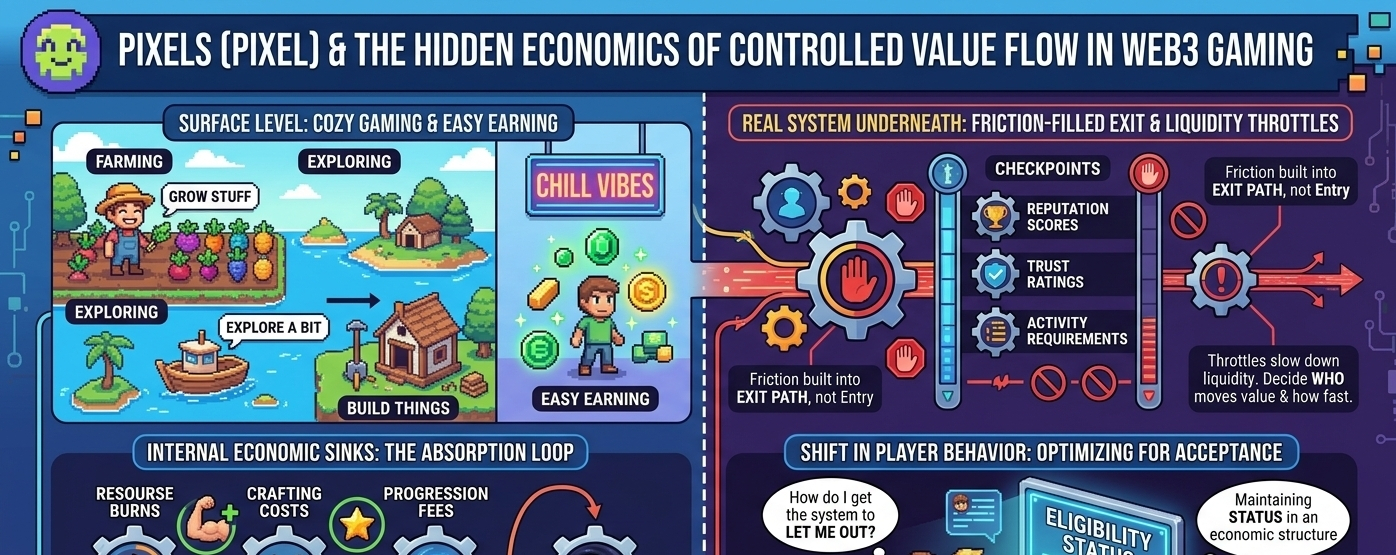
Pixels (PIXEL) runs on the Ronin Network, and on paper it looks like just another cozy Web3 farming game. You know the type—grow stuff, explore a bit, build things, hang out. Chill vibes.
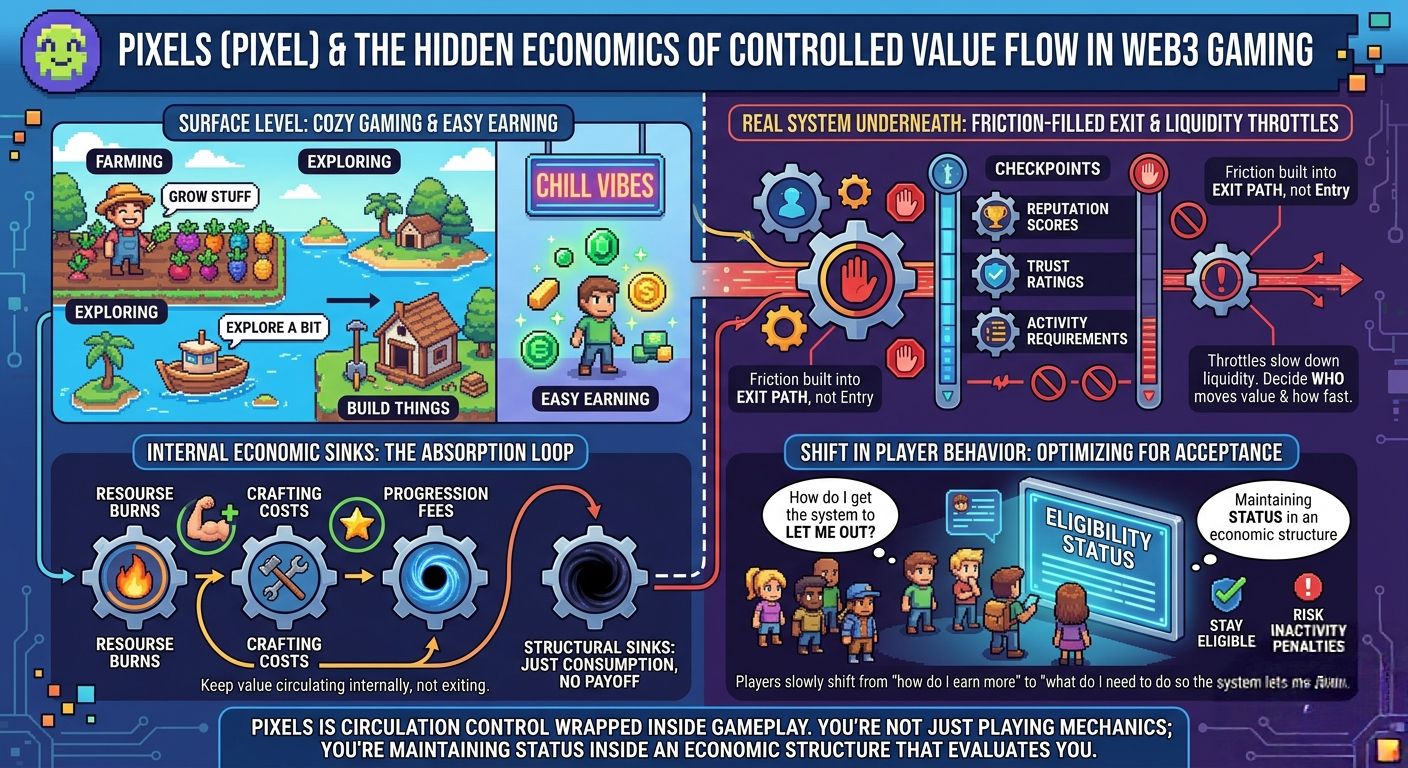
But honestly, that surface layer only tells you half the story. Maybe less.
Because the real system underneath isn’t just about farming or exploration. It’s about how value moves… and more importantly, how it doesn’t move.
Let’s start with the obvious tension nobody can really ignore once they notice it: earning inside the game feels simple, almost natural. You do tasks, you accumulate resources, you progress. Easy.
But the moment you try to translate that into actual withdrawable value outside the game? Things slow down. Sometimes a lot.
And yeah, that’s not a bug. That’s the design.
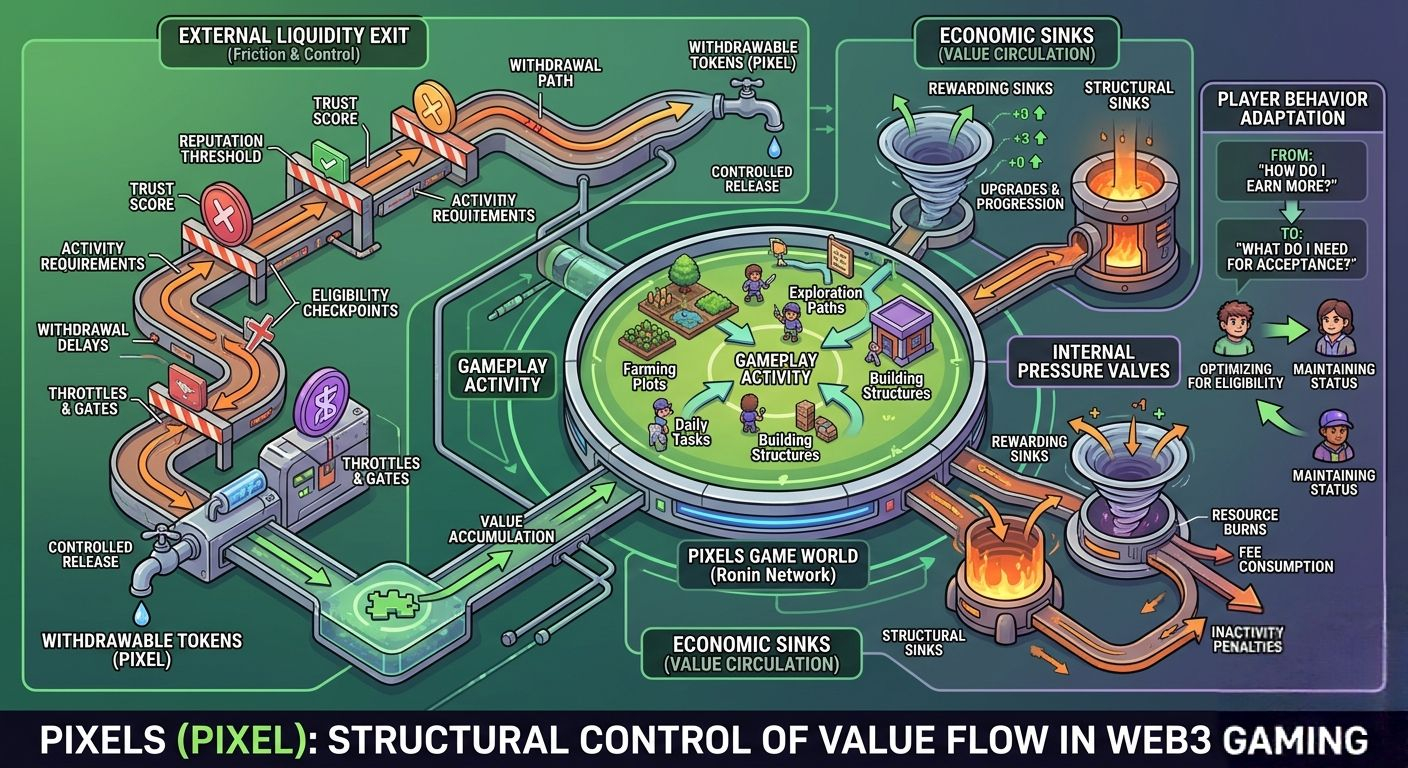
Here’s the thing—if every bit of in-game value could instantly flow out into external liquidity, the whole system would fall apart. Fast. So Pixels (like most Web3 economies that want to survive more than a minute) builds friction into the exit path.
Not entry. Exit.
That distinction matters more than people think.
So what you get is this weird gap between “I earned this” and “I can actually take this out.” And that gap… it changes how players think. Quietly. Over time.
Now look at the so-called “checkpoints” in the system—reputation, trust scores, activity requirements, whatever label you want to use.
Let’s be real here. These don’t just function as safety features. They behave like throttles.
They slow down liquidity. They decide who moves value out and who doesn’t. Or at least, who moves it fast versus who waits.
And once you see that, you can’t unsee it.
I’ve seen this pattern before in other Web3 games too. It always shows up under different names, but the behavior stays the same. Gate first. Then release.
Now the interesting part isn’t even the gates themselves—it’s how players adapt to them.
People stop just playing. They start optimizing for acceptance.
Sounds weird, right? But that’s exactly what happens.
Instead of asking “how do I earn more,” players slowly shift toward “what do I need to do so the system lets me out?”
That shift is subtle, but it’s everything.
Meanwhile, inside the game, you’ve got these economic sinks running constantly. Crafting, upgrades, resource burns, progression costs—you name it.
Some of them feel rewarding. You upgrade something, you feel stronger. Fine.
But others? They just eat resources. No real payoff. Just consumption.
And yeah, that’s intentional. Those sinks don’t exist for fun. They exist to keep value circulating internally instead of piling up and rushing toward the exit.
It’s like a pressure valve system. Without it, inflation hits hard. Too fast. Game breaks.
But here’s where things get tricky—players don’t always see the difference between “useful sink” and “structural sink.” They just see progression systems. They assume it’s all part of gameplay.
It’s not. Not entirely.
And once you combine sinks with withdrawal friction, you get a loop where value constantly moves—but almost never cleanly exits.
It circulates. It gets redirected. It gets absorbed.
Clean exits? Rare. Controlled. Conditional.
And over time, this does something interesting to player behavior.
People start changing how they play—not for fun, not even purely for profit—but just to stay “eligible.”
That word matters more than it should.
Eligible for what? Exit. Liquidity. Trust.
Call it what you want.
And that’s the quiet shift nobody really talks about enough.
At that point, the game stops feeling like a game in the traditional sense. It becomes more like a system you have to stay aligned with. You’re not just playing mechanics anymore—you’re maintaining status inside an economic structure that constantly evaluates you.
Sounds heavy, but it plays out in small decisions. Everyday stuff. Upgrade now or wait. Spend here or hold. Grind more or risk inactivity penalties. Tiny choices, stacked over time.
And yeah, the system doesn’t need to force anything directly. It just sets the boundaries and lets behavior sort itself out.
Honestly, that’s the clever part.
You still feel like you’re choosing freely. But your “best option” always sits inside the same narrow corridor.
Look, I’m not saying this is unique to Pixels. It isn’t. I’ve seen this pattern across a lot of Web3 games built around tokenized economies.
But Pixels makes it pretty clear once you zoom out a bit.
It’s not just farming and exploration.
It’s circulation control wrapped inside gameplay.
And once you notice that, you start playing differently… even if you pretend you don’t.