
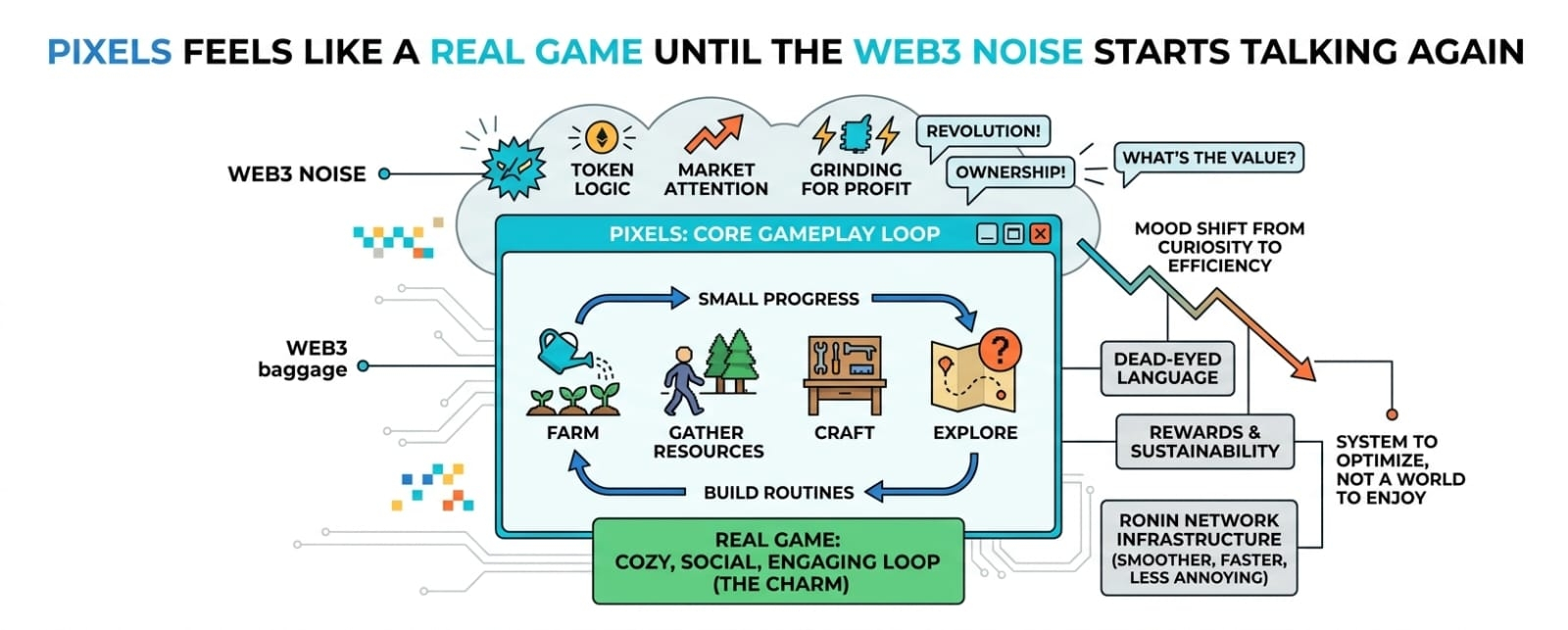
The problem with Pixels is not that it is empty. That would be easier. The real problem is that there is actually something decent here, and that makes all the extra Web3 baggage feel even more annoying. If the game was bad from top to bottom, nobody would care. You would look at it once, shrug, and move on. But Pixels has that dangerous thing a lot of crypto games never manage to build. It has a loop. A real one. A loop that pulls you in quietly, without needing to scream about revolution, ownership, or whatever else people in this space keep throwing around when they do not know how to explain why a game matters.
At its core, Pixels is simple in a way that helps it. You farm. You walk around. You gather resources. You craft. You explore. You do little tasks, build routines, and slowly settle into the world. That sounds basic because it is basic, and honestly that is one of the smartest things about it. Games do not always need some giant trick. Sometimes they just need a rhythm that feels good enough to repeat. Pixels gets that. The farming loop is familiar, almost stubbornly familiar, and that works in its favor because familiarity is underrated. People already know why they like this kind of game. It is the same reason farming and life-sim games keep surviving every trend. Small progress feels good. Tiny rituals feel good. Logging in, doing your rounds, seeing your effort pile up a little more than yesterday, all of that still works because people are still people.
And that is the weird part. Under all the Web3 branding, Pixels sometimes feels like it understands normal human habits better than a lot of bigger, louder projects do. It knows that not every player wants chaos. Not every player wants some complicated economic lecture disguised as gameplay. Sometimes people just want a place to spend time. A place where the actions make sense, the world feels active, and the next step is always clear enough that you do not have to fight the game just to stay in it. That kind of design should not be rare, but in Web3 gaming it somehow still is.
The Ronin Network helps a lot with that, even if people do not always frame it that way. Good infrastructure is boring until it is bad, and then it becomes the only thing you can think about. If a game is slow, clunky, expensive to interact with, or constantly tripping over its own blockchain setup, players feel it immediately. Ronin makes Pixels smoother. Faster. Less annoying. That matters more than the hype people usually attach to chain talk. Most players do not care what chain a game is on. They care if the game feels easy to enter and easy to stay in. Ronin helps Pixels feel more like a normal game and less like a wallet tutorial wearing a costume, which is probably one of the biggest compliments you can give a Web3 title right now.
Still, the problem never fully goes away. That problem being the same old crypto layer that hangs over everything like a cloud that never really moves. No matter how charming the world is, no matter how decent the loop feels, once a game gets tied to token logic and market attention, the atmosphere changes. People stop just playing. Some start calculating. Some start grinding with a different kind of hunger. The mood shifts from curiosity to efficiency. That is where Web3 games often damage themselves. Not always in some dramatic way. Sometimes it is subtle. A slow change in how people talk about the game, what they expect from it, what they want from updates, what counts as success. Suddenly the discussion is not just about whether the game feels good. It becomes about rewards, sustainability, token pressure, value, retention, and all the dead-eyed language that can drain the life out of something that should feel a bit more alive.
Pixels lives right in the middle of that tension. It wants to be this cozy, social, open-world farming experience where people build routines and enjoy the pace of it, but it also exists in a corner of gaming where money never stays fully in the background. That is hard to manage. Really hard. A cozy game should let you relax. It should let you waste time in the good way, where you wander a little too long, gather stuff you do not urgently need, and enjoy progress that is small but satisfying. But once financial logic gets too close to the surface, people start treating that same loop differently. Less like a world to enjoy. More like a system to optimize. That does not always ruin the game, but it changes its temperature. Makes it colder.
And yet I still think Pixels matters, mostly because it proves that Web3 games do not always fail because the game part is hopeless. Sometimes the game part is actually fine. Sometimes even good. Sometimes the problem is that the crypto layer keeps pulling attention in the wrong direction, like a constant reminder that nobody in this space knows how to just let a game breathe. Pixels is strongest when it lets the farming, exploration, and creation speak for themselves. It is weakest when the Web3 side starts demanding to be the main character again.
That is probably why I keep coming back to it in my head. Not because I think it solves Web3 gaming, because it does not. Not because it proves the future of gaming is on-chain, because that still feels like a massive reach. But because it shows there is at least a version of this idea that can work when the actual game is allowed to matter. Pixels is not perfect. It carries the same baggage as the rest of the space. But there is a real game under the noise, and in Web3 gaming that alone still feels stranger, and more valuable, than it should.
