
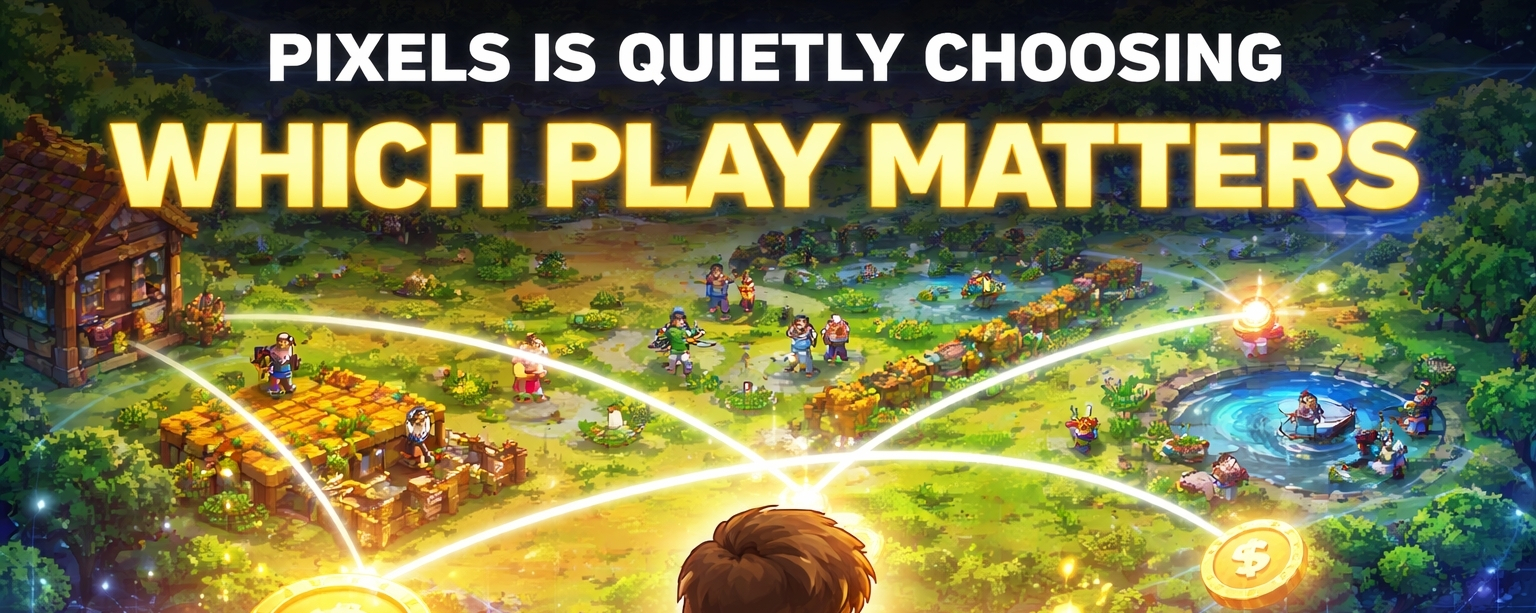
I didn’t notice the shift right away. Pixels felt almost indifferent at first. You could log in, move around, farm, explore—nothing pushed back, nothing rushed you. It gave the impression that how you played didn’t really matter.
But after spending more time watching different players, that feeling started to crack a little. Some players weren’t just progressing—they were ending up in better positions without doing anything obviously “more.” Not faster, not harder. Just… differently.
That’s where it started to feel less like a typical game economy.
Most GameFi systems I’ve seen treat activity as the main signal. The more you grind, the more you earn. It’s clean, measurable, and usually short-lived. Once players realize every action is valued equally, they stop asking what’s meaningful and start asking what’s easiest to repeat. That’s how systems get drained.
Pixels doesn’t seem fully aligned with that logic anymore. There’s a quiet unevenness to it. Some loops feel like they open doors over time. Others stay flat, no matter how consistently you repeat them. It’s hard to point to directly, but you can feel it if you stay long enough.
It reminds me of how platforms like TikTok or YouTube behave. Not everything grows just because it exists. The system amplifies certain patterns, and people slowly adjust, even without clear instructions.
In that sense, $PIXEL doesn’t feel like a simple reward token anymore. It feels closer to a signal—something that reflects which behaviors the system is willing to carry forward.
What I’m still unsure about is where that leads. If players start chasing signals instead of playing naturally, do they eventually understand the system… or just learn how to bend it again?