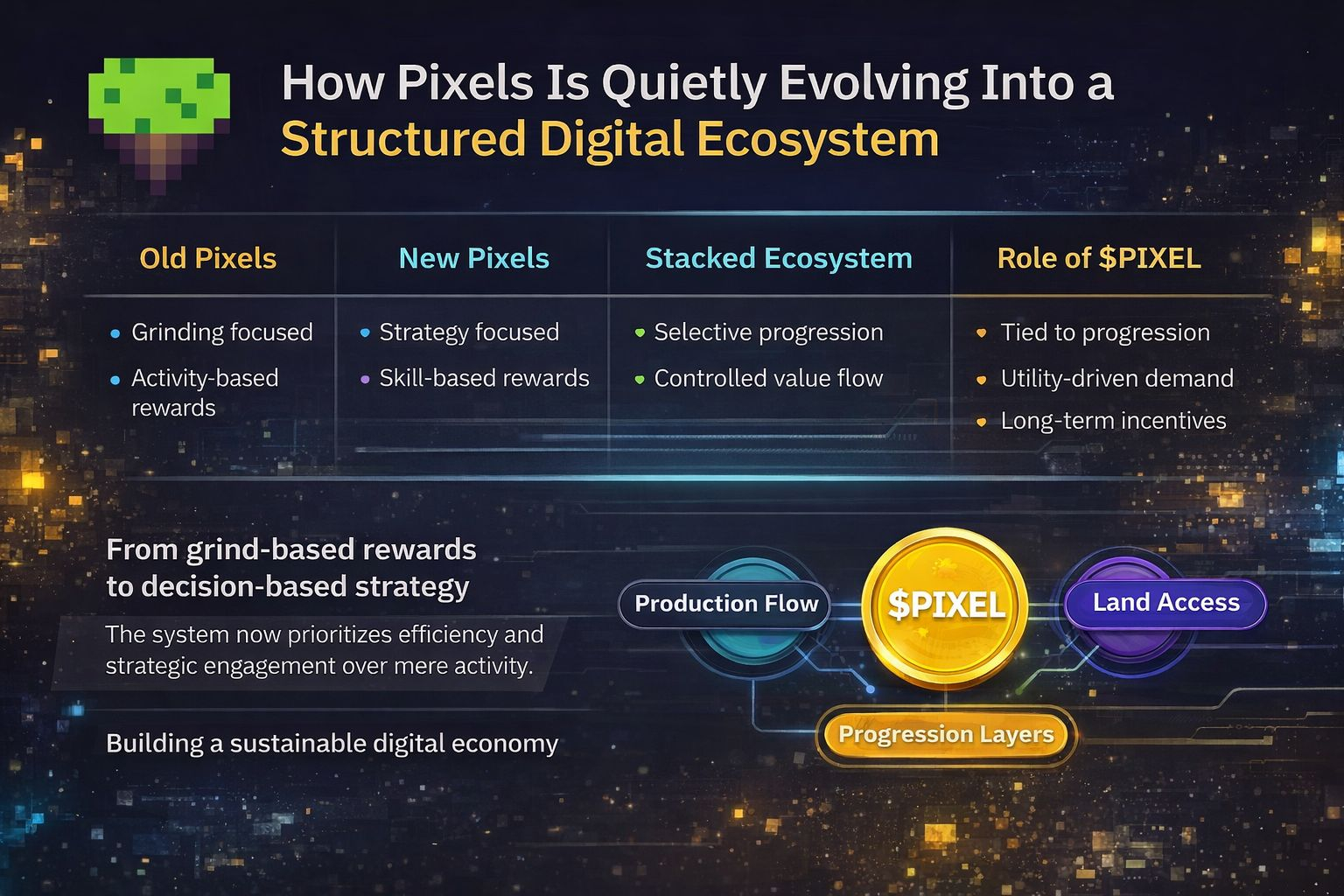
When most people look at @Pixels today, they still see what it used to be known for. A simple farming loop. Plant, harvest, trade, repeat. On the surface, nothing looks too complicated. And that’s exactly why many are missing what’s actually changing underneath.
Because Pixels isn’t just improving as a game. It’s restructuring itself as an economy.
And that shift is happening slowly, without noise, without hype, but very deliberately.
The Difference Between Activity and Value
In most Web3 games, activity equals rewards. The more you play, the more you earn. Sounds fair in theory, but in practice it usually breaks the system.
Players optimize for extraction, not participation.
Bots come in. Farmers scale aggressively. Rewards inflate. Token value struggles to hold. And eventually, the system weakens.
Pixels is moving away from that model.
Now, it’s not just about how much you play, but how you play.
Consistency matters. Efficiency matters. Positioning inside the game matters.
This changes everything.
Because once rewards start aligning with behavior instead of raw activity, the entire economy becomes more selective. Not everyone scales the same way anymore. And that’s exactly what prevents uncontrolled inflation.
Stacked: The Layer Most People Underestimate
A big part of this shift comes from the Stacked ecosystem.
At first glance, Stacked might look like a reward system. Play games, complete tasks, earn rewards. Simple enough.
But underneath, it’s doing something much more important.
It’s deciding distribution.
Who gets rewarded. When they get rewarded. And why they get rewarded.
This is something most Web3 systems never solved properly.
Instead of running a constant reward faucet, Stacked acts more like a controlled flow system. It observes player behavior across time. It identifies patterns. It prioritizes engagement that actually contributes to the ecosystem.
That means rewards aren’t just handed out randomly anymore. They’re becoming targeted.
And when rewards become targeted, they stop being inflationary and start becoming strategic.
From Grinding to Decision Making
This is where gameplay starts to feel different.
Before, you could grind endlessly and still get similar outcomes to everyone else. Effort didn’t always translate into advantage.
Now, the gap is widening.
Players who understand production cycles, land usage, and timing are starting to perform better than those who just repeat actions without thinking.
That’s a big transition.
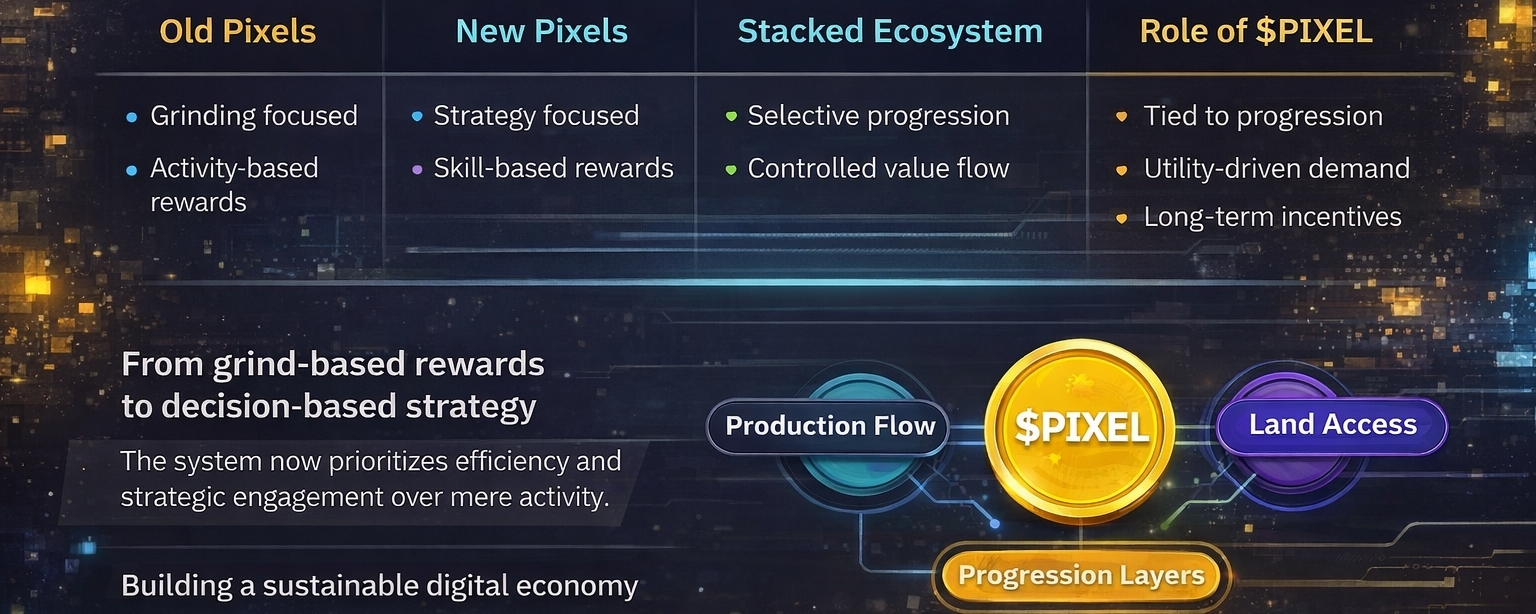
Pixels is moving from a grind-based loop to a decision-based system.
You’re no longer just playing. You’re planning.
Which resources to focus on. When to produce. Where to operate. How to position yourself within the economy.
That layer of thinking is what turns a game into a system.
The Role of pixel Is Becoming Clearer
Early on, many people saw pixel as just another reward token.
Earn it, trade it, move on.
But that view doesn’t fully capture its role anymore.
Pixel is increasingly tied to progression, access, and long-term participation.
It connects players to deeper parts of the ecosystem.
Access to certain mechanics. Upgrades and advanced features. Participation in higher-level systems.
This creates a different kind of demand.
Not hype-driven demand. Not speculation-driven demand.
But utility-driven demand.
And utility tends to be more stable over time.
Because it’s tied to actual usage, not just narrative.
Tier Expansion and Controlled Growth
With the introduction of higher-tier systems, especially Tier 5 industries, Pixels is adding another layer of structure.
Production is no longer unlimited.
Access is controlled. Capacity is limited. And positioning matters more than ever.
Only certain lands can host advanced industries. Slots need to be unlocked. And maintaining those slots requires ongoing effort.
This introduces friction into the system.
And while friction sounds negative, in economic design, it’s actually necessary.
It prevents oversupply. It creates competition. It forces players to make decisions instead of doing everything at once.
That’s how value stabilizes.
A Living Economy, Not a Static Game
One of the most interesting things about Pixels right now is how alive it feels.
Not just in terms of players being active, but in how the system behaves.
Markets move. Resources fluctuate. Strategies evolve.
Nothing feels fixed.
And that’s important.
Because a real economy is never static.
It adapts based on behavior.
Pixels is starting to reflect that.
Instead of being a predictable loop, it’s becoming something players have to continuously understand and adjust to.
Why This Approach Matters Long-Term
Most Web3 games fail for the same reason.
They focus too much on rewards and not enough on sustainability.
They attract players quickly. They distribute value aggressively. And then they struggle to maintain balance.
Pixels is trying a different path.
Slower growth. More control. Better alignment between player behavior and rewards.
It’s not as flashy.
But it’s more durable.
And in the long run, durability matters more than speed.
The Quiet Shift Most People Haven’t Noticed Yet
If you only glance at Pixels, it might still look simple.
But if you spend time inside the system, you start noticing patterns.
Rewards feel different. Progression feels more intentional. Decisions carry more weight.
That’s not accidental.
It’s design.
And it’s pointing toward something bigger.
Pixels is no longer just experimenting with play-to-earn mechanics.
It’s building a structured digital economy where participation, strategy, and consistency shape outcomes.
That’s a much harder thing to build.
But if it works, it changes everything.
Final Thought
Right now, Pixels isn’t trying to prove itself loudly.
It’s doing something more subtle.
It’s refining how value flows.
And that’s why many people still haven’t fully understood where it’s heading.
But the ones paying attention can already see it.
This isn’t just a farming game anymore.
It’s a system that’s slowly learning how to sustain itself.
And in Web3, that might be the most important upgrade of all.