
If you knew your decentralized "bank" was being drained by state-sponsored hackers, would you be the first to pull your funds, or the one left holding the bag?
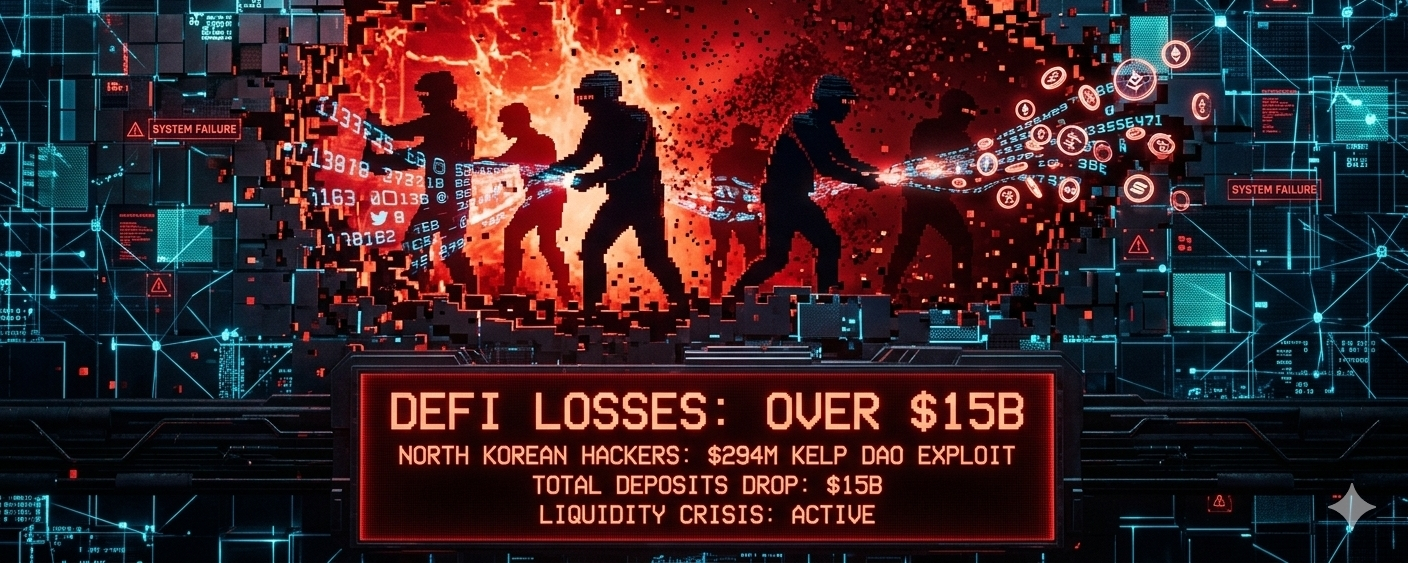
The decentralized finance landscape has entered a state of emergency as North Korean-linked hacking groups escalate their digital offensive, contributing to a staggering $15 billion drop in total DeFi deposits this year. The latest and most devastating blow came from a massive $294 million exploit on Kelp DAO’s cross-chain bridge, an event that has transformed from a single protocol failure into a systemic contagion. This wave of state-sponsored theft is no longer just about individual losses; it is actively hollowing out the liquidity of the entire ecosystem, forcing investors to pull their capital in a massive "flight to safety" that has shrunk the market’s total value by billions in just a few months.
The fallout from the Kelp DAO breach has been particularly brutal for lending giants like Aave. Because the exploited rsETH tokens were widely used as collateral, their sudden devaluation created a "bad debt" crisis that paralyzed the platform. Panicked users rushed to withdraw their assets, causing Ethereum utilization to hit a 100% breaking point and leaving many depositors unable to access their funds. This liquidity trap is a direct result of the "Lego-like" nature of DeFi; when a foundation-level asset like rsETH is compromised by sophisticated state actors, every protocol built on top of it begins to lean toward collapse.
In response to this $15 billion contraction, the industry is entering a defensive crouch. Major protocols including Lido and Morpho have taken the unprecedented step of suspending cross-chain functions and freezing affected markets to prevent further bleeding. Security experts warn that these North Korean-led attacks have evolved far beyond simple code exploits, now utilizing complex social engineering and private key compromises that traditional audits cannot easily detect. As the sector grapples with these persistent security challenges, the central question for investors is whether the rewards of DeFi still outweigh the risk of being targeted by the world’s most disciplined cyber-armies.
Do you think DeFi can ever truly be secure as long as it remains an open, permissionless target for state-sponsored hackers?