
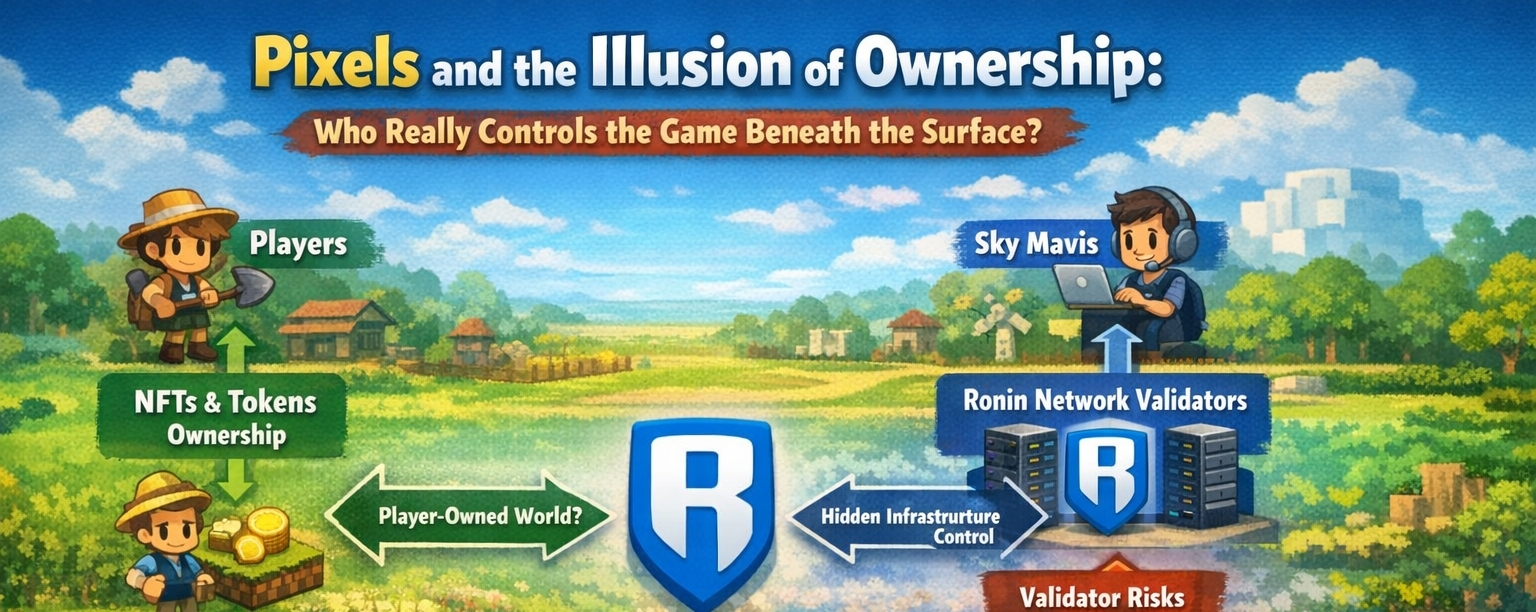
There’s something quietly beautiful about Pixels. You plant crops, explore land, build routines—it feels calm, almost personal. And because it’s built on Web3 ideas, there’s this deeper promise underneath it all: that this world belongs to the players, not just the creators. That what you earn, you keep. That what you build, you own.
But that feeling starts to shift when you follow the threads a little deeper.
Pixels doesn’t exist on its own. It runs on the Ronin Network, a system designed to make blockchain games faster and cheaper. And it works—really well. Transactions are smooth, gameplay isn’t interrupted, and everything feels seamless. But that smoothness comes from a structure that’s more controlled than it appears.
Ronin isn’t fully open in the way people often imagine when they hear “decentralized.” It relies on a smaller group of validators, many of which have been closely tied to Sky Mavis. These validators aren’t just background infrastructure—they’re the ones deciding what transactions go through, what becomes permanent, what counts as real. So even though you’re farming, trading, and building freely, all of it is still passing through a system that a limited group ultimately oversees.
That doesn’t mean Pixels is fake or misleading. It just means the freedom it offers has edges.
In some ways, this setup helps the game. Developers can respond quickly, fix problems, adjust the economy, and keep things running smoothly. You don’t get stuck waiting for slow, global consensus like on bigger chains such as Ethereum. But that speed comes from coordination behind the scenes, not from pure decentralization. Someone still has to make the call.
And when everything is working, you don’t notice that. You just play.
It’s only when you look at moments where things break that the structure becomes visible. The Ronin Network hack showed how much power sits in those hidden layers. Attackers didn’t need to touch the game—they only needed control over enough validators. Once they had that, the system itself bent. It wasn’t about farming or tokens anymore. It was about who had the keys to the foundation.
That pattern isn’t new. Back in the The DAO hack, even one of the most decentralized ecosystems had to rely on human decisions to resolve a crisis. Code mattered, but people decided the outcome. Power, in the end, gathered somewhere.
Pixels lives in that same tension.
You can own land, earn tokens, build your identity inside the game. But there are still questions sitting underneath all of it. Who controls the contracts if they need to change? Who decides if the economy gets rebalanced? What happens if the rules shift overnight? Ownership exists, but it depends on systems that can still be adjusted.
Even governance, when it exists, can feel like it stops just short of real authority. Players might have a voice, but not always the final say. And that gap—between being heard and being in control—is easy to ignore when the experience feels good.
Maybe that’s the most honest way to understand Pixels. It’s not fully centralized, and it’s not fully decentralized. It sits somewhere in between, offering a version of ownership that’s real, but not absolute. A world that invites you in, gives you tools, lets you grow—but still holds onto something essential at its core.
So the question isn’t whether Pixels is decentralized or not. It’s something quieter, and harder to answer.
If the world feels like it belongs to the players, but the foundation is still held by a few… then when the future of that world is decided, whose voice actually carries the most weight?