
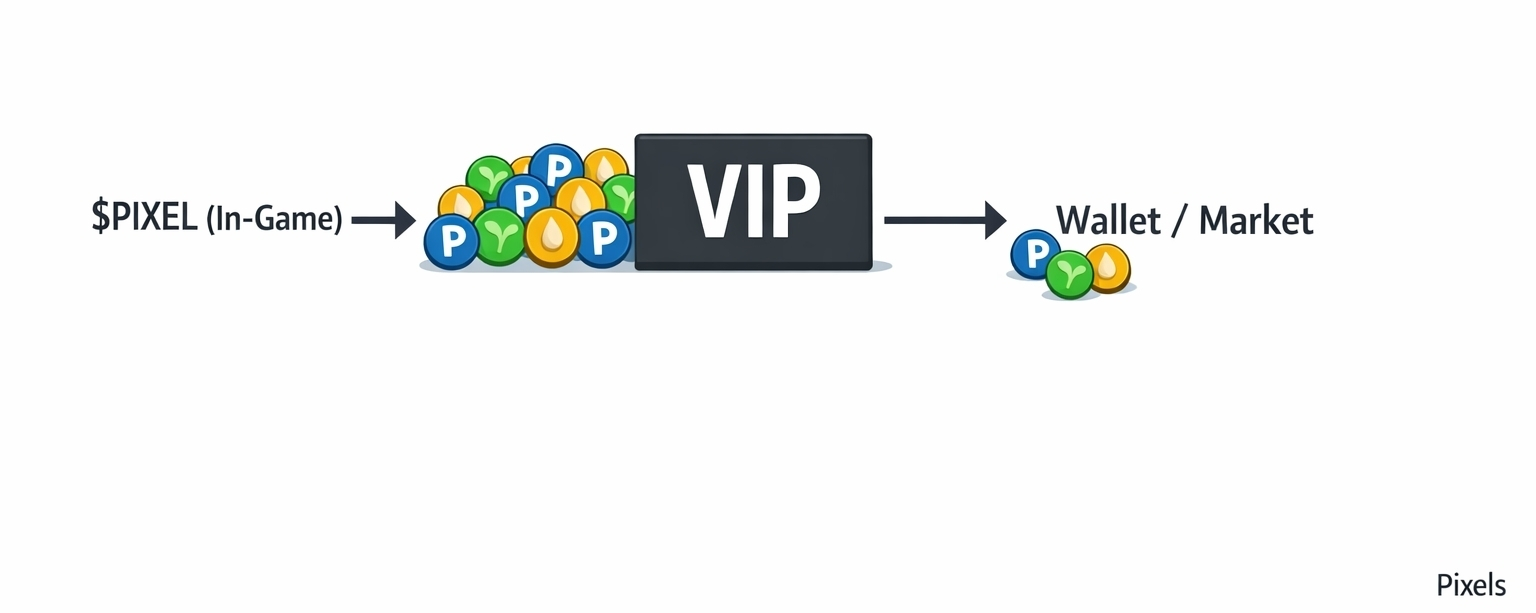
I want to talk about something that gets mentioned in Pixels coverage almost always in the wrong context.
VIP membership.
Most writeups treat it as a monetization feature. Pay $PIXEL , get perks, access exclusive areas, withdraw tokens faster. Premium tier. Standard stuff. The kind of thing every live game has in some form. Nothing particularly interesting about it on the surface.
I kept reading.
Because the more I looked at how VIP actually functions inside the Pixels economy — not what it gives you but what it is structurally doing — the less it looked like a monetization layer and the more it looked like an economic valve.
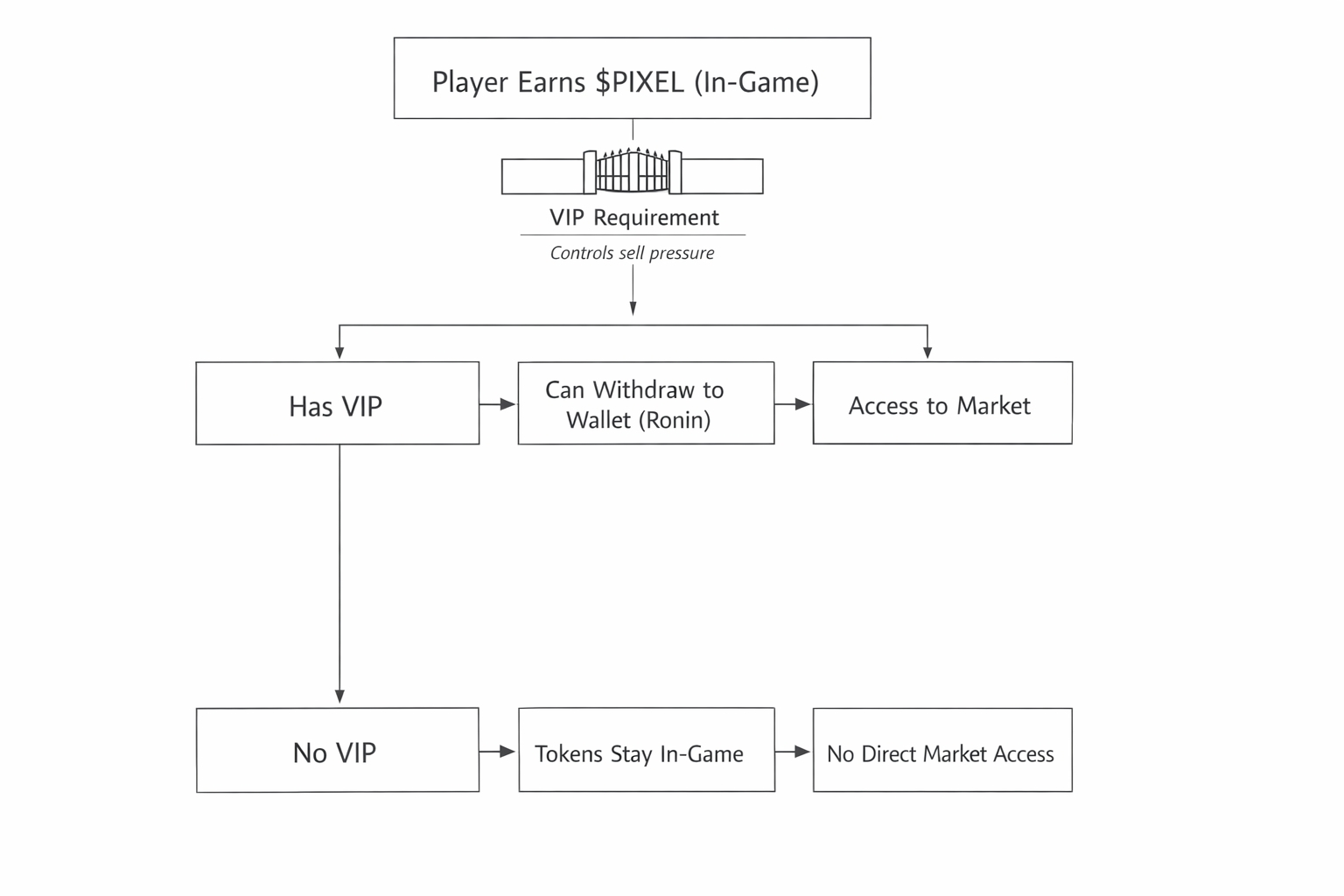
Here is what I mean.
VIP in Pixels is not just about access. It is about withdrawal. Specifically, the ability to withdraw PIXEL from your in-game account to your Ronin wallet is gated behind VIP status. Non-VIP players can earn PIXEL inside the game. They cannot move it out without the membership.
That single design decision is doing enormous economic work that almost nobody discusses directly.
Think about what it means in practice. Every player who earns PIXEL inside Pixels but has not purchased VIP is holding tokens inside the ecosystem. Not on an exchange. Not in a wallet they can sell from. Inside the game. The PIXEL exists. It is real. But its path to the open market runs through a deliberate checkpoint.
That checkpoint is not arbitrary. It is load-bearing.
One of the fundamental problems with Web3 game token economies is sell pressure. Players earn tokens. Players sell tokens immediately. Token price drops. New players see dropping price and lose interest. The economy deflates faster than the game can generate genuine demand to replace the selling. That cycle has destroyed more Web3 game economies than any other single factor.
VIP-gated withdrawal does not eliminate that cycle. Nothing eliminates it completely. But it changes the economics of participation in a specific way. Players who want to extract value from the Pixels economy have to first invest PIXEL to access VIP. That investment creates buy pressure. It also creates a small but real alignment between the player's interests and the ecosystem's health — because a player who has spent PIXEL on VIP has a slightly stronger reason to want PIXEL to hold its value than a player who has invested nothing.
That is not a perfect mechanism. I want to be honest about that. Sophisticated extractors can absolutely calculate the VIP cost, factor it into their farming economics, and still extract profitably. The gate is not impenetrable.
But it changes the baseline. It raises the cost of pure extraction by a meaningful amount. And it creates a natural population of players — VIP members — whose economic interests are more aligned with the ecosystem than pure farmers.
The reputation system interacts with this in a way that I think deserves more attention.
Pixels' documentation notes that VIP status is one of the factors that influences reputation. Which means VIP is not just an economic gate. It is also a signal. A player with VIP membership and consistent activity over time accumulates reputation faster than a player without it. That reputation then opens access to better PIXEL tasks on the board, which creates more genuine earning potential, which creates more reason to maintain VIP status.
That loop — VIP spend, reputation building, better task access, stronger earning, maintained VIP — is not accidental. It is what a sustainable player economy looks like when someone has thought carefully about how to align individual player incentives with ecosystem health.
And then Stacked sits on top of all of this.
The VIP system produces something Stacked needs to function well. It produces a segmented player population with identifiable behavioral characteristics. VIP players behave differently from non-VIP players in ways that are measurable and meaningful. Their session patterns are different. Their spending behavior is different. Their churn risk profile is different. That segmentation makes Stacked's reward targeting more precise because the cohorts are more clearly defined.
A winback campaign targeting lapsed VIP players looks very different from a winback campaign targeting players who never converted. The message is different. The reward type is different. The timing is different. VIP status is not just a game feature. It is a data layer that makes the entire LiveOps infrastructure smarter.
I think this is what people miss when they read about Pixels' monetization.
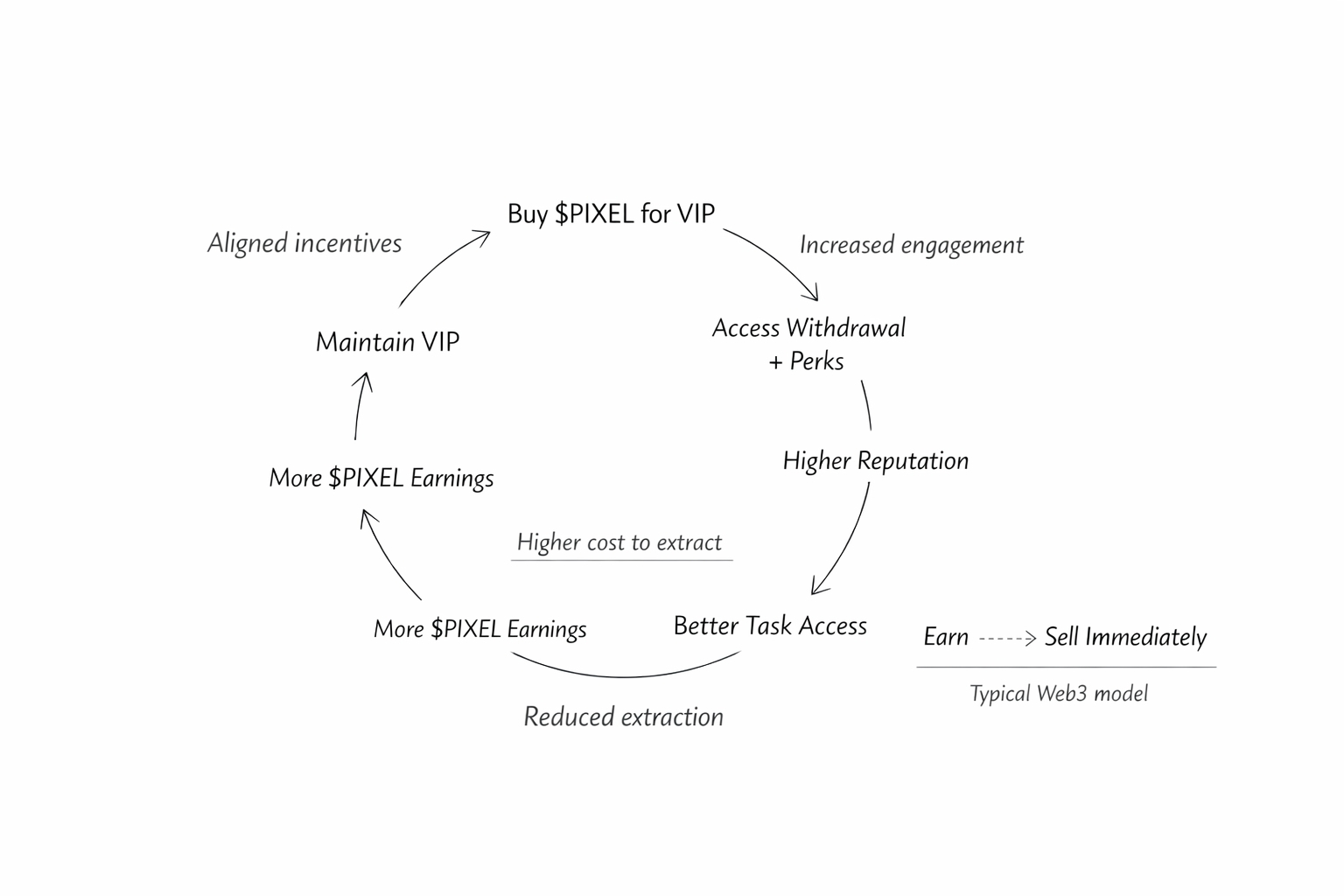
The VIP system is not primarily about generating revenue from premium players. It is about creating the conditions under which the broader PIXEL economy can function sustainably. The withdrawal gate manages sell pressure. The reputation interaction aligns incentives. The behavioral segmentation feeds the intelligence layer.
None of that is visible when you read "pay $PIXEL for VIP perks."
All of it becomes visible when you ask why the system was designed exactly this way and not some other way.
That question — why this design and not another — is usually where the most interesting answers live in Pixels' documentation. The team has made a lot of choices that look like standard game features on the surface and reveal deliberate economic architecture underneath.
VIP is one of the clearest examples of that pattern.