
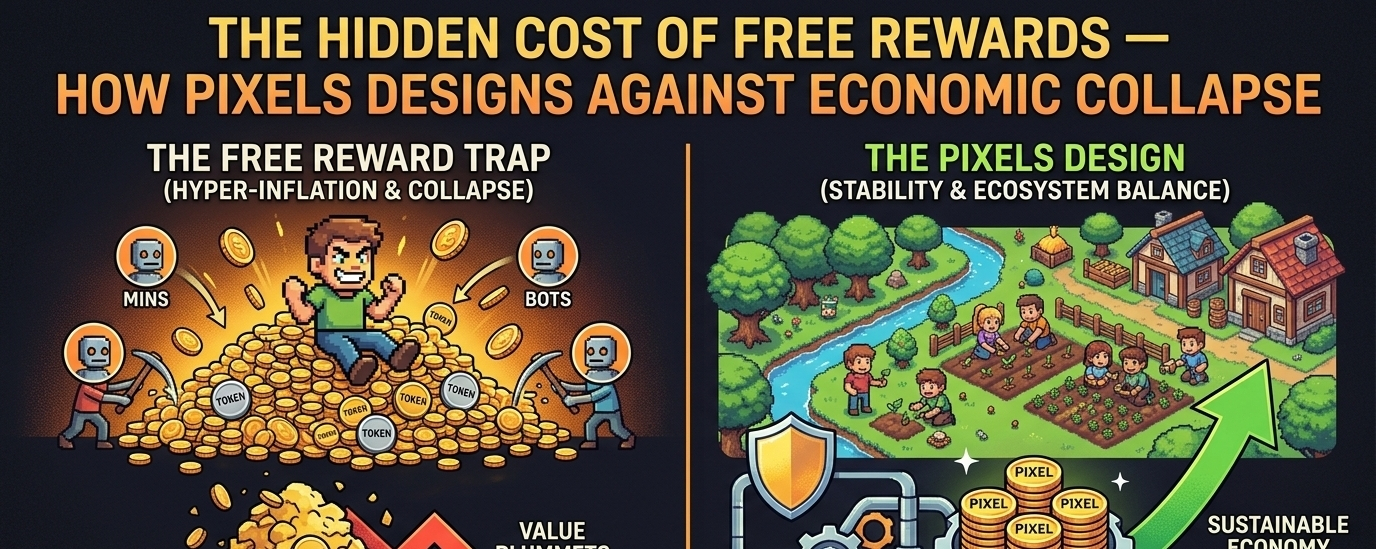


When I first got into GameFi, “free rewards” sounded like the best part. Play a game, earn tokens, and you’re getting paid for your time it felt like a win from every angle. But after trying multiple projects, I started noticing the downside that doesn’t get talked about enough.
Free rewards aren’t really free.
Every token that gets distributed has to come from somewhere, and if there’s no strong system behind it, the result is always the same. More players join, more rewards get emitted, and eventually the value starts to drop. I’ve been in games where this happens quickly what felt rewarding at the start becomes almost meaningless after a while.
And then the behavior shifts.
Instead of playing normally, people start focusing only on extraction. Bots appear, farming becomes aggressive, and the gap between genuine players and exploiters gets wider. At that point, the economy doesn’t just weaken it starts to collapse under its own pressure.
That’s the hidden cost.
What feels different with PIXELS, at least from my experience so far, is that it doesn’t seem to treat rewards as something unlimited. It feels more controlled, more tied to what’s actually happening inside the game rather than being fixed and predictable.
With systems like Stacked, the impression I get is that rewards aren’t just pushed out blindly. They seem to adjust based on player activity how much is being farmed, how players are interacting, and how the overall balance looks.
I can’t see the exact mechanics, but from a player perspective, it doesn’t feel easy to exploit one method endlessly. And that alone helps reduce the kind of pressure that usually breaks these systems.
Another important part is mindset.
In many GameFi projects, the goal becomes “take as much as possible before it’s too late.” Here, I’ve felt less urgency to do that. I’ve actually used what I earn inside the game instead of immediately thinking about selling it.
That’s a subtle but important shift.
Of course, no system is perfect, and long-term sustainability is something that only proves itself over time. But compared to the usual “high rewards first, collapse later” model, @Pixels feels like it’s trying to slow things down and keep the system balanced.
And honestly, that might be the real difference.
Not how much it gives but how carefully it controls what it gives.
Because in the end, it’s not the rewards that decide if a game survives.
It’s whether the economy behind those rewards can hold up.
