
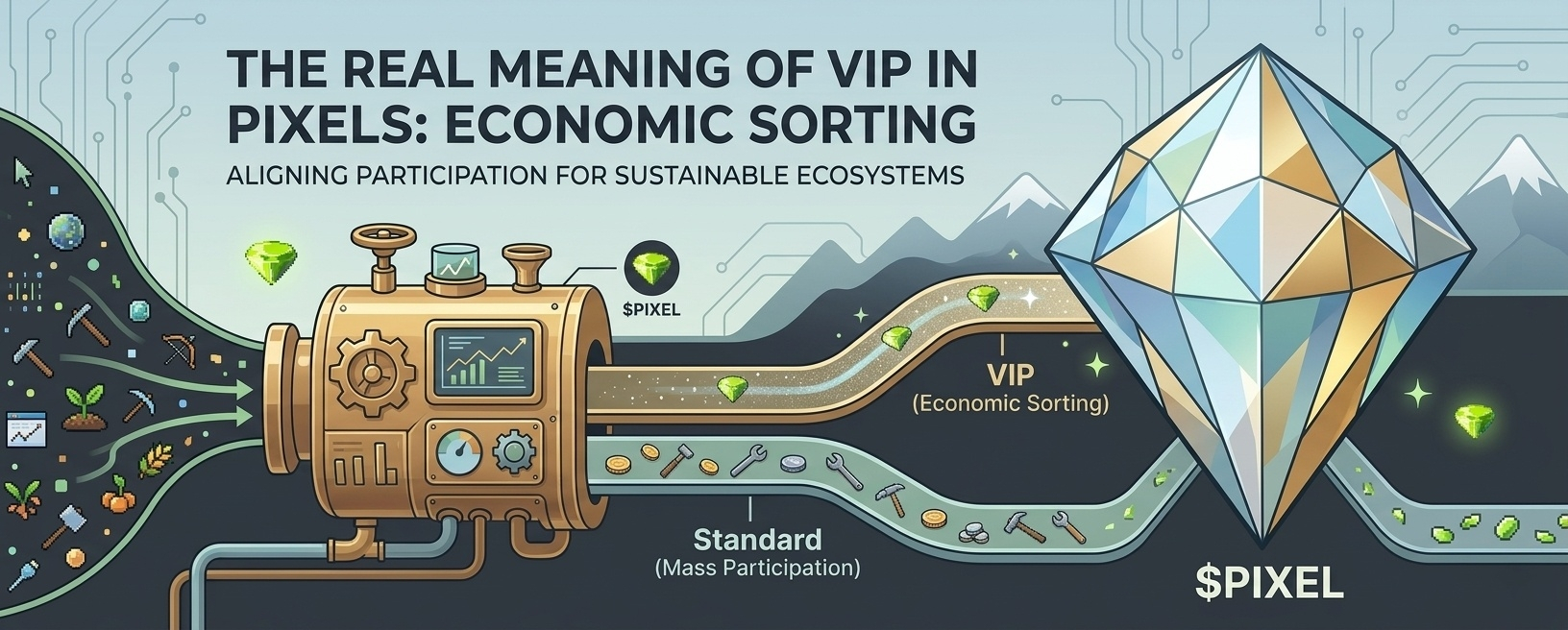
I noticed something small the last time I looked at Pixels. In most games, a VIP badge reads like decoration with benefits attached. You assume it is there to flatter the player a little, smooth a few annoyances, and maybe extract some monthly spend. At first glance, Pixels VIP looks like that too. The more I sat with it, the less I thought it was really about status.
What I think people may be missing is that VIP in Pixels works less like a vanity layer and more like an economic filter. On the surface, it is a monthly membership that costs about $10 in PIXEL and adds convenience. It gives extra backpack slots, 1,500 reputation points, access to a VIP lounge with 1,000 instant energy every 8 hours, three extra Task Board tasks, VIP only tasks, and extra marketplace listing capacity. But underneath, those are not cosmetic perks. They are throughput advantages. They change how much a player can do, how often they can do it, and how visible they are to the game’s reward and trading loops.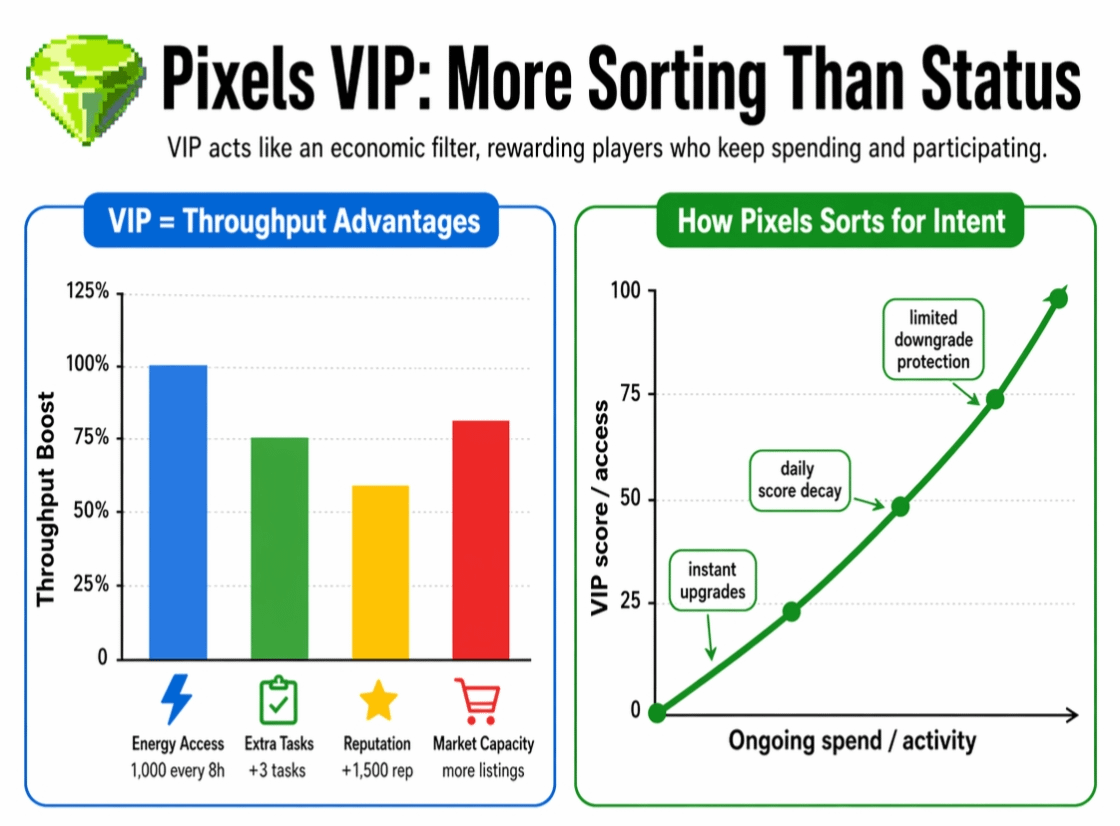 That is why my thesis is pretty simple. VIP in Pixels matters because it helps the economy sort for intent. It is a way of identifying which players are willing to keep spending into the system, not just extract from it. The newer tiering design makes that even clearer. VIP score increases with PIXEL spending, upgrades happen instantly when thresholds are crossed, the score decays a little each day, and there is only limited downgrade protection. In plain English, Pixels is not just asking whether you paid once. It is watching whether you keep participating.
This matters more in Pixels than it would in a slower economy because the token itself still trades like a fairly liquid small cap game asset. As of April 21, 2026, PIXEL was around $0.00743 with about $11.67 million in 24 hour volume and a market cap near $5.73 million. That ratio stands out to me. When turnover is large relative to market value, rewards can reach the market faster than conviction forms. In that kind of environment, a VIP system is not just monetization. It becomes a routing tool. It tries to push more of the reward economy toward players who have already shown some willingness to recycle value back into the game.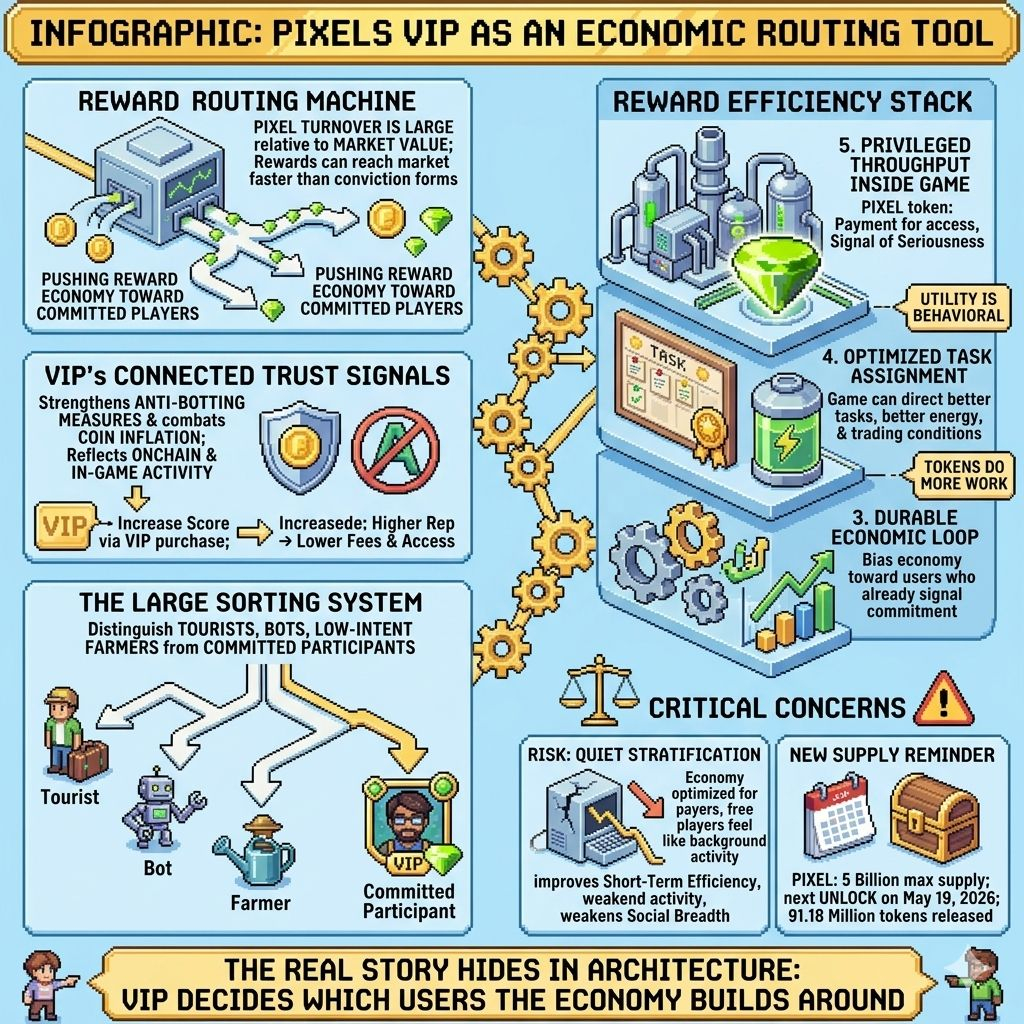
I also keep coming back to the fact that Pixels has already connected VIP style commitment to broader trust signals. In its reputation rework, the team said reputation would reflect both onchain and in game activity to strengthen anti botting measures and combat coin inflation. They explicitly listed purchasing VIP as one way to increase score, and they tied higher reputation to lower marketplace fees and access thresholds such as withdrawals. That tells me VIP is not sitting off to the side as a premium club. It is part of a larger sorting system that tries to distinguish tourists, bots, low intent farmers, and more committed participants.
The strongest case for this design is reward efficiency. If the game can direct better tasks, better energy access, and better trading conditions toward players who are more likely to stay, then each token spent on incentives may do more work. Instead of spraying rewards across the whole population and hoping some of it sticks, Pixels can bias its economy toward users who already signal commitment through recurring spend and continued activity. That is also why the token matters beyond speculation. PIXEL is not only a tradable asset here. It functions as a payment for access, a signal of seriousness, and a mechanism for shaping who gets privileged throughput inside the game. In this case, utility is not abstract. It is behavioral.
Still, there is a real risk in this model. Better sorting can quietly turn into stratification. If the economy becomes too optimized around high intent payers, then free players may stop feeling like future committed users and start feeling like background activity around a paying core. That can improve short term efficiency while weakening the social breadth that makes a game world feel alive. The decaying VIP score is smart because it prevents one time spend from buying permanent priority, but it also means the system is always leaning toward those who can keep feeding it.
That tension feels especially important now because PIXEL still has a 5 billion max supply and the next unlock on May 19, 2026 will release 91.18 million tokens, about 1.8 percent of total supply. I do not read that as a disaster signal. I read it as a reminder that sinks and sorting mechanisms have to keep doing real work. When new supply is still coming, the structure around who earns, spends, and stays matters more than the badge itself.
So when I look at VIP in Pixels now, I do not really see prestige. I see a system deciding which users the economy wants to build around. That is a subtler and more consequential thing. Status is mostly about appearance. Sorting is about architecture. And in crypto games, architecture is usually where the real story hides.
@Pixels $PIXEL #pixel