By Areeba
When I first came across @Pixels , I didn’t really give it much attention. It looked like another Web3 game trying to figure out rewards, token usage, and player retention. And if you’ve spent even a little time in this space, you already know how that usually plays out. There’s excitement in the beginning, people rush in, rewards start flowing, and for a while everything feels like it’s working. Then slowly, things start fading. The hype drops, users lose interest, and the whole system begins to feel repetitive. I’ve seen that pattern more times than I can count, so naturally, I assumed this would follow the same path.
But something felt different the more I looked into it. Not in an obvious, flashy way, but in a quieter, more subtle way. It didn’t feel like they were just focused on building one game and pushing it as far as possible. It felt like they were thinking beyond that, and that’s what caught my attention. Most projects stay locked inside their own ecosystem. Everything they build revolves around one product, one experience, one loop. If that loop breaks, everything else follows. But here, it didn’t feel like that was the only plan.
The idea that started forming in my mind was simple: what if this wasn’t just about one game? What if they were actually trying to build something that other games could use too? That thought alone changes how you look at everything. Because once you move from a single-game mindset to something broader, the entire structure shifts. You’re no longer dependent on one environment. You’re no longer limited by one type of user behavior. You’re not placing all your weight on a single outcome.
If you think about most game tokens, they all share the same weakness. They live and die within one ecosystem. When the game is active and people are engaged, the token has purpose. It moves, it circulates, it feels alive. But the moment that activity slows down, the token starts losing relevance. There’s nowhere else for it to go, no second layer to support it, no alternative use case to keep it moving. Everything depends on one place, and that’s a risky position to be in.
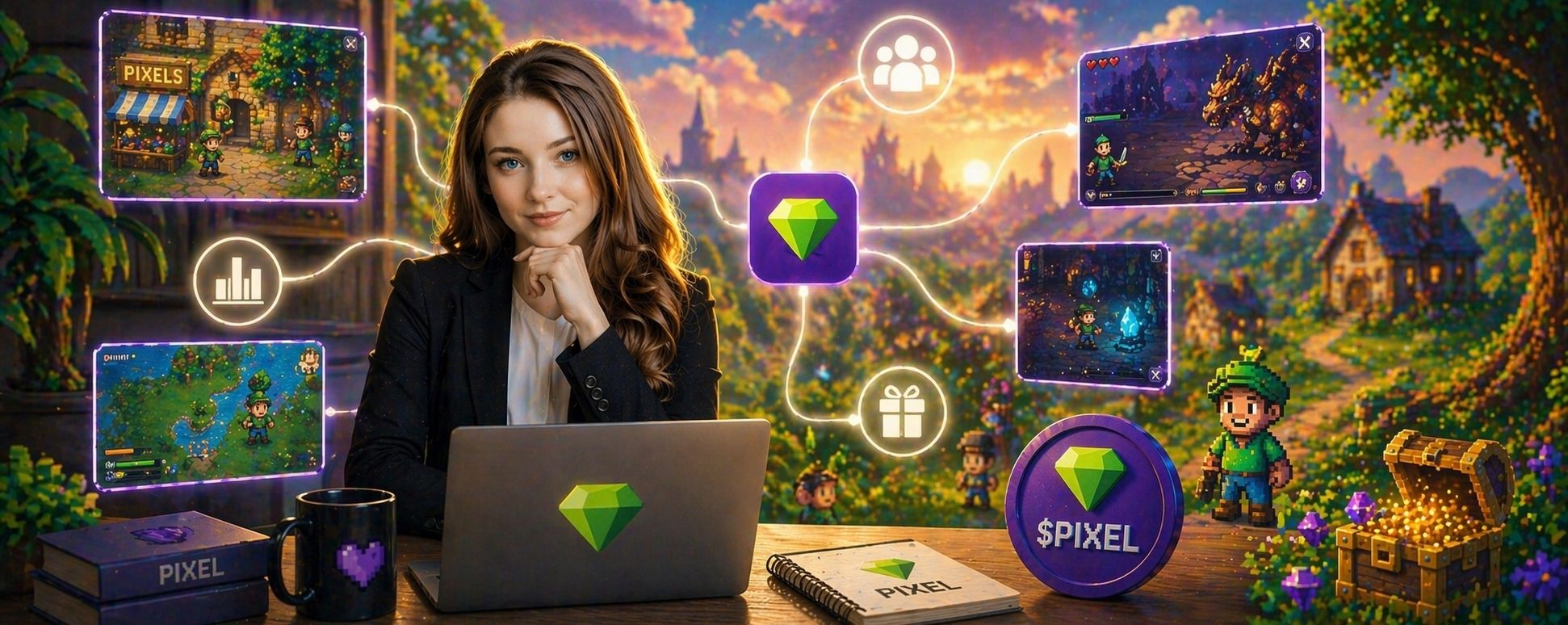
That’s where things start to get interesting with what Pixel is building. With Stacked, it doesn’t feel like they’re trying to stay limited to a single environment. It feels like they’re building a system that can extend beyond their own game. And if that actually happens, then the role of Pixel naturally changes. It stops being just an in-game token and starts becoming part of something larger. Instead of being tied to one loop, it begins to move across multiple experiences.
This isn’t something that happens overnight, and it’s not something you can just assume will work instantly. But if multiple games start connecting to the same system, then the dynamics shift completely. Now you’re not looking at one game feeding into one token. You’re looking at multiple games feeding into a shared structure where that token plays a role. That creates more touchpoints, more activity, and more exposure over time.
Another thing that kept coming to mind while thinking about this is how games actually spend money. Most people don’t really think about this part, but it’s important. Game studios spend a huge amount on user acquisition. Ads, marketing campaigns, partnerships — it all adds up. But the interesting part is that most of that money doesn’t go to players. It goes to platforms. Players are the ones driving engagement, but they’re not really part of that value flow in a direct way.
Now imagine if even a portion of that spending was redirected toward players themselves. Not randomly, not inefficiently, but in a way that actually makes sense. Rewarding people who are active, who stay, who contribute in a meaningful way. That changes the relationship between the game and the player. It stops feeling one-sided. It becomes more balanced.
That’s where something like Stacked starts to make sense to me. Not just as a reward system, but as a way to rethink how value moves inside these ecosystems. If rewards are being distributed more intentionally, and if they’re connected to real behavior instead of surface-level activity, then the system becomes more stable. And when the system is more stable, everything around it benefits, including the token.
I’m not saying this is guaranteed to succeed. There are still a lot of things that need to happen for this to fully play out. Expanding into multiple games is not easy. Different games have different types of players, different engagement patterns, and different ways systems can be used or misused. Managing all of that at scale is a real challenge. Adoption also takes time. Other studios need to see value before they decide to integrate something new.
But even with all those uncertainties, the direction itself feels more grounded compared to what we usually see. It doesn’t rely on hype or quick attention. It feels like something that’s being built step by step, based on what actually works and what doesn’t. And that’s probably why it caught my attention in the first place.
When I first looked at @pixels, I saw it as just another project trying to get rewards right. Now, it feels like they’re quietly building something that could extend beyond their own game. Something that might actually be useful to others. And if that happens, then Pixel won’t stay limited to a single ecosystem anymore.
It’s still early, and there’s a lot left to prove. But sometimes, the projects that don’t try too hard to impress are the ones worth watching. Not because they promise the most, but because they focus on getting the fundamentals right.
And right now, that’s exactly what this feels like.