


A lot of Web3 gaming platforms talk about ecosystem growth. Fewer explain how a studio is supposed to actually plug in and benefit from it. That is the part I find more interesting.
Pixels seems to be building a studio toolkit that gives partner games real infrastructure instead of just marketing noise. That matters because most game partnerships fail when the integration is shallow. A logo on a page is not a growth model.
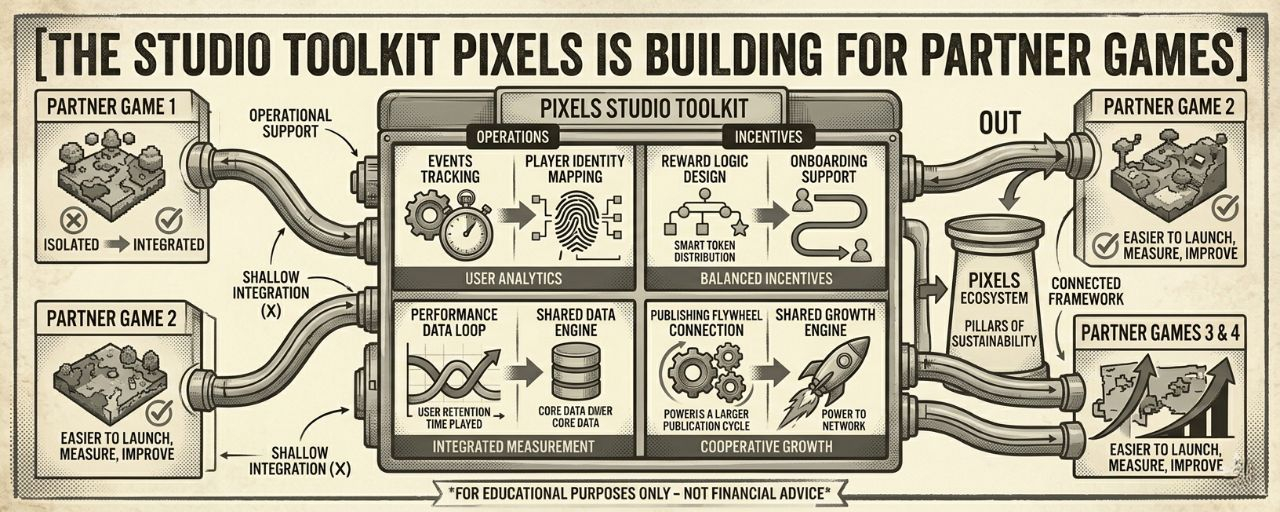
What stands out to me is the practical side of it. Things like events tracking. player identity mapping. onboarding support. reward logic. and performance data. That is the kind of tooling studios can actually use. It helps them understand who is playing. what is working. and where engagement is coming from.
I think this is important because partner games do not just need users. They need a system that helps them keep users. If the toolkit can improve analytics and make incentive design smarter. then the value is more than distribution. It becomes operational support.
The bigger idea is simple. Pixels is not just trying to add more games. It is trying to make each new game stronger by connecting it to the same data loop and reward framework. That is how a publishing ecosystem starts to feel real.
Of course. this still has risks. Studios will only care if the toolkit is easy to use and clearly useful. If integration feels heavy. adoption will slow. If the data is not clean. the whole system loses value. And if the incentives are not balanced. partner games may still struggle to hold players.
That is why I am watching this as an infrastructure play. Not a hype play. If Pixels can make partner games easier to launch. easier to measure. and easier to improve. then the toolkit becomes one of the most important parts of the ecosystem.
The real question is simple. Can Pixels turn partner games into a shared growth engine instead of isolated experiments?
This is for educational purposes only, not financial advice.