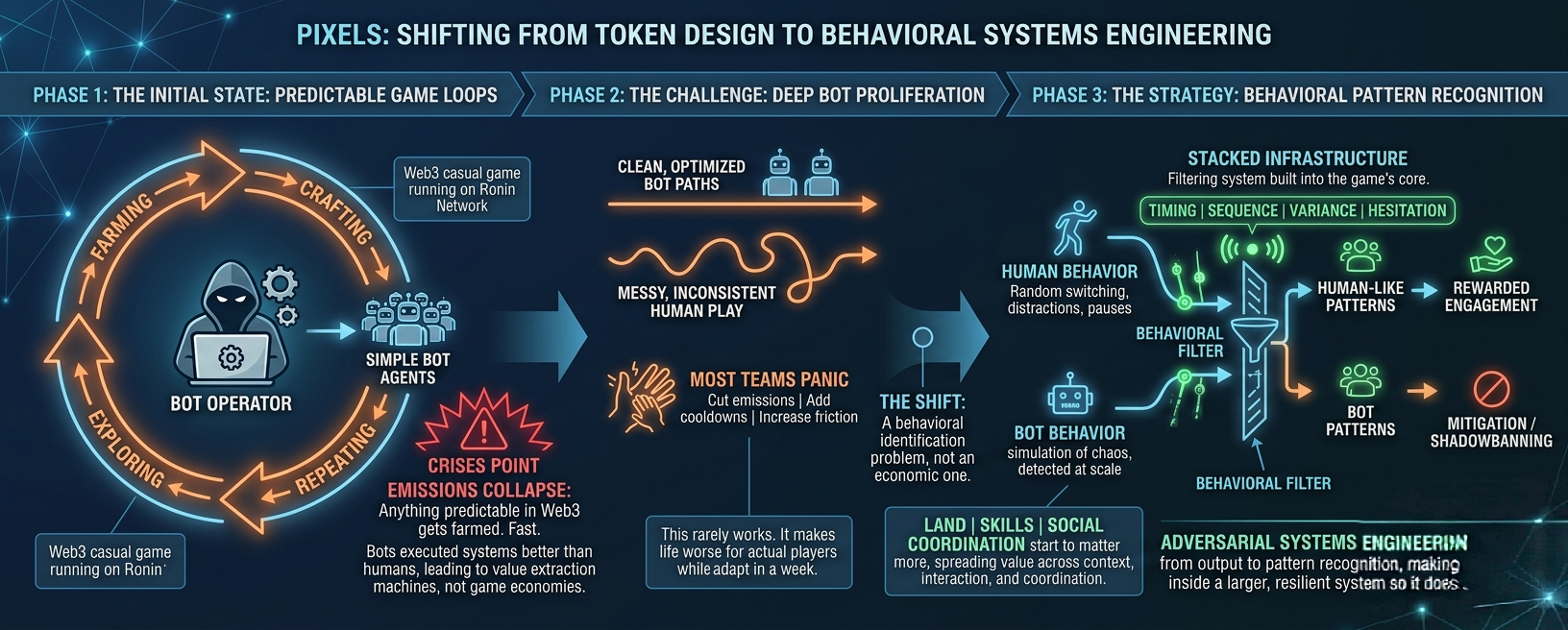
Pixels runs on Ronin, and on paper it looks like your typical Web3 casual game loop farming, crafting, exploring, repeating. You know the type. But honestly, that surface-level description misses the real story completely.
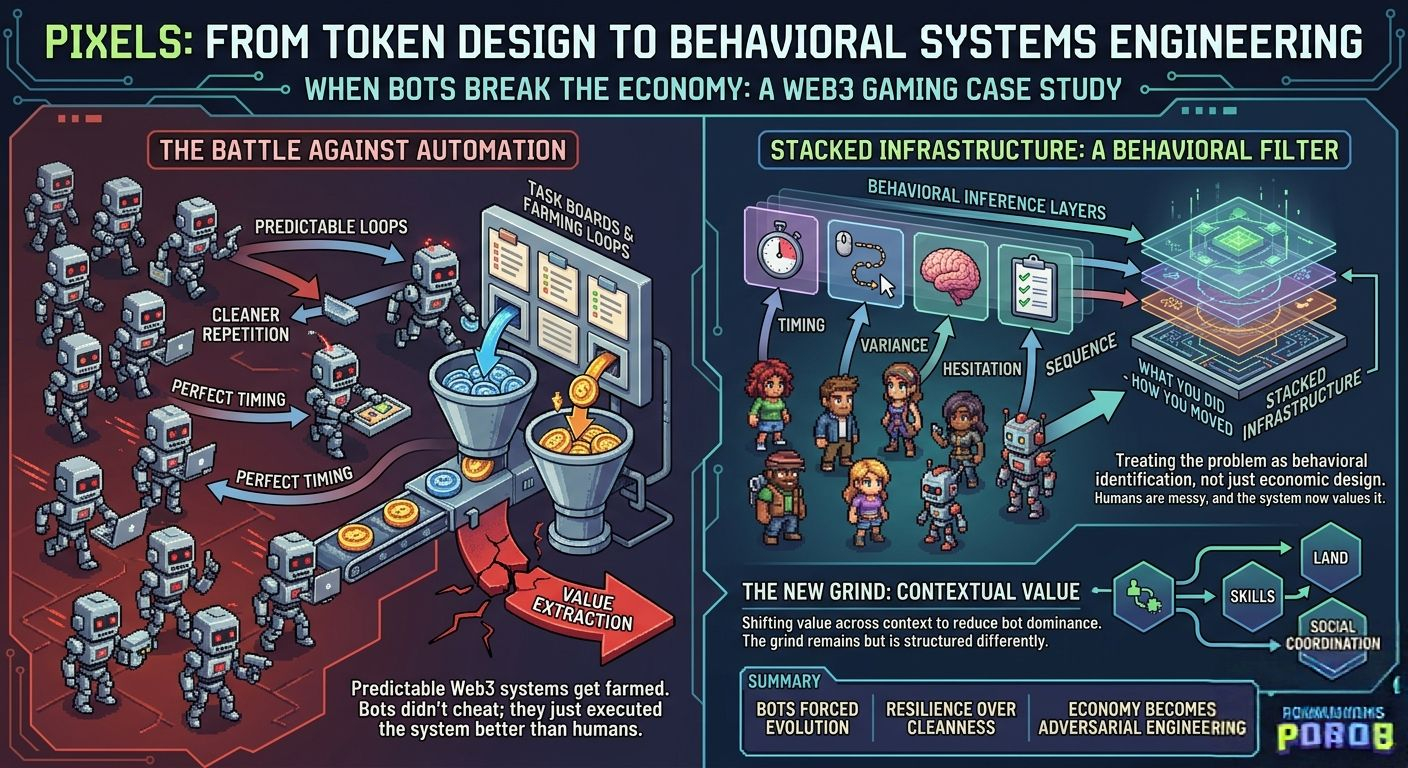
Here’s the thing: the economy didn’t break because the design was “bad.” It broke because it was predictable. And anything predictable in Web3 gets farmed. Fast.
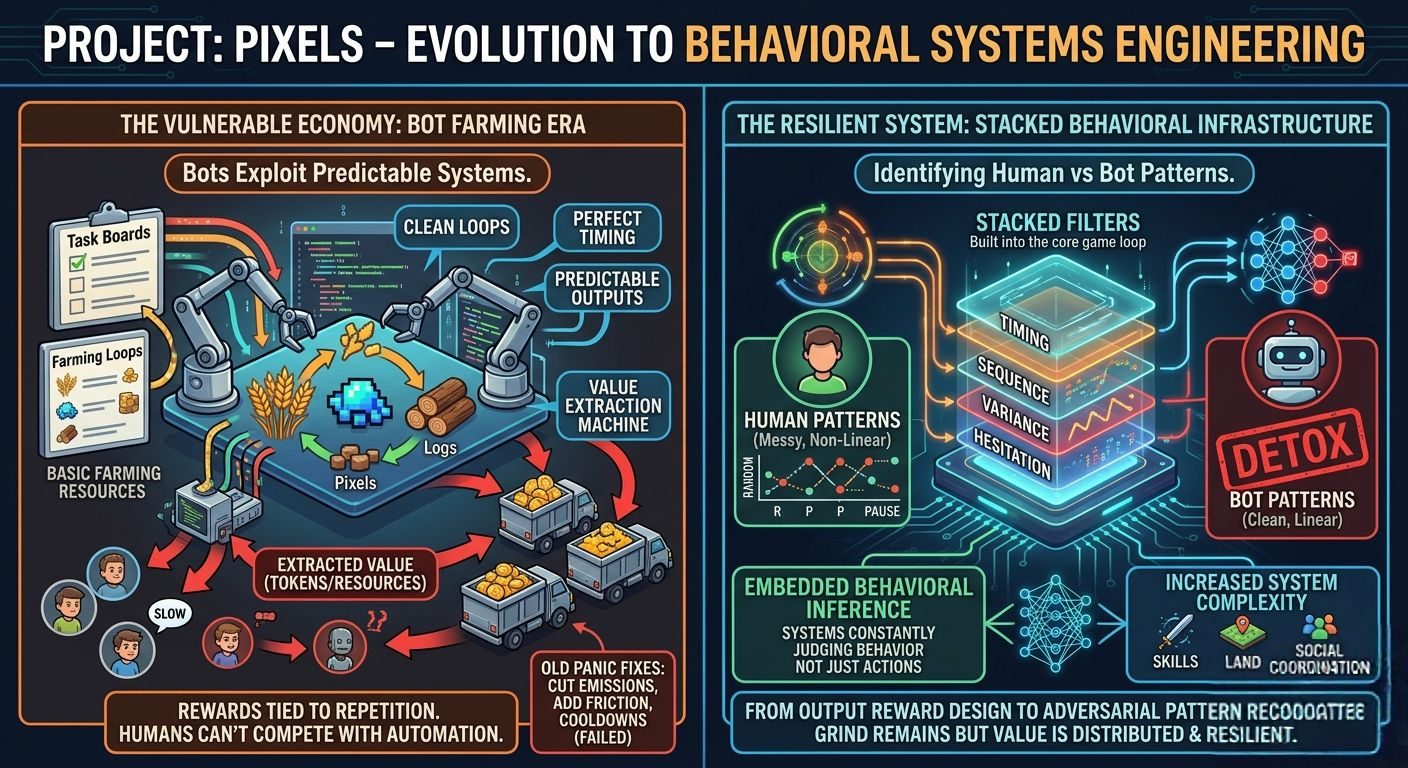
Bots showed up and did what bots always do. They didn’t “cheat” in some dramatic sense. They just executed the system better than humans did. That’s it. Cleaner loops, perfect timing, zero hesitation. Meanwhile, real players are distracted, inconsistent, slow. So guess who wins when rewards are tied to repetition? Yeah. Not humans.
And this is where things get messy.
The task boards and farming loops weren’t originally a problem. They actually made sense. Simple actions, simple rewards. But once automation hits that kind of structure, it stops being a game economy and turns into a machine for extracting value. I’ve seen this before in other Web3 games — once the loop becomes readable, it’s basically over unless you redesign the system entirely.
Most teams panic at this stage. They do the obvious stuff. Cut emissions. Add cooldowns. Increase friction. Honestly? That rarely works. It just makes life worse for actual players while bots adapt in a week.
Pixels didn’t fully go down that path. Instead, they started treating the problem like what it actually was: a behavioral identification problem, not an economic one.
And that shift matters more than people realize.
Instead of asking “how do we stop bots from farming,” the real question became “how do we even tell the difference between a bot and a human when both are just clicking optimized loops all day?”
That’s not a simple fix. That’s a systems redesign.
So they started building what people now refer to as Stacked infrastructure. Think of it less like a single tool and more like a behavioral filter layered into the game itself. It doesn’t just look at what you did. It looks at how you move through the system over time.
Timing matters. Sequence matters. Variance matters. Even hesitation matters.
And yeah, that’s the part people don’t talk about enough — humans are messy. We don’t optimize perfectly. We switch tasks randomly, we get distracted, we pause for no reason. Bots don’t do that unless you force them to simulate it, and even then it’s usually detectable at scale.
So Stacked leans into that difference. Not perfectly. Nothing in this space is perfect. But enough to shift the balance.
Here’s what’s interesting: they didn’t just bolt this on as an anti-cheat layer. It became part of the infrastructure itself. That’s a big deal. Because once you embed behavioral inference into the core system, you’re no longer just running a game economy — you’re running a system that constantly judges how people behave inside it.
That sounds intense because it is.
And let’s be real — that level of complexity only shows up when things get bad enough that simpler fixes fail. Nobody builds this kind of infrastructure “for fun.” It comes from pressure. Real pressure.
Bots forced the system to evolve. Not players. Not design philosophy. Bots.
That’s the uncomfortable truth.
Now, the grind didn’t disappear. People sometimes assume new systems magically remove repetition. They don’t. Pixels still has energy limits, crafting loops, resource cycles — all the usual stuff. You’re still grinding.
It’s just structured differently now.
And this is where land, skills, and social coordination start to matter more than people initially expect. Because once you expand the system beyond a single loop, you reduce the chance that one optimized bot path dominates everything. You spread value across context. Across interaction. Across coordination.
But I won’t sugarcoat it — the game is still demanding. It still asks for time. It still asks for repetition. If anything, it just makes that repetition sit inside a larger system so it doesn’t collapse into pure automation farming.
There’s a tradeoff here, and people should be honest about it. You get more structural depth, but you also get more complexity and more hidden systems influencing outcomes. It’s not cleaner. It’s just more resilient.
And that’s really the core story.
Pixels didn’t “solve bots” in some clean, satisfying way. That never happens in systems like this. What they did instead was shift from thinking about rewards to thinking about behavior. From output to pattern recognition. From economy design to something that looks a lot more like adversarial systems engineering.
Honestly, that’s the part that actually matters.
Everything else is just surface detail.