
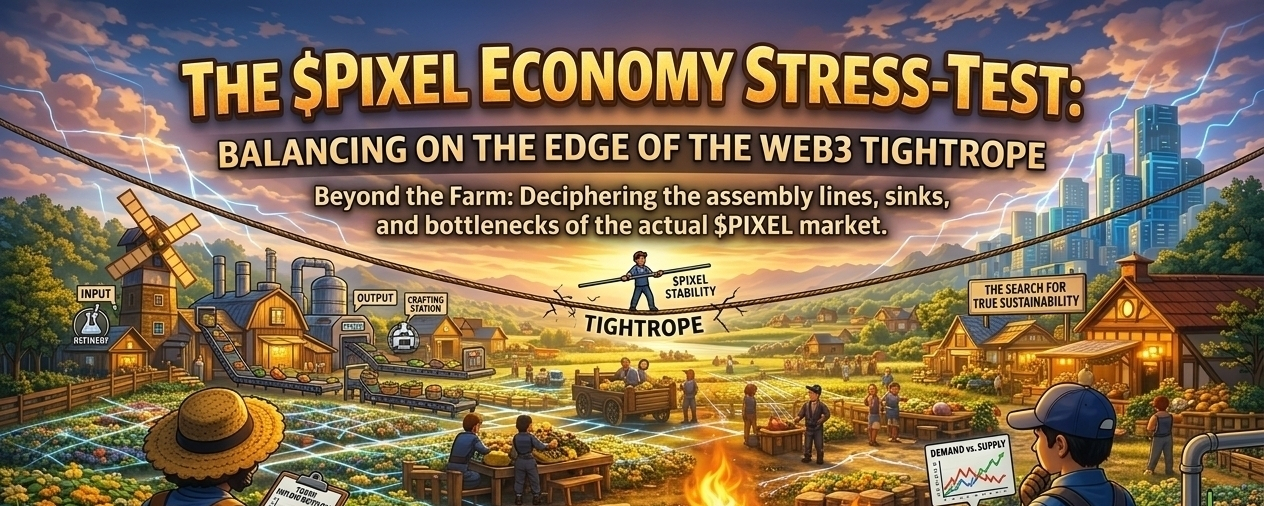
A lot of people casually write off Pixels as "just another farming game with a token." It’s an easy narrative: you plant some crops, craft some stuff, earn a little $PIXEL , and maybe flip an NFT. But when you actually look under the hood, the farming layer is probably the least important part of the game. The real genius is the underlying assembly line—how fast inputs turn into outputs, and where the game forces those outputs to go.
Think of resource generation as a giant throughput puzzle. The loop usually goes like this: grow a crop → refine it into an ingredient → craft a tool or consumable → sell it to some guy who needs it to finish his own quest. Simple enough. But the actual "economy" thrives entirely on its bottlenecks. Energy limits, time gates, recipe unlocks, and land restrictions aren't just there to balance the gameplay; they exist to stop the market from instantly flooding. It really feels like Pixels is fighting tooth and nail to avoid that classic Web3 death spiral where everyone farms the exact same meta until prices hit zero.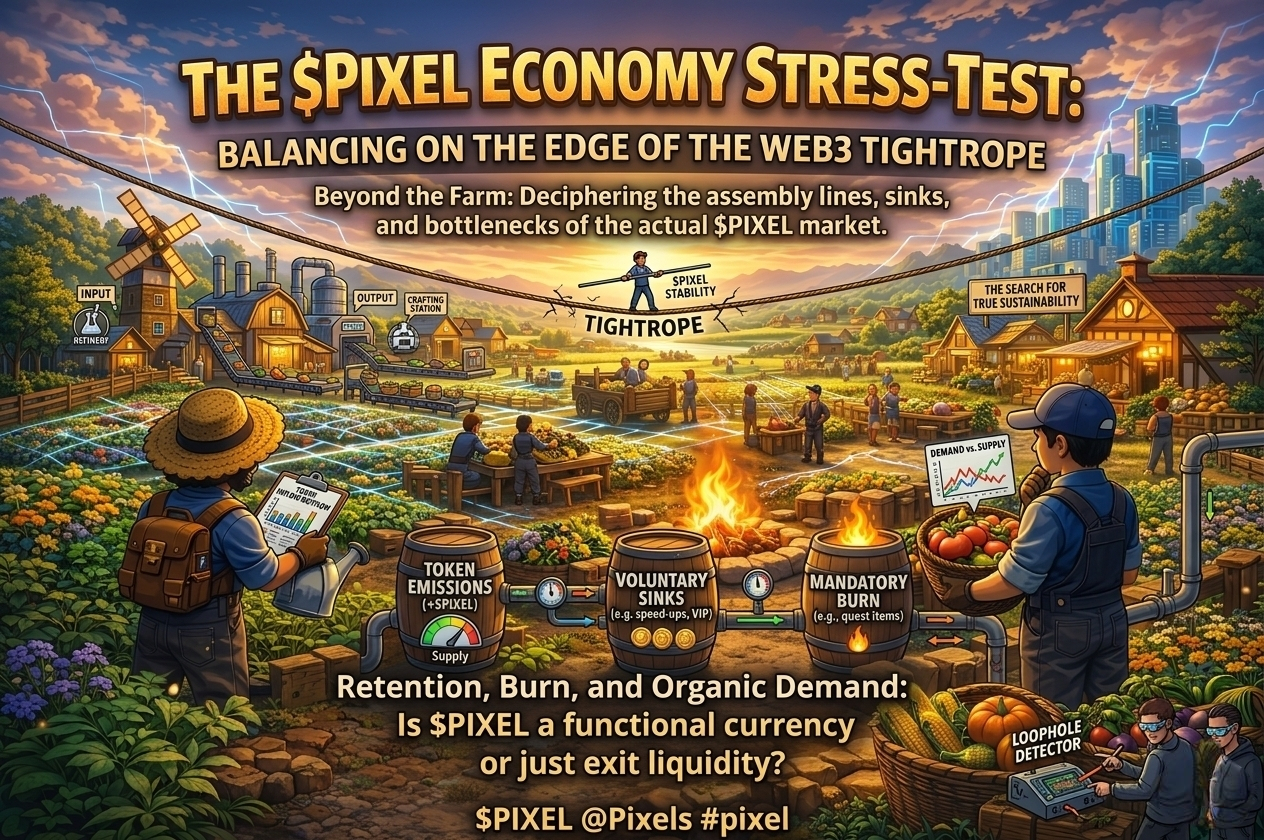
Then there’s the token flow, which is where I still get a bit skeptical. $PIXEL emissions are what make the grind feel worth it, but let's be real, emissions are essentially just background inflation. So I keep looking for real sinks. Are players burning $PIXEL because the progression is genuinely fun, or just because they feel pressured to optimize and keep up with the latest event?
Here’s the catch-22: if sinks are purely optional (like speed-ups or VIP perks), they rely entirely on player confidence. The minute the vibes shift and confidence drops, optional spending is the first thing to die. On the flip side, if you make sinks mandatory to prop up the token, the game starts to feel like a series of toll booths, and players will just leave. It’s a brutal tightrope to walk between stabilizing the economy and destabilizing the player base.
The player-to-player market makes it even messier. If demand is organic—meaning people actually need these crafted items at scale—the economy can hum along nicely without relying too heavily on token incentives. But if demand is mostly driven by events, the economy starts feeling a bit scripted. The devs effectively play market-maker by deciding what’s valuable this week. Traditional games do this all the time, but throw a liquid token into the mix, and the stakes skyrocket. Turn off the rewards, and production might stop dead while everyone just dumps whatever they’ve hoarded.
Infrastructure-wise, running this on Ronin is a massive carry. Zero friction and smooth wallet flows mean you can actually craft, list, and trade without feeling like every single click is a financial decision. A higher-friction chain would choke this high-frequency market out instantly. But the flip side? Ronin brings a player base of hardened Web3 degens who are ruthlessly efficient. If there is a single profitable loophole between emissions and sinks, they will find it, optimize it, and drain it.
Which brings me to sustainability. I’m still torn on whether Pixels is actually generating real economic value or just playing a massive game of musical chairs with incentives.
The dream scenario: Players create useful goods, items are consumed, a real specialization economy forms, and $PIXEL is just the currency holding it together.
The nightmare scenario: Players are just extracting value, and the game’s only job is to try and slow them down.
That second model relies entirely on a constant influx of new players acting as exit liquidity to absorb the supply. If user growth stalls, we’ll find out real quick if those sinks actually work.
There’s no neat bow to tie this up with, which is kind of the point. Pixels feels incredibly well-tuned right now, but sometimes "well-tuned" just means "it works perfectly until momentum drops."
Here’s what I’m watching going forward:
Retention: Do people stick around when a cycle isn't insanely profitable?
Net token flow: Are we actually burning more than we print, or just shuffling it around?
Organic demand: Do crafted items keep selling when there isn't a shiny new event forcing people to buy them?
Dev intervention: Are they doing normal game balancing, or constantly running around patching leaks?
Ultimately, if Pixels turned off the money printer for a month, would people still be farming because they want to play… or would the fields go empty?