
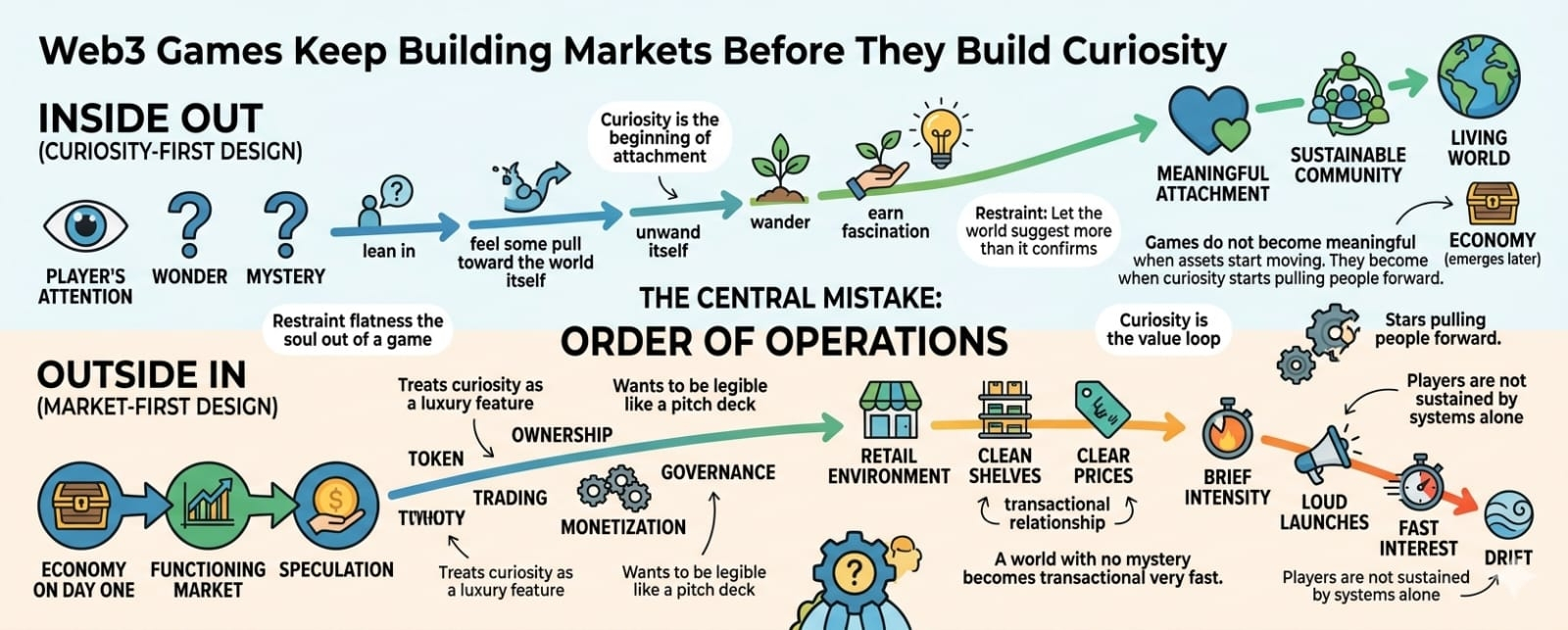
There is a strange impatience at the heart of Web3 gaming, and once you notice it, you start seeing it everywhere. So many projects want a functioning economy on day one. They want trading, ownership, scarcity, speculation, progression, monetization, governance, status, all of it stacked up immediately, as if the fastest path to a living world is to turn that world into a marketplace before players have even found a reason to care. And maybe that is the central mistake. Not the technology itself, not even the ambition, but the order of operations. Because games do not become meaningful when assets start moving. They become meaningful when curiosity starts pulling people forward.
That comes first. Or at least it should.
The best games, even very simple ones, understand that people need a reason to lean in before they need a reason to invest. They need mystery, texture, friction, mood, a sense that there is something worth uncovering just beyond the edge of what they already know. A game has to create that little private itch in the player’s mind. What is over there. What happens if I try this. Why does this area feel different. Why am I still thinking about this one mechanic after I closed the tab. That is the beginning of attachment. Not ownership. Not yield. Curiosity.
Web3 gaming, though, keeps rushing past that stage like it is optional. It often treats curiosity as a luxury feature, something that can be added later once the token is live, the systems are connected, the economy is “sustainable,” and the community has a roadmap graphic to stare at. But a game without curiosity is just a structure. It may be efficient, it may be monetized, it may even be active for a while, but it does not breathe. It does not linger in the mind. It does not create the kind of energy that makes players return for reasons they cannot fully explain.
And that matters more than the spreadsheets ever seem to admit.
You can feel when a game was designed from the inside out versus the outside in. Inside out design starts with the player’s attention. What do they notice first. What do they want to test. What kind of surprise keeps them from mentally checking out. Outside in design starts with the architecture around the player. What can be tokenized. What can be owned. What can be earned. What can be traded. The second approach is not automatically wrong, but it has a habit of making worlds feel like retail environments. Clean shelves, clear prices, lots of systems, very little wonder.
And wonder is not some soft, decorative thing. It is load-bearing. It is one of the few reasons people stay with a game through its rougher edges. They stay because something about it still feels unfinished in their mind, unfinished in the good way, like there is more to see, more to understand, more to accidentally stumble into. That feeling is hard to fake. It does not come from economic design documents. It comes from restraint. From not explaining everything too quickly. From letting the world suggest more than it confirms.
Web3 games often struggle with restraint because the space is obsessed with proving value immediately. Every feature has to justify itself in public. Every system has to be explained in terms of utility. Every asset needs a role. Every mechanic needs an economic logic attached to it so that nobody asks what the point is. But honestly, that pressure can flatten the soul out of a game. It makes everything feel pre-decoded. Too legible. Too eager to be understood as a product. Nothing gets to just sit there and be intriguing.
And players notice that, even if they do not use those words.
A world with no mystery becomes transactional very fast. You enter, you assess, you optimize, you leave. There is no real wandering because wandering only works when there is a chance the world might surprise you. That is why so many Web3 games feel strangely closed even when they claim to be open economies or open ecosystems or open worlds. They are open in the technical sense, maybe, but mentally they feel sealed. The player understands the entire pitch too early. Once that happens, the relationship becomes mechanical. There is nothing left to discover except whether the numbers work for you.
That is not enough. It was never enough.
And to be fair, traditional games make this mistake too. Plenty of them over-explain, over-systematize, over-design. But Web3 gaming has a particularly bad habit of doing it because it is always trying to answer investors, communities, speculators, and players all at once. It wants to be legible to everyone from the beginning. That sounds smart until you realize games are not supposed to reveal themselves like pitch decks. They are supposed to unfold. Slowly, unevenly, sometimes awkwardly. They are supposed to earn fascination, not prepackage it.
The projects that eventually matter in this space will probably be the ones that stop treating curiosity like dead time before monetization. They will understand that curiosity is not a delay in the value loop. It is the value loop, or at least the start of it. Before people care about what they own, they need to care about where they are. Before they measure the upside, they need to feel some pull toward the world itself. Before a game becomes an economy, it has to become a place that can hold attention without bribing it.
That is the part the space keeps trying to skip, and it keeps paying for that impatience in the same way. Loud launches. Fast interest. Brief intensity. Then drift. Because players are not sustained by systems alone. Systems can organize behavior, sure, but they cannot create fascination on their own. A market can amplify interest, but it cannot replace it. And if there is no curiosity at the center, then the whole thing starts to feel hollow the moment the novelty of participation wears off.
Maybe that is the real test Web3 games keep failing. Not whether they can build a token, a marketplace, or a reward loop, but whether they can make someone pause for a second and think, I want to see a little more. That impulse is small. Easy to underestimate. But it is where every lasting relationship with a game begins. Without it, all you have built is a market looking for a world to stand in.
