
Ethereum continues to be the heart of decentralized finance (DeFi), but in 2026, the real action is happening on Layer-2 networks. Instead of users relying only on Ethereum mainnet, they are moving to faster and cheaper Layer-2 solutions like Arbitrum, Base, and Optimism. This shift is changing how DeFi works and making crypto more practical for everyday users.
One of the biggest reasons for this growth is the impact of EIP-4844, also known as Proto-Danksharding. This upgrade made Layer-2 transactions dramatically cheaper by reducing rollup data costs. Reports show that Layer-2 fees dropped by 90–99%, with many transactions costing as little as $0.001 to $0.05, while Ethereum mainnet fees also became much lower at around $0.10–$0.20 per transaction. This made DeFi trading, staking, lending, and payments far more accessible for small investors.
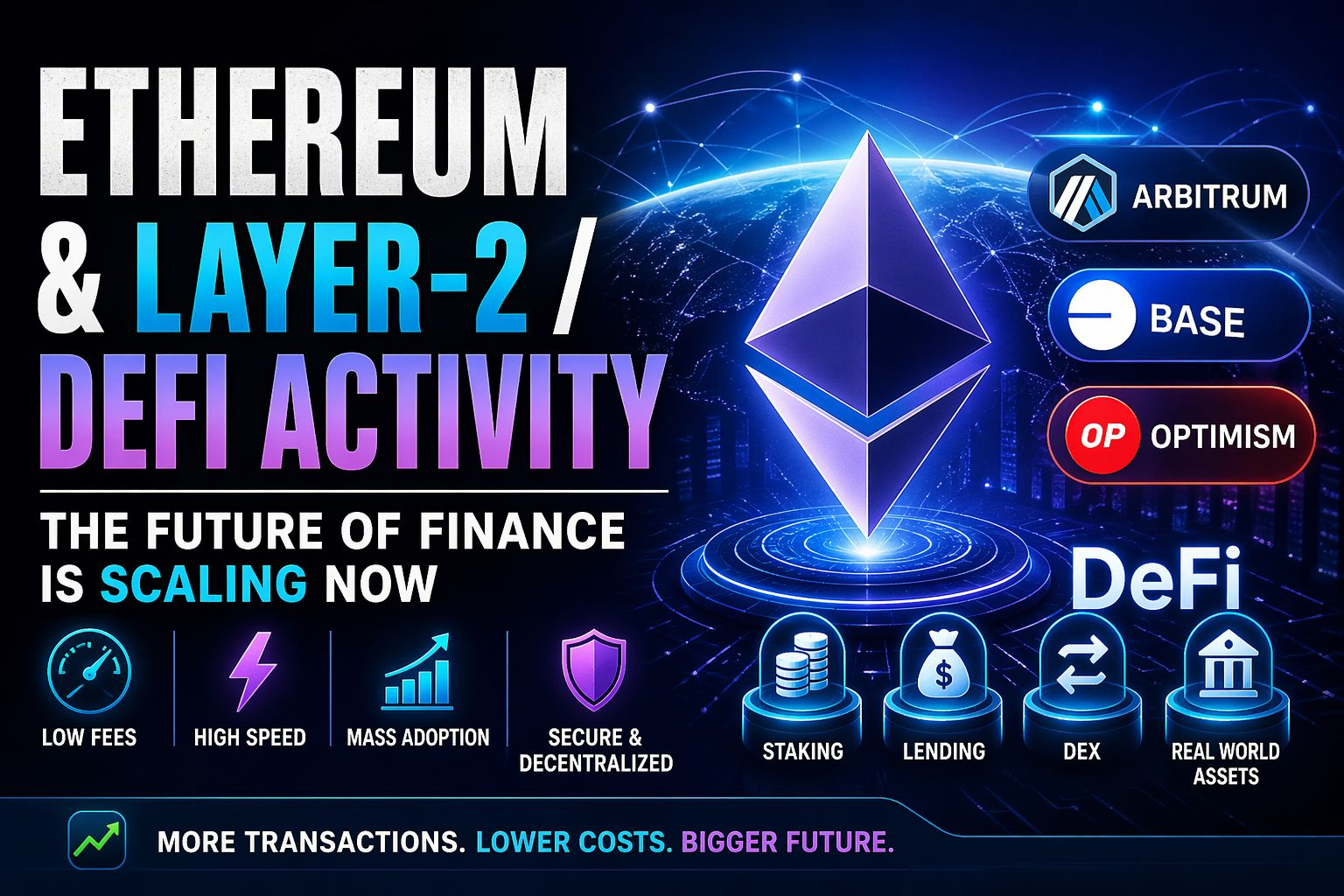
Today, Layer-2 networks process more transactions than Ethereum mainnet itself. This proves that Ethereum is evolving into a settlement layer, while daily user activity happens on Layer-2 chains. According to recent reports, some Ethereum Layer-2 ecosystems have even crossed major milestones in transaction volume, showing strong adoption across DeFi, gaming, and payments.
Arbitrum remains a major player for DeFi users because of its strong liquidity and advanced DeFi protocols. Base has grown quickly because of easy onboarding for retail users and strong stablecoin activity. Optimism continues to attract developers with its ecosystem support and scalability improvements. Instead of one chain dominating everything, each Layer-2 is building its own specialized ecosystem.
DeFi itself is also becoming more mature. Instead of hype-driven projects, users are focusing on real utility—staking, lending, decentralized exchanges (DEXs), and real-world asset tokenization. More than 37 million ETH is now staked, representing around one-third of Ethereum’s supply, with staking rewards averaging around 3–4% APR. This creates stronger long-term confidence for investors and institutions.
Institutional interest is another major factor. Spot $ETH ETFs reportedly attracted billions in inflows during 2025, showing that large investors are taking Ethereum seriously. This supports long-term ecosystem growth, especially as institutions look for secure and scalable DeFi infrastructure.
However, challenges still remain. MEV (Maximal Extractable Value), bridge security, and competition from faster chains like Solana continue to pressure Ethereum’s ecosystem. Some smaller Layer-2 chains are also becoming “ghost chains” with low activity, while user attention concentrates on stronger networks like Base, Arbitrum, and Optimism.
Looking ahead, Ethereum’s roadmap—including upgrades like Glamsterdam and improved interoperability—could make Layer-2 adoption even stronger. The future of Ethereum is no longer just about the mainnet. It is about a full ecosystem where Layer-2 chains handle scale, while Ethereum provides trust and security.
In simple words, Ethereum is no longer just a blockchain—it is becoming the foundation of the next financial system, and Layer-2 networks are the engines driving that future.
#MarketRebound #Ethereum #ETH2026 #StrategyETHPurchase #EthereumMarket