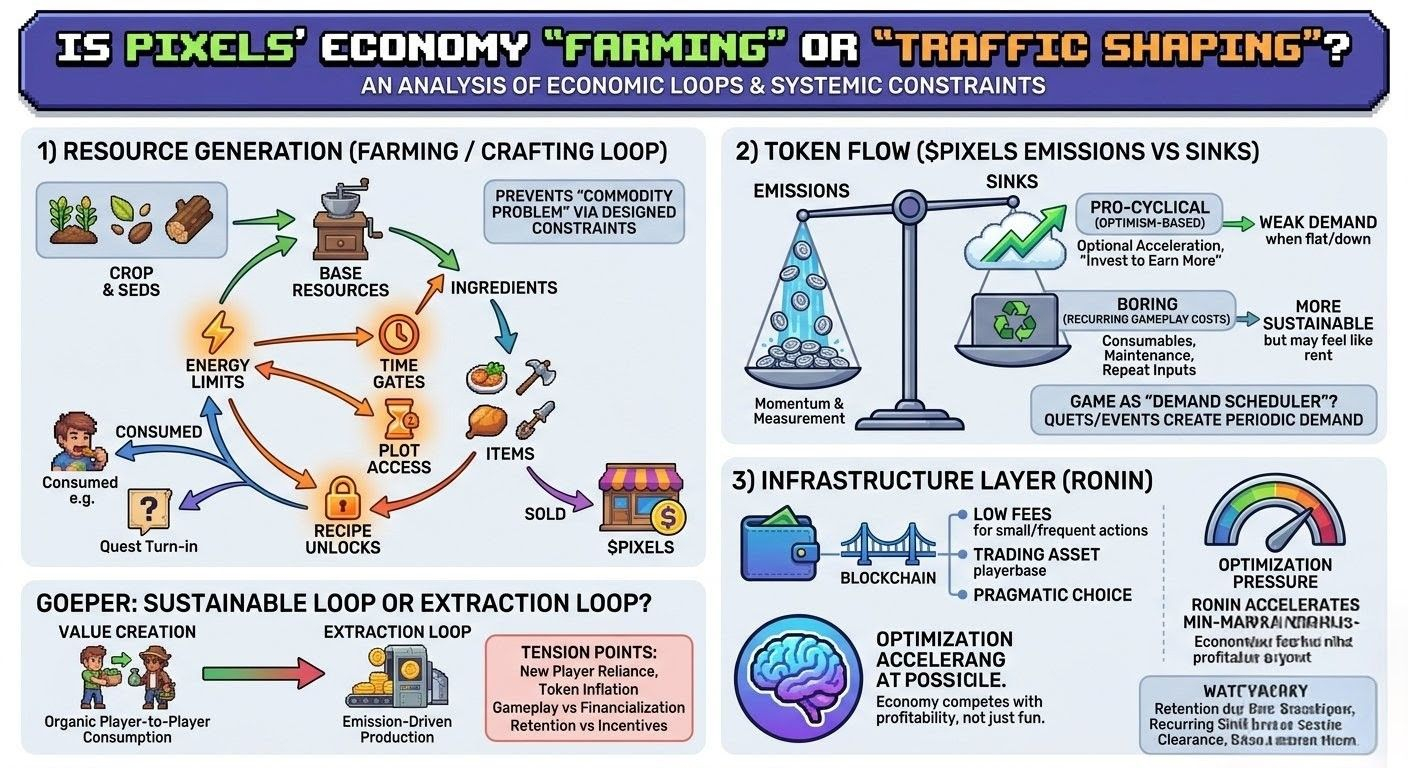
most people treat pixels as this straightforward thing: cute pixel farm, do quests, earn $pixels, maybe flip some items. and sure, you can play it that way. but what stands out once you follow the loops is how much of the design is basically about controlling congestion. like: who’s allowed to produce, how fast they can produce, and what they’re incentivized to do with the output.
1) resource generation (farming / gathering / crafting)
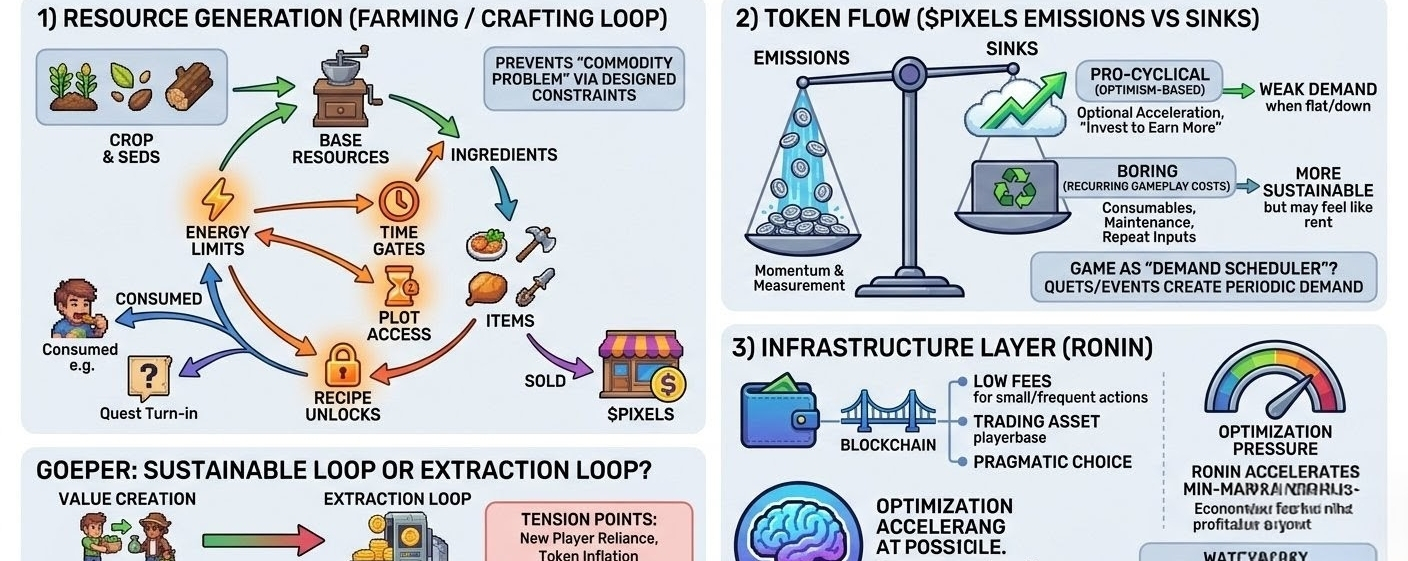
the core loop is clean: you generate base resources, you convert them into ingredients, you craft items, then you either consume them for progression or sell them. the “conversion” part is where the economy actually lives. a simple example: i grow a crop → turn it into an ingredient → craft a food item → sell it because other players need it for quest turn-ins or to keep their own crafting chain moving. it feels like a normal supply chain, but the constraints are the real game: energy limits, time gates, recipe unlocks, tool tiers, maybe land/plot access. honestly, it reads like the team is trying to prevent the commodity problem (everyone spams the same profitable recipe, everything goes to zero) without making the gates feel too obviously punitive.
2) token flow ($pixels emissions vs sinks)
this is the part i’m still trying to get comfortable with. emissions give the system momentum and make “doing stuff” feel measurable, but emissions always create the same question: what forces tokens back out? if $pixels mostly leaves via player selling, you need sinks that scale with participation, not just one-off purchases.
and here’s the part i’m thinking about: sinks that depend on player optimism are weak. if spending $pixels is mainly for optional acceleration or “invest to earn more,” then sink demand is basically pro-cyclical. when people are excited, they reinvest and the sink looks great. when the token is flat or down, people stop spending and just extract. the more sustainable sinks are the boring ones: recurring costs tied to real gameplay needs (consumables, maintenance-like mechanics, repeat crafting inputs). but those can also make the game feel like it’s charging rent, which hurts retention. so pixels is stuck balancing “economic drain” with “don’t make it miserable.”
i also keep wondering how much value is actually player-to-player versus system-to-player. if demand for items is mostly created by rotating quests/events, the game is kind of acting as a demand scheduler. that can keep markets alive, but it’s not the same as organic consumption.
3) infrastructure layer (ronin)
ronin seems like a pragmatic choice: low fees, decent wallet experience, and a playerbase that already understands trading game assets. pixels needs cheap settlement because the economy is made of small, frequent actions (listing items, buying ingredients, moving assets), not occasional big trades. if every action had meaningful fees, the whole market layer would freeze up.
but ronin also changes the player behavior profile. the ecosystem has a lot of people who will optimize quickly. any mismatch between emissions, crafting profitability, and market prices gets found fast. so the economy isn’t just competing with “is the game fun,” it’s competing with “can the loop survive being min-maxed at scale.”
going deeper: sustainable loop or extraction loop?
i’m still undecided. if players are mainly producing goods that get consumed repeatedly (not just hoarded), that’s actual value creation inside the world. if players are mainly producing because emissions make it worth it, then it’s closer to extraction with extra steps. what depends on continuous user growth is liquidity and absorption: new players buying starter goods, clearing low-tier inventory, keeping the market from feeling dead. if growth slows, you find out whether sinks and consumption are real or just masked by onboarding waves.
tension points i can’t ignore
- reliance on new players to keep demand ahead of supply
- token inflation pressure vs sink “stickiness”
- gameplay vs financialization (when does optimization become the main activity?)
- retention vs incentives (do people stay when rewards normalize?)
watching:
- player retention during boring weeks (no major events, token flat)
- sink usage rates: are people actually spending $pixels in recurring ways?
- marketplace clearance for everyday crafted goods (not just rare/collectible assets)
- frequency of emission/gating adjustments (balancing, or patching leaks?)
i don’t have a clean conclusion. pixels might be a genuinely durable little economy, or it might be a very well-paced loop that needs constant motion. if $pixels stayed flat for months and user growth stalled, would people still be buying each other’s output for real utility—or would the market just thin out?