


I noticed it after a routine check on my crafting queue—items were being produced on time, no delays, no system errors. But when I mapped output against progression, something didn’t add up. The volume was there, yet the impact on long-term growth was inconsistent. Some cycles pushed me forward, others just kept me busy.
That’s where Pixels starts to reveal its structure.
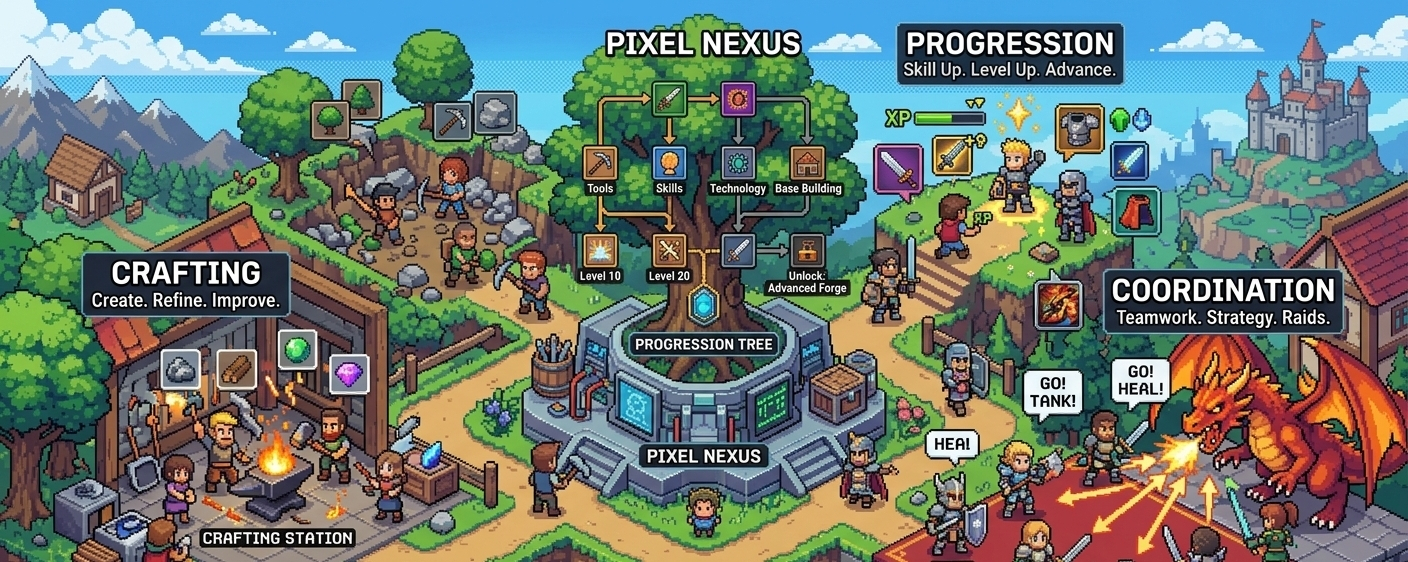
Crafting in Pixels isn’t just a feature—it’s a conversion layer. Raw resources from farming and exploration don’t hold much value on their own. They only become meaningful when processed into items that either improve efficiency or feed into deeper production chains. The system is built so that crafting decisions directly influence progression speed. If you’re producing without aligning it to upgrades or higher-tier outputs, you’re effectively stalling, even while staying active.
This ties directly into how progression works. On paper, it looks linear—complete tasks, gain rewards, unlock new capabilities. In practice, it’s more conditional. Progress depends on how well players connect different systems: farming feeds crafting, crafting feeds upgrades, and upgrades improve future output. When these loops are aligned, growth compounds. When they’re not, progression becomes flat despite high activity.
The multiplayer layer adds another dimension. Collaboration isn’t enforced, but it emerges naturally around efficiency. Players share spaces, exchange resources, and indirectly coordinate production. It’s not formal governance, but it behaves like one. Groups that organize well tend to stabilize their own micro-economies, while isolated players rely more on external markets and fluctuate more.
From an infrastructure standpoint, this coordination is supported by a mix of on-chain and off-chain systems. Ownership of assets and token balances are verifiable, but most gameplay interactions are handled $PIXEL off-chain for speed. This split allows Pixels to maintain responsiveness while still anchoring value in verifiable records. PIXEL tokens move through this system as both reward and constraint—they incentivize activity but also act as a limiting factor when tied to upgrades, crafting costs, or access to certain actions.
Trust in this environment isn’t just about security—it’s about consistency. Players need to believe that effort translates into predictable outcomes. If crafting outputs feel disconnected from progression #pixel or if rewards don’t align with input, confidence weakens. The system doesn’t break immediately, but behavior starts to shift toward short-term extraction.
There are clear risks here. Crafting systems can become saturated if too many players produce similar outputs without sufficient sinks. Progression gaps can widen if optimized players compound faster than others. And multiplayer coordination, while beneficial, can create uneven advantages where organized groups dominate resource flows.
What matters most, from an operator’s perspective, are a few core metrics: how often crafted items are reinvested into progression, how long players stay engaged beyond initial loops, and how balanced the flow of tokens remains between earning and spending. High activity alone doesn’t mean stability. It’s the quality of that activity—whether it feeds back into the system—that determines health.
Looking at Pixels this way, it feels less like a game economy and more like a set of interdependent systems trying to stay in balance. Crafting, progression, and @Pixels coordination aren’t separate features—they’re pressure points. And the system holds together only as long as those pressures remain aligned.