
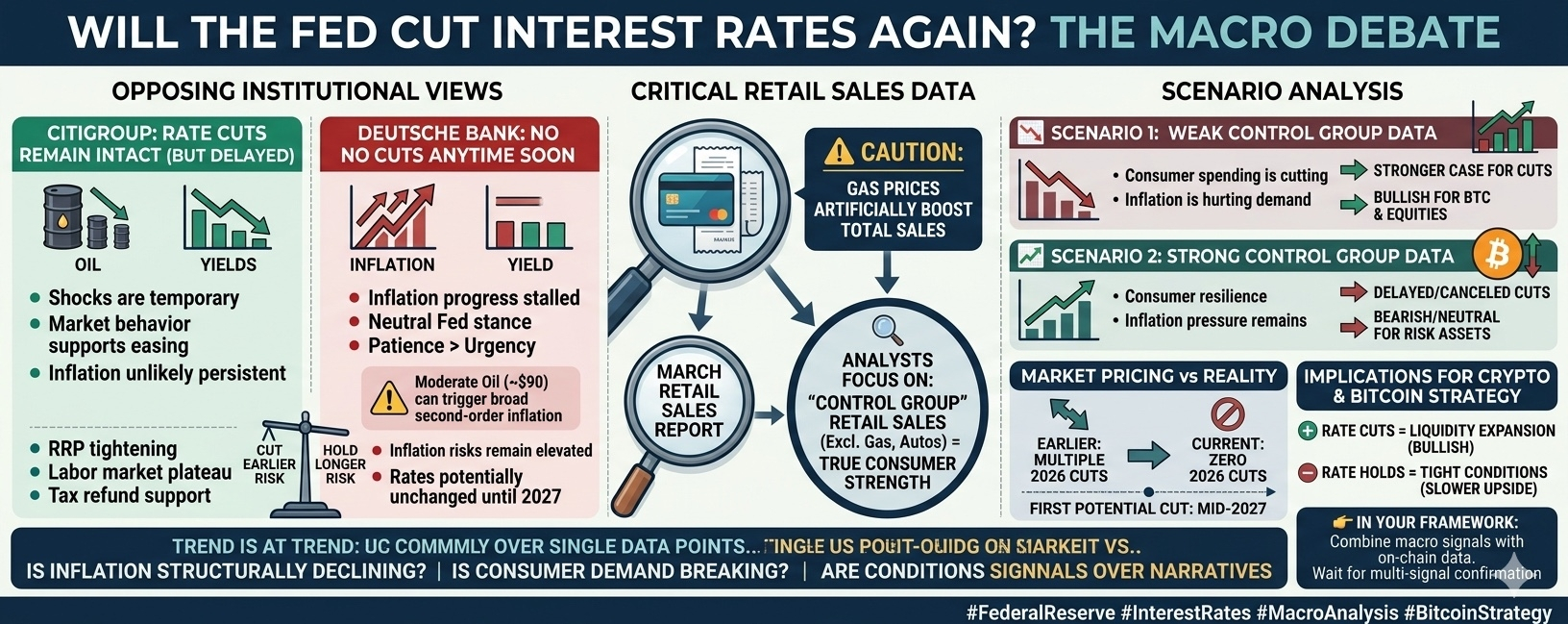
Why Tonight’s Data Could Decide the Next Market Move
1. The Core Debate: Inflation vs. Growth Pressure
The current macro battle shaping markets revolves around one key question:
Will inflation stay high due to energy shocks, or will it weaken demand enough to force rate cuts?
The Federal Reserve is navigating a complex environment where:
Geopolitical tensions are pushing oil prices higher
Consumer demand may be weakening under inflation pressure
Financial conditions are tightening despite stable policy rates
👉 This creates a policy dilemma:
Cut rates too early → risk reigniting inflation
Hold rates too long → risk economic slowdown
2. Two Opposing Institutional Views
🟢 Citigroup: Rate Cuts Are Still Coming
Citigroup maintains a bullish case for rate cuts, based on the belief that current disruptions are temporary.
Key Arguments:
Oil supply shocks (e.g., Strait of Hormuz tensions) are short-lived
Market behavior (falling yields, stabilizing oil) supports this view
Inflation pressure is unlikely to become structurally persistent
Supporting Signals:
Liquidity tightening (RRP near zero, rising mortgage rates)
Labor market showing early signs of plateau
Tax refund flows providing short-term consumer support
👉 Conclusion:
The path to rate cuts remains intact—just delayed, not canceled.
🔴 Deutsche Bank: No Cuts Anytime Soon
Deutsche Bank presents a much more cautious (hawkish) outlook.
Key Arguments:
Inflation progress has stalled
The Fed is already at a “neutral” policy stance
Officials increasingly signal patience, not urgency
Key Insight:
Even moderate oil prices (~$90) could trigger second-order inflation effects, spreading into broader goods and services.
Policy Signals from Fed Officials:
Some warn inflation risks remain elevated
Others suggest rates may stay unchanged for a long period
A few even acknowledge the possibility of no cuts until 2027
👉 Conclusion:
The Fed may hold rates steady far longer than markets previously expected.
3. Why Tonight’s Retail Sales Data Matters
The upcoming March Retail Sales report is not just another data release—it’s a policy signal trigger.
⚠️ Headline vs. Reality
Rising gasoline prices → artificially boost total retail sales
This can mislead investors into thinking demand is strong
👉 That’s why analysts focus on:
🔍 “Control Group” Retail Sales
(Excludes gas, autos, and volatile components)
This metric shows true consumer strength.
4. Scenario Analysis: What the Data Could Signal
📉 Scenario 1: Weak Control Group Data
Indicates consumers are cutting spending
Confirms inflation is hurting demand
👉 Market Reaction:
Stronger case for rate cuts
Bullish for risk assets (BTC, equities)
📈 Scenario 2: Strong Control Group Data
Shows resilience in consumer demand
Suggests inflation pressure remains
👉 Market Reaction:
Delayed or canceled rate cuts
Bearish/neutral for risk assets
5. Market Pricing vs. Reality
Interestingly, market expectations have shifted dramatically:
Earlier outlook → Multiple rate cuts in 2026
Current pricing → Zero cuts expected in 2026
First potential cut → Mid-2027
👉 This reflects a broader shift toward a “higher-for-longer” interest rate regime.
6. What This Means for Crypto & Bitcoin Strategy
For assets like Bitcoin, macro liquidity remains the dominant driver.
🔑 Key Takeaways:
Rate cuts = liquidity expansion → bullish for crypto
Rate holds = tight conditions → slower upside
Rate hikes (unlikely but possible) → bearish pressure
👉 In your trading framework:
Combine macro signals with on-chain indicators
Avoid overreacting to single data points
Wait for multi-signal confirmation (like your BTC strategy system)
7. Final Insight: This Isn’t Just About One Data Release
Tonight’s data is important—but it’s not decisive on its own.
The Fed’s decision path depends on trend confirmation, not one report.
👉 The real game is:
Is inflation structurally declining?
Is consumer demand breaking down?
Are financial conditions tightening enough?
Only when these align will policy shift.
Conclusion
The clash between rate-cut optimism and “higher-for-longer” reality reflects a market still searching for direction.
Citigroup sees temporary disruption → eventual easing
Deutsche Bank sees persistent inflation → prolonged pause
The truth likely lies in data-dependent evolution.
👉 For traders and investors:
Focus less on predictions and more on interpreting signals in context.
Because in today’s market, macro direction—not narratives—drives outcomes.