
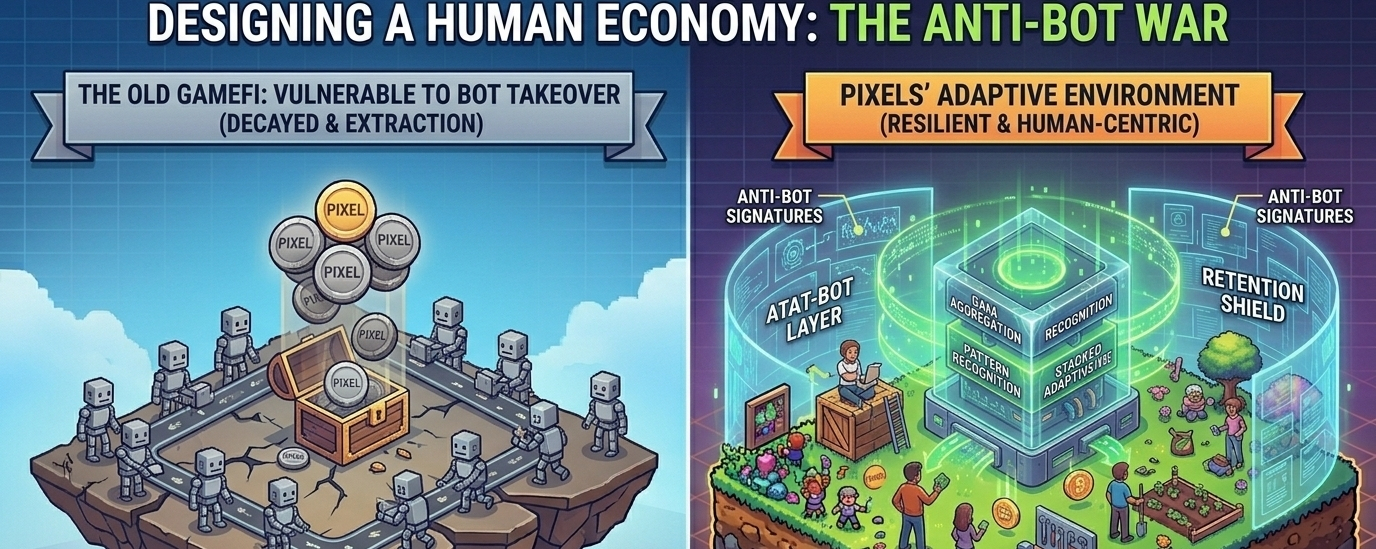


One of the biggest issues I’ve seen in Web3 gaming isn’t always obvious at first. You join a new game, rewards look good, activity is high, and everything feels alive. But after some time, something starts to feel off. Progress slows down, rewards feel weaker, and the experience becomes less engaging.
In many cases, that shift has less to do with real players and more to do with bots.
I’ve been in games where automation quietly takes over. Systems that are easy to farm attract scripts and optimized loops that run constantly. At that point, it’s no longer a fair environment. Bots don’t get tired, don’t make mistakes, and don’t play for enjoyment. They extract value as efficiently as possible.
And once that happens, the balance breaks.
Rewards that were meant for active players get diluted. The economy starts feeling strained. Real players notice it first not always directly, but through weaker returns and less meaningful progress. Eventually, many of them leave, because the system no longer feels worth the effort.
The problem is that most GameFi systems aren’t built to handle this.
Fixed reward structures are easy to exploit. Once someone finds the most efficient path, it can be automated and repeated at scale. By the time developers react, the damage is already done.
That’s where something like PIXELS feels like it’s taking a different approach.
From what I’ve experienced, the system doesn’t feel completely predictable. It’s harder to lock into one strategy and repeat it endlessly without change. With Stacked acting as a dynamic layer, it seems like rewards and activity are being adjusted based on what’s actually happening inside the game.
I can’t see the exact mechanisms, but it feels like the system is responding rather than staying static.
That alone creates some resistance to pure automation.
When things aren’t completely predictable, it’s harder to just run the same loop again and again. That’s usually what bots rely on consistency. If that breaks, even a little, they’re not as effective. And for normal players, it feels more fair because you’re not constantly competing with something that’s running 24/7.
I’ve noticed that this also changes how the whole economy feels. When everything isn’t being farmed at maximum efficiency all the time, rewards don’t drain as fast. It feels a bit more balanced, and your time in the game actually holds its value longer.
When rewards are better aligned with real engagement instead of pure repetition, value doesn’t drain as quickly. Players who are actually participating not just extracting become more central to how the system works.
And that changes the foundation.
It shifts the focus from volume to behavior. From how much is being farmed to how the game is actually being played.
Of course, no system can eliminate bots completely. That’s unrealistic. But reducing their impact and making them less dominant can already make a big difference.
From what I’ve seen so far, @Pixels doesn’t feel like it’s trying to win the anti-bot war with strict barriers alone. It feels like it’s designing an environment where automation is less effective to begin with.
And if that balance holds, it could lead to something most Web3 games struggle to achieve an economy where real players actually matter more than automated ones.
