
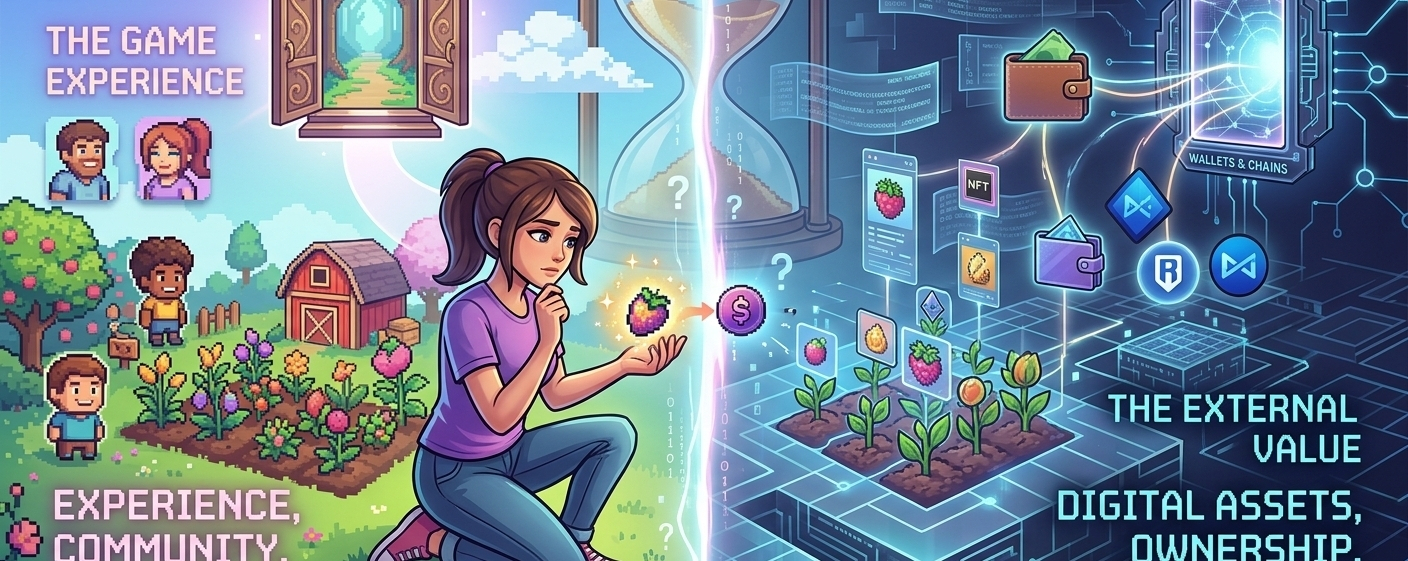
I sometimes wonder if we’ve made games more complicated without really making them more meaningful. Not in terms of graphics or design, but in the way we think about ownership. Pixels.xyz sits right in that uncomfortable middle, where playing a game and owning something inside it are starting to overlap, but not always in a way that feels fully settled.
Before systems like this existed, games were simple in a very specific way. I could log in, build something over time, collect items, level up, and feel attached to my progress. But everything I did belonged entirely to the game’s world. If the servers shut down or the company changed direction, there was nothing I could take with me. The effort was real, but it lived and died inside a closed space.
For a long time, I didn’t question that structure much. It was just normal. But over the years, especially as games became more social and time-consuming, that idea started to feel slightly incomplete. I was investing a lot of attention into worlds I didn’t actually control. When blockchain games started appearing, they tried to solve that gap by introducing ownership through tokens and NFTs. But early versions often felt like they were more about financial systems than actual gameplay. Something about the experience started to feel heavier, less playful.
Pixels.xyz takes a different approach. It doesn’t try to reinvent what a game looks like. At its core, it still feels like a familiar browser-based farming and social game. I can gather resources, upgrade tools, complete tasks, and interact with others in shared spaces. If I ignore the technical layer underneath, it doesn’t immediately feel like a “crypto game” in the way early experiments did.
But the difference is sitting quietly underneath everything. Some parts of what I do in Pixels are recorded on-chain, meaning they can exist outside the game’s internal system. Other parts remain fully inside the game environment. This creates a kind of split reality where not everything I earn or build carries the same weight outside the world I’m playing in.
That hybrid structure seems intentional. It keeps the gameplay smooth and familiar while slowly introducing the idea of external ownership. I don’t have to think about blockchain mechanics every second I’m playing, which honestly helps the experience feel less intimidating. But at the same time, it also means the boundaries of what is “mine” are not always immediately clear.
Economically, the game is built around repetition and gradual progress. I do tasks, collect materials, and slowly improve my position. Some of these actions connect to systems that have value beyond the game, but not everything is tied to that layer. And this is where things become a bit tricky for me to fully define. If only part of my progress exists outside the game, then what exactly am I building toward?
There’s also a difference in how people experience the same world. Some players stay entirely within the gameplay loop, treating it like any other social or farming game. Others engage more deeply with the external systems, thinking about assets and long-term value. Even though we share the same environment, the way we relate to it can feel very different.
I also notice that accessibility is still not as simple as it first appears. The game is easy to start, but the deeper you go, the more you encounter wallets, tokens, and external systems that not everyone is equally comfortable with. That naturally creates a kind of invisible divide between casual play and more engaged participation.
What stands out to me most is that Pixels doesn’t really claim to have solved anything. It feels more like an ongoing experiment, trying to hold two ideas at the same time: games as places for experience, and games as systems where parts of that experience can persist beyond the platform. Those two ideas don’t always align neatly, and the tension between them is still visible.
I don’t think the project fully resolves that tension, and maybe it doesn’t need to. Instead, it shows what happens when you try to stretch traditional game design into something that also carries ownership outside itself. The result is interesting, but also unfinished in a way that still leaves questions open.
And maybe that’s the part I keep thinking about most: if a game lets me take pieces of it with me outside its world, does that actually deepen what I feel while playing, or does it quietly change what it means to play at all?
