
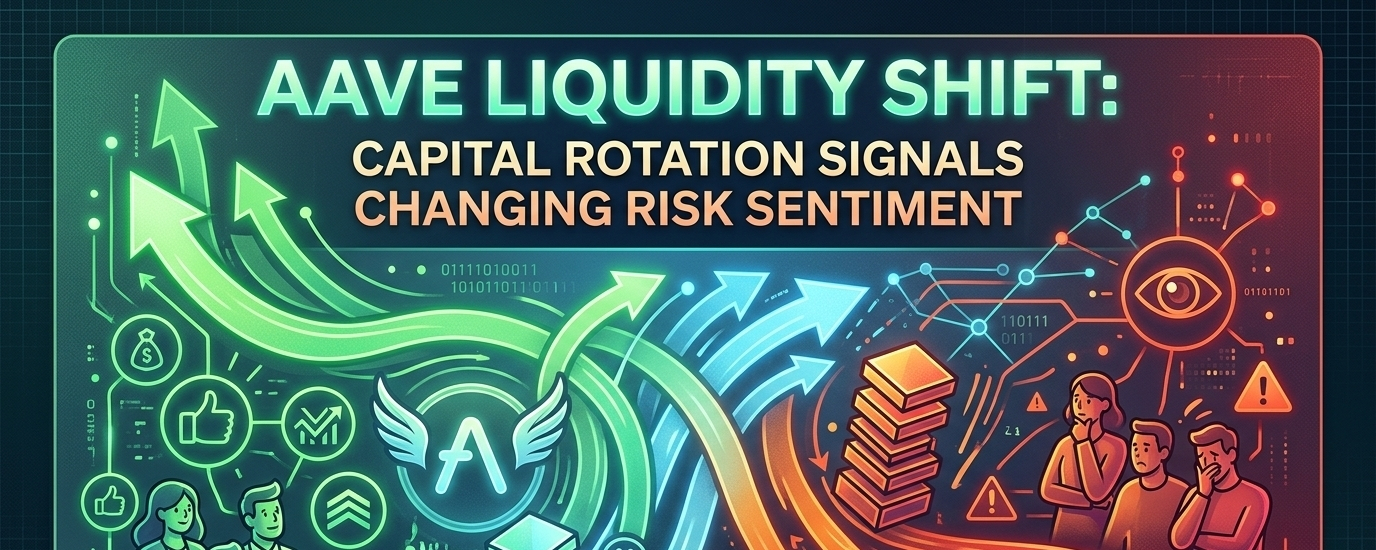
The decentralized finance (DeFi) landscape is rarely quiet, but every so often, the ground shifts beneath our feet in a way that demands attention. If you’ve been watching the charts lately, you’ve likely noticed the turbulence surrounding Aave. With billions in liquidity flowing out in a matter of days following the recent KelpDAO-related exploits, it’s natural to feel a bit of whiplash.
But if we look past the immediate panic, we can see something much more instructive happening. What we are witnessing isn’t just a "hack" or a "liquidity crisis"—it is a masterclass in how market participants rotate capital when their risk appetite shifts.
The Signal in the Noise
For a long time, DeFi has operated on the assumption of “trustless liquidity.” Protocols like Aave act as the bedrock, holding massive amounts of capital that make the rest of the ecosystem tick. When we see a rapid $8B+ outflow from a platform like Aave, it’s not just users losing faith in one protocol; it’s a broader signal that the market is switching from "yield-seeking mode" to "capital preservation mode."
Think of it like this: when the market feels bullish and secure, capital sits in lending pools, earning yield and fueling leverage. When that sentiment cracks due to exploits, macro uncertainty, or regulatory whispers capital doesn't just evaporate. It moves. It rotates toward the exits or toward assets perceived as "safer," often leaving the most aggressive leverage protocols first.
Why Aave is the "Canary in the Coal Mine"
Because Aave is a "blue-chip" protocol, its liquidity profile acts as a barometer for the entire DeFi sector. The recent spike in vault utilization—hitting 100% in some markets—is the technical way of saying the room got very crowded, very fast.
The Rotation: We are seeing capital flow out of leveraged positions (where users borrow against assets like rsETH) and toward liquid, stable assets.
The Sentiment Shift: The current environment is forcing a repricing of risk. Participants are no longer asking, "What is the highest yield I can get?" They are asking, "Is my collateral safe if the protocol hits a snag?"
The "Smart Money" Counter-Narrative
Interestingly, while retail participants often react to these liquidity shifts with immediate, emotional exits, we are seeing signs that "smart money" is viewing this differently. Reports of whale accumulation during this price dip suggest that experienced players don't see this as the end of the line for Aave. Instead, they see it as a necessary, albeit painful, deleveraging event.
History shows us that these periods of capitulation often precede structural resets. Aave has survived previous market cycles, and while $196 million in potential bad debt is a serious hurdle, the protocol’s resilience—maintaining functionality even under massive outflow pressure—is exactly what institutional investors look for when assessing long-term durability.
What to Watch Next
As we move forward, the key isn't to guess the next price move of the AAVE token, but to monitor the "Flow Back." If we see liquidity starting to return to the core lending markets and the utilization rates begin to normalize, it will be the clearest indicator that the market has processed the risk and is ready to enter the next phase of the cycle.
Until then, the lesson is clear: in DeFi, liquidity is the ultimate truth-teller. It doesn't care about narratives; it only cares about risk. And right now, the market is telling us it prefers to sit on the sidelines until the dust settles.
#StrategyBTCPurchase #MarketRebound #JointEscapeHatchforAaveETHLenders #RAVEWildMoves #altcoins $AAVE $XRP
