
I didn’t notice Pixels because of hype. In fact, what pulled me toward it was the absence of it. In a space where most projects compete for attention, Pixels felt unusually calm almost like it wasn’t trying to convince anyone of anything. And over time, I’ve started to realize that this silence is not weakness. It’s structure.
When I look at Pixels today, I don’t just see a Web3 game. I see a system that is trying to solve something deeper how to turn digital participation into something that holds value without constantly relying on speculation.
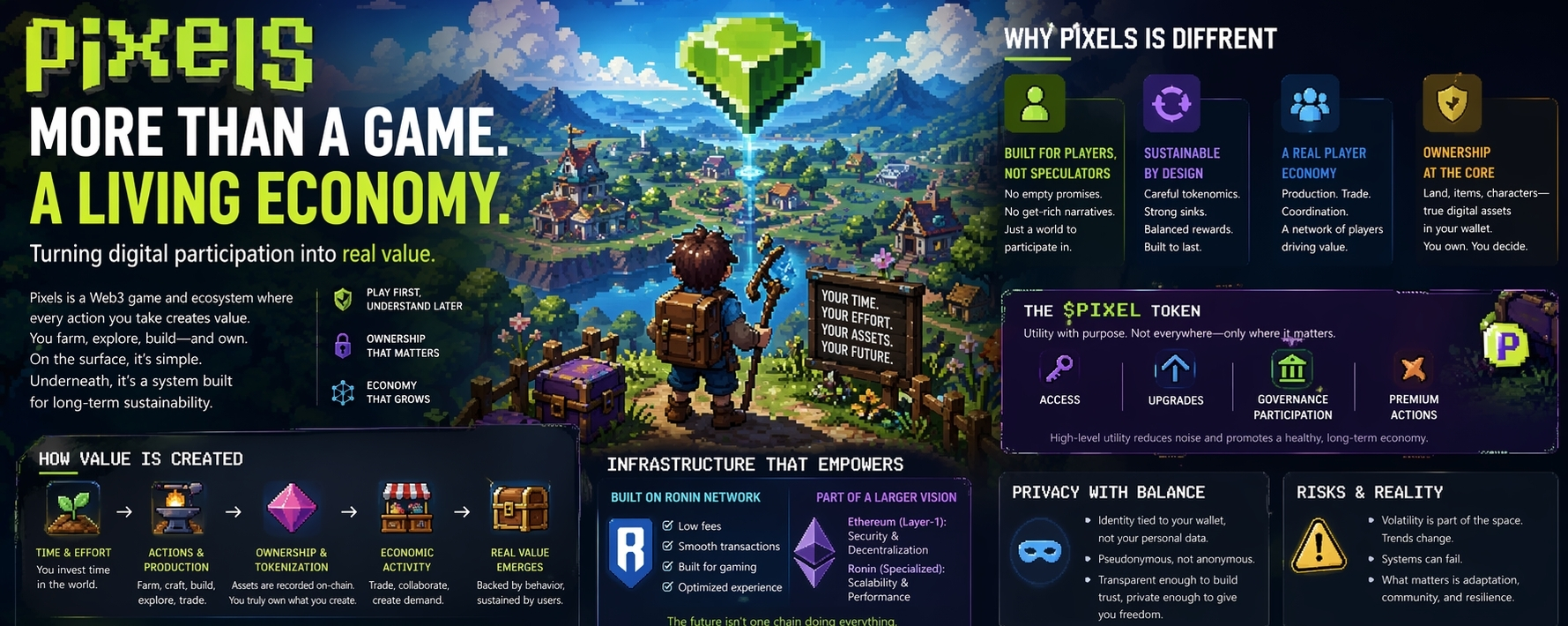
At the surface, Pixels is simple. I farm, I explore, I build. It feels familiar, almost like the kind of casual games people used to play without thinking about tokens or blockchain. But that simplicity is layered. Underneath, every action connects to an economic loop that is recorded, owned, and transferable. That’s where it stops being a game and starts becoming something closer to an ecosystem.
The Web3 aspect here is not forced. I don’t feel like I’m interacting with blockchain every second. Instead, it sits quietly in the background, doing what it’s supposed to do keeping track of ownership. That’s important, because one of the biggest problems I’ve seen in Web3 gaming is overexposure to complexity. Pixels avoids that. It lets me play first, and understand later.
Ownership is where everything changes.
In traditional games, no matter how much time I invest, nothing truly belongs to me. Progress is locked, items are controlled by developers, and everything can disappear if the system changes. In Pixels, that dynamic shifts. Land, items, characters—these are not just in-game objects; they exist as digital assets tied to my wallet. I can trade them, hold them, or use them as part of a larger strategy.
That’s where tokenization starts to make sense to me. It’s not about turning everything into a tradable asset just for the sake of it. It’s about giving weight to time. If I spend hours building something, that effort is no longer isolated it becomes part of an economy.
The $PIXEL token plays an interesting role in all this. I’ve noticed that it’s not pushed aggressively into every action. Instead of being the main currency for everything, it sits at a higher level. It’s used for decisions that matter access, upgrades, governance-like participation, and certain premium actions. That separation feels intentional. It reduces noise.
I’ve seen many GameFi projects fail because they mix everything into one token. Farming rewards, trading, governance—it all gets tangled, and eventually inflation breaks the system. Pixels seems aware of that history. It doesn’t rush distribution. It builds sinks. It creates reasons to spend, not just earn.
And that’s where I think the project shows maturity.
Because if I’m being honest, sustainability in Web3 gaming is rare. Most economies look strong in the beginning because rewards are high. But over time, when new users slow down, the system starts collapsing under its own emissions. Pixels, on the other hand, feels like it’s trying to slow that entire process down.
I can see that in how the economy is evolving.
It’s no longer just about individual gameplay. There are layers forming where players depend on each other. Production chains, resource coordination, land utilization—it’s starting to resemble something closer to a real economy. I don’t just play alone; I become part of a network of activity.
This is where I begin to connect it with the idea of real-world value lnot in the traditional sense of physical assets, but in behavior. In Pixels, value is emerging from how people interact. Time, effort, coordination these become the backing layer. It’s subtle, but it’s powerful.
And it makes me think differently about what “real world assets” could mean in the future.
Maybe it’s not always about tokenizing real estate or commodities. Maybe it’s about recognizing that digital environments can produce their own forms of value if the system is designed correctly. Pixels feels like an early version of that idea.
The blockchain infrastructure behind it also matters more than people realize.
Running on Ronin Network gives it a different kind of advantage. I don’t deal with high fees every time I make a move. Transactions feel smooth. That might sound like a small thing, but in a game where interactions are constant, friction can destroy the experience. Ronin reduces that friction.
At the same time, I see how this connects to the broader Layer-1 and Layer-2 discussion.
Ethereum, as a Layer-1, provides security and decentralization, but it struggles with scalability. Ronin, acting more like a specialized environment, optimizes for a specific use case gaming. This is where I think the future is heading. Not one chain doing everything, but multiple layers and networks focusing on what they do best.
Pixels benefits from that specialization.
It doesn’t try to solve blockchain problems itself. It builds on top of an infrastructure that is already optimized. That allows the team to focus on what actually matters the economy, the experience, and the long-term behavior of users.
Privacy is another interesting angle when I think about it.
In Pixels, I don’t need to share personal information to participate. My identity is tied to my wallet, not my real-world data. That creates a form of pseudonymity. It’s not complete privacy, because transactions are still visible on-chain, but it’s a shift away from traditional systems where data is constantly collected and monetized.
I find that balance important.
Too much transparency can feel invasive, but too much privacy can break trust. Pixels sits somewhere in the middle. It gives enough openness for the system to function, while still allowing users to remain flexible in how they present themselves.
From a market perspective, I stay cautious.
I’ve seen the price of $PIXEL move, rise, fall, and react to sentiment like most tokens do. That volatility doesn’t surprise me anymore. It’s part of the space. But I’ve also learned not to judge projects only by their price charts.
Because price reflects attention.
Behavior reflects reality.
And when I look at Pixels through that lens, I see something more stable than its chart suggests. I see users staying, interacting, and slowly building something. That doesn’t create instant spikes, but it creates foundations.
Still, I don’t ignore the risks.
GameFi is one of the most unpredictable sectors in crypto. Trends shift quickly. User interest can disappear overnight. Even strong systems can struggle if they fail to adapt. Pixels is not immune to that.
What matters is whether it can continue evolving.
So far, I think it’s trying to do that. I see changes in how the economy is structured, how rewards are balanced, how social systems are integrated. It doesn’t feel static. And in this space, being dynamic is survival.
What keeps me interested is not what Pixels promises, but what it avoids promising.
It doesn’t tell me I’ll get rich.
It doesn’t rush me to invest.
It doesn’t create urgency where there is none.
Instead, it gives me a space where I can participate, observe, and decide for myself.
That approach feels rare.
Because most of Web3 still operates on speed fast launches, fast gains, fast exits. Pixels feels like it’s moving in the opposite direction. It’s slower, more deliberate, more focused on building something that can last.
And that brings me to where I stand with it.
I don’t see Pixels as a perfect system. It still has challenges. It still depends on user growth, economic balance, and continuous development. But I also don’t see it as just another GameFi project.
I see it as an experiment.
An experiment in whether digital worlds can hold value without constant hype.
An experiment in whether users will stay if they are not being aggressively incentivized.
An experiment in whether time, when structured correctly, can become a form of capital.
If it succeeds, it won’t just be because of technology. It will be because of behavior.
And if it fails, it will likely fail quietly just like it started.
But either way, I think it represents something important.
