
I Will Be Honest.👍
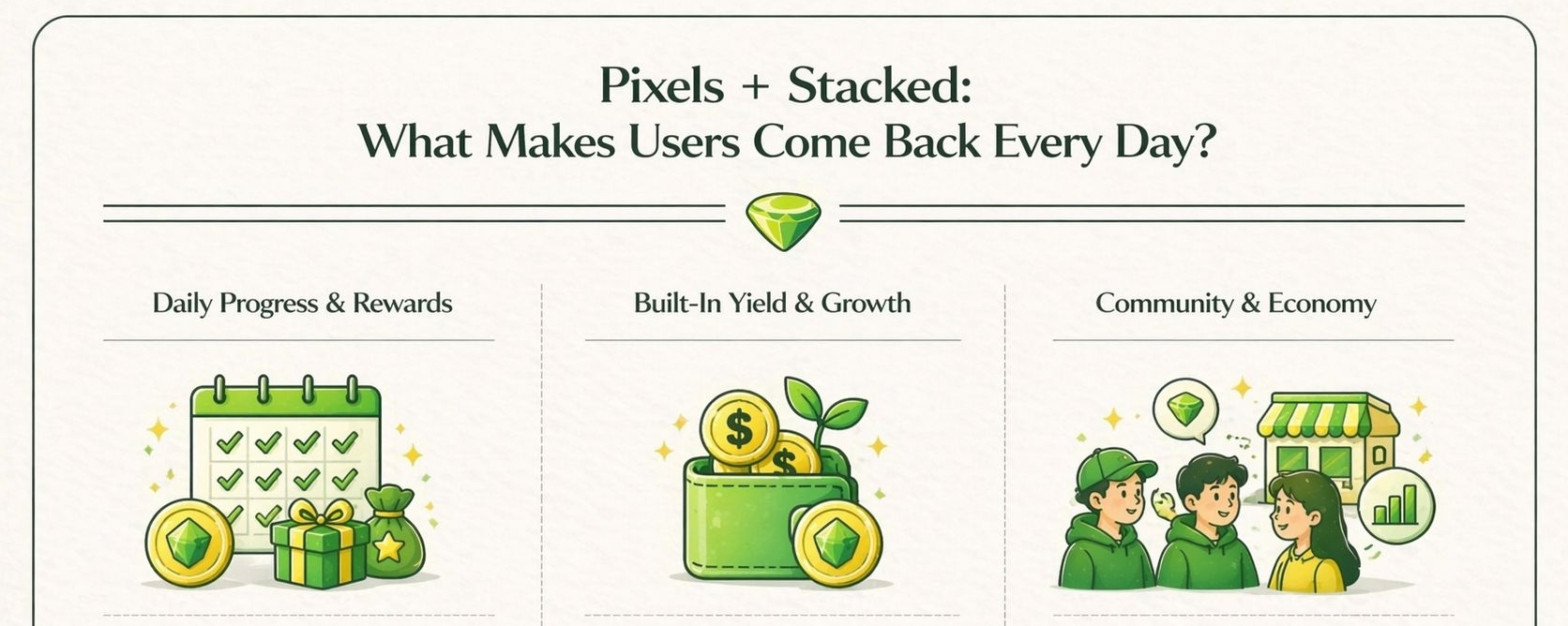
Lately, while revisiting the Pixels roadmap and watching how the community discusses Stacked, one question keeps standing out to me: what actually makes users return every single day?
From my perspective, it’s rarely about huge rewards or flashy new features that create short-term excitement.
What truly drives daily retention is much simpler, but much harder to design: the feeling that logging back in today still matters.
With Pixels + Stacked, I believe the strongest retention factor is not one specific reward, but the sense that progress never really stops.
Pixels already has a major advantage here because the gameplay is light and easy to return to. It doesn’t demand long sessions or high pressure. Even short visits—doing a few familiar tasks—still create visible progress.
That matters a lot.
In any product built around daily retention, low friction is essential. The easier it is to return, the easier habits begin to form.
But easy gameplay alone isn’t enough.
Many games can attract users for a few days, but then the routine starts to feel repetitive. Players stop seeing a meaningful difference between logging in today and logging in yesterday.
Things repeat, but nothing feels like it is building toward something bigger.
This is where Stacked becomes important.
It doesn’t directly create the habit like gameplay does, but it adds something deeper: the feeling that returning isn’t just about continuing to play—it’s about staying connected to a stream of value that keeps accumulating over time.
That changes everything.
Traditional games often rely on content to keep users engaged.
Pixels + Stacked creates retention through economic continuity.
A lot of people describe rewards as the main reason users stay, but rewards alone usually work only in the short term.
Long-term retention comes from the relationship between small daily actions and the feeling that those actions remain useful.
People don’t necessarily return because today’s reward is huge.
They return because skipping today feels like breaking a progression chain.
For me, Stacked makes that much clearer.
It shifts value away from isolated rewards and turns it into a connected loop where today’s actions directly support tomorrow’s outcomes.
That kind of structure is much easier to turn into a lasting habit.
Another thing I find interesting is how Pixels + Stacked makes daily return feel like a rational decision, not just an automatic reflex.
Users aren’t only coming back because they fear missing rewards.
They return because the time spent today still feels like a worthwhile investment.
It starts to resemble how people think about allocating time or capital.
And that gives the ecosystem more depth.
When players see returning as a valuable choice instead of just routine behavior, retention becomes far more sustainable.
I’ve noticed many older Web3 systems try to retain users by constantly increasing daily rewards.
That works early on, but it becomes difficult to maintain.
Once users adapt to high rewards, the project has to keep raising expectations, and eventually retention becomes expensive rather than meaningful.
Pixels + Stacked seems to be moving in a different direction.
Instead of making rewards bigger, it makes the reason to return stronger.
A strong loop doesn’t need endlessly increasing incentives.
It needs users to feel like every return adds another brick to something being built.
That could be an asset.
That could be their position in the system.
That could simply be long-term accumulated value.
For me, that is what really drives daily return.
Not because today is exceptionally rewarding, but because today still belongs to a much longer journey.
I also think Stacked is effective because it makes today’s participation feel relevant to long-term value.
That’s a major difference from short reward loops.
When the system understands user behavior and rewards meaningful participation, people feel their presence matters.
Most users don’t think in terms like retention or LTV.
But they absolutely notice one thing: does this system make my time feel useful?
If the answer is yes, they stay.
If not, habits disappear quickly.
Another important point is that daily retention often depends less on “substitutability” and more on “ease of returning.”
Pixels succeeds because the gameplay makes returning easy.
Stacked succeeds because it makes returning feel worthwhile.
One side reduces friction.
The other creates purpose.
To me, that is the strongest combination in the entire model.
If something is easy but not meaningful, people get bored.
If it’s meaningful but too demanding, people leave.
But when it is both easy to return and valuable to continue, real daily rhythm begins to form.
I also don’t think retention comes from one specific reward point.
It comes from the feeling that your time inside the ecosystem doesn’t disappear into nothing.
You return today, and there is still something to do.
You finish, and there is still something worth holding onto.
And what you hold today still matters tomorrow.
When those layers connect, the product stops being just a game and starts becoming part of a user’s life rhythm.
If I had to summarize it in one sentence:
The reason users return to Pixels + Stacked every day is not the size of the reward, but the feeling that progress continues and value remains even after they log out.
For me, gameplay is what brings them back.
But Stacked is what makes coming back tomorrow still feel worth it.