
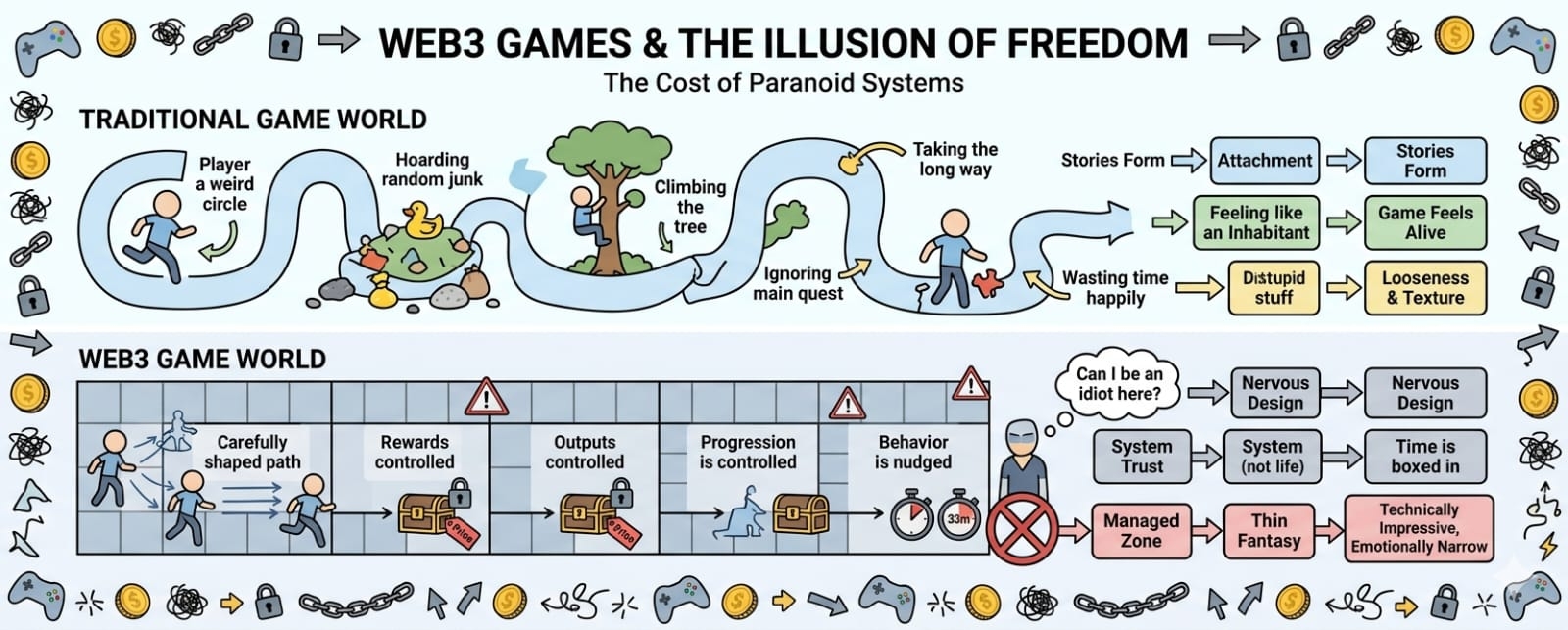
One of the best parts of games has always been the dumb stuff. Not the optimized stuff. Not the efficient stuff. The dumb stuff. Taking the long way for no reason. Hoarding junk you do not need. Running around a map because some corner feels weirdly interesting. Ignoring the “right” path because you got distracted by something pointless and suddenly an hour is gone. That kind of nonsense matters more than people think. It is not a side effect. It is part of the magic. It is how a game starts feeling like a place instead of a system.
Web3 games keep saying they want player freedom, but the second players start doing anything messy, weird, inefficient, or hard to measure, the design usually gets nervous.
That is the part that stands out to me more and more. These projects love the language of freedom. Player ownership. Open economies. User-driven worlds. Permissionless participation. Big words. Nice words. But then you get inside the actual game and everything feels carefully shaped to stop players from breaking the logic of the machine. Rewards are controlled. Outputs are controlled. progression is controlled. behavior is nudged. time is boxed in. The whole thing starts feeling like a freedom-themed hallway.
And yeah, some limits are normal. Every game has rules. Every world has structure. That is not the issue. The issue is whether the rules make the world feel alive or whether they make it feel paranoid. A lot of Web3 systems feel paranoid. Like they are always one bad player habit away from economic collapse. One exploitable loop away from panic. One burst of real player creativity away from the spreadsheets going ugly. So instead of building worlds that can absorb weird behavior, they build worlds that quietly try to prevent it.
That comes at a cost.
Because when players cannot do stupid things, they also usually cannot do memorable things.
The stupid stuff is where stories come from. It is where attachment forms. It is where players stop acting like users and start acting like inhabitants. A world becomes meaningful when it lets people misuse it a little. Not in a destructive way, necessarily. Just in a human way. In a way the designers did not fully script. That looseness is important. It gives the game texture. It gives players room to create their own rhythm instead of just following one.
Web3 games often talk like they understand that. Then they build systems that punish it.
You see it in how quickly these games pull everything back toward utility. Every item needs a purpose. Every action needs a reward logic. Every loop needs balance. Every path needs to make economic sense. The moment a player starts doing something just because it is funny or satisfying or weirdly personal, that behavior often ends up sitting outside the value structure. And if too much of the game sits outside the value structure, the model starts looking inefficient. So the design keeps steering people back. Back to the sanctioned loops. Back to the measurable outputs. Back to the kind of play that the economy can understand.
That is such a bad trade.
Because the economy may stay tidier, but the world gets smaller.
The strange thing is that traditional games learned this lesson years ago, even when they did not explain it out loud. People remember games for the things that spilled outside optimization. The accidental habits. The pointless rituals. The bizarre communities that formed around stuff no economist would ever prioritize. The game gives players some structure, then gets out of the way enough for life to happen inside it. That is what Web3 games still struggle with. They do not trust life. They trust systems. They trust incentives. They trust control.
And that control always leaks through.
You can feel when a game is nervous about you. Nervous that you might play the wrong way. Nervous that you might create an imbalance. Nervous that your freedom might turn into a problem somebody has to explain in an economy update later. That nervousness changes the vibe. It makes the world feel watched. Less like a playground, more like a managed zone where the boundaries are painted in invisible ink until you bump into them.
Then suddenly the whole fantasy gets thinner.
Because freedom in games is not really about being able to own an item on-chain. Not emotionally. Not in the way people actually experience it. Freedom is being able to waste your own time inside a world and still feel like that time mattered. Freedom is doing something useless and having it become meaningful because it was yours. Freedom is taking the game slightly off-purpose and discovering that it still has room for you. That is what people mean when they say a world feels alive, even if they never phrase it that way.
Web3 gaming keeps trying to define freedom in legal or financial terms. Ownership. Transferability. composability. asset rights. Fine. Maybe those things matter. But they are not the first kind of freedom players feel. The first kind is behavioral. Can I be weird here. Can I follow my own curiosity. Can I build habits that do not look optimal from the outside. Can I care about something stupid without the system trying to funnel me back into productive behavior.
A lot of Web3 games still fail that test.
They want players to feel empowered, but only in ways that preserve the economy. They want emergent behavior, but only if it stays inside healthy parameters. They want open worlds, but only if the openness does not create too much unpredictability. That is not freedom. That is supervised flexibility. Useful, maybe. Marketable, definitely. But still a long way from the kind of looseness that makes a game feel worth living in.
And I think that is one reason so many of these projects end up feeling technically impressive and emotionally narrow. The systems are there. The logic is there. The architecture is there. But the player never fully feels allowed to go off-script. Everything routes back to the machine too quickly. The game keeps reminding you that your presence is supposed to fit a model. Once you notice that, it is hard to unsee.
A really good game can survive players doing dumb things. More than that, it can be enriched by them. It can let wastefulness become style. Let inefficiency become identity. Let pointless behavior turn into culture. That is where a lot of the best game memories come from. Not from the clean path. From the unnecessary one.
So when Web3 games keep pitching freedom, I always end up asking the same thing. Not whether I own the asset. Not whether the token has utility. Something much simpler.
Can I be an idiot in this world for an hour and still feel like the world wants me there?
Because if the answer is no, then all that freedom talk starts sounding like branding again. And this space already has enough of that.
