
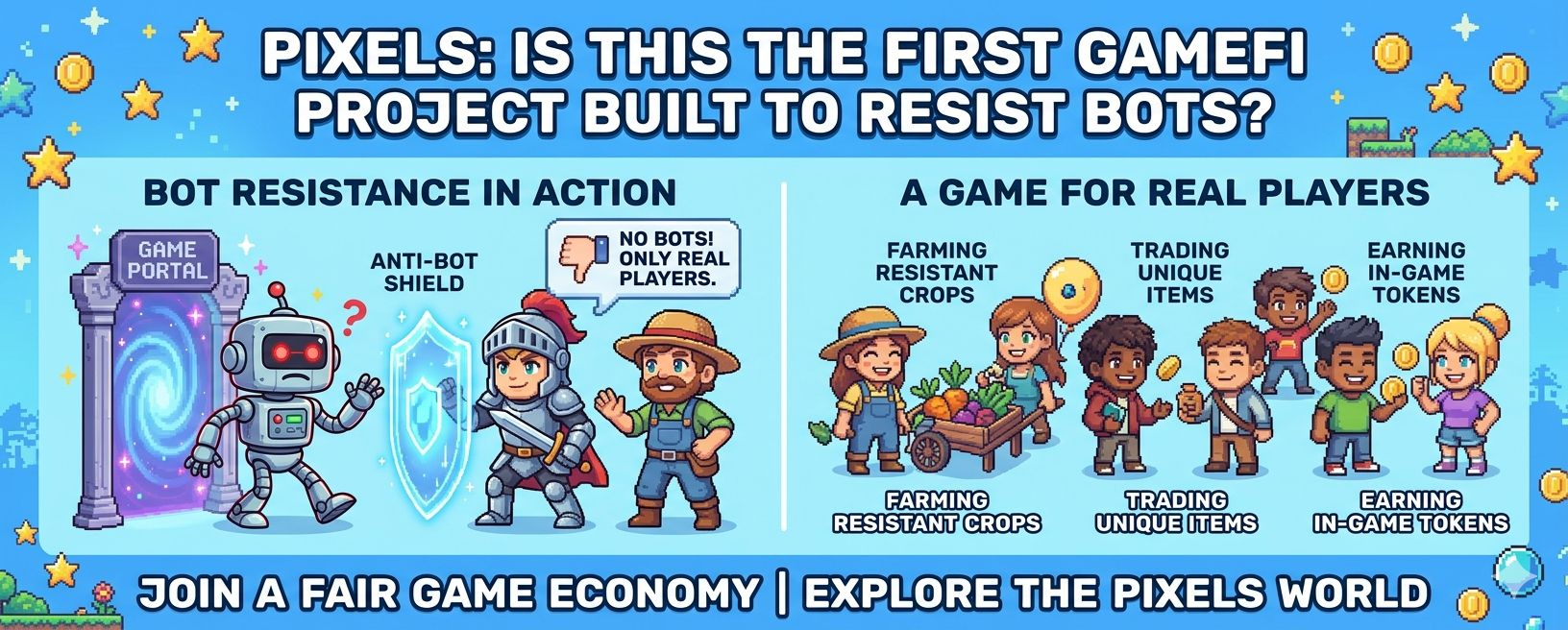
I have become cautious around projects that speak in loud, future-facing language. The usual script is familiar: big vision, big promises, big diagrams, and a very small amount of actual resistance to abuse. That is why Pixels stands out to me for a different reason. It does not feel like a project trying to impress you with a grand narrative. It feels like a project trying to solve a very specific problem: how do you keep a digital economy from collapsing under bots, shortcuts, and low-effort extraction?
That distinction matters more than people admit.
In most GameFi environments, the real enemy is not competition. It is contamination. Once scripts, multi-accounts, and farming loops take over, the entire economy starts to look alive while quietly becoming hollow. Rewards still move. Activity still appears. But underneath it, the system is being drained by players who are not really players at all. Many teams react with blunt tools: IP bans, wallet filters, or temporary restrictions that catch the wrong people along with the bad ones. Pixels appears to be taking a more disciplined path.
What interests me most is not the surface gameplay. It is the anti-fraud logic sitting behind it.
A reputation-based system changes the frame completely. Instead of asking only, “How much can this wallet extract?” it starts asking, “What kind of participant is this account actually behaving like?” That is a much more serious question. A wallet balance can be rented, transferred, split, or manufactured through coordinated behavior. But trust patterns are harder to fake over time. If a system can measure continuity, interaction quality, and on-chain behavior in a meaningful way, then it stops treating every address as equally credible.
That is where Pixels gets unusually practical.
The project seems less interested in rewarding raw volume and more interested in weighting behavior. In simple terms, it is not just about how much someone does, but how they do it, how consistently they do it, and whether their activity fits the shape of a real participant rather than a scripted one. That is a very different philosophy from the usual “farm first, ask questions later” design seen across a lot of Web3 games.
And honestly, that is refreshing.
Because the truth is, the Web3 gaming sector has been punished by its own incentives. Too many projects optimized for fast attention rather than durable structure. They built systems that were easy to enter and even easier to abuse. Pixels seems to understand that an economy without friction is not elegant. It is fragile. If every action can be replicated at scale by machine behavior, then the game is no longer built for people. It becomes a machine for extraction.
The most interesting part of Pixels, then, is not that it talks about anti-fraud. It is that it appears to elevate anti-fraud into a core design principle rather than a support feature. That is a big difference. When anti-bot systems are treated as an afterthought, they usually lag behind the attackers. When they are built into the logic of participation itself, they become part of the architecture.
That approach has consequences.
It means the system can reward patience instead of noise. It means long-term activity may matter more than short-term volume. It means social behavior, on-chain presence, and consistency can become economic signals. In a space full of disposable identities and synthetic engagement, that kind of framework is not just useful. It is necessary.
There is also something modest about Pixels that I respect. It does not rely on the fantasy that it must reinvent entertainment, society, and digital ownership all at once. It stays closer to the ground. Farming, building, collecting, interacting — these are not revolutionary verbs. But sometimes the strongest projects are the ones that start with ordinary actions and make them structurally meaningful.
That is where its real strength may lie.
A low-cost chain environment like Ronin helps too. If a game depends on frequent user actions, then transaction friction matters. High fees kill routine behavior. Low fees make repeated participation feasible. And repeated participation is exactly what a reputation-heavy system needs. You cannot build trust economics if every interaction feels expensive or accidental. The system has to be light enough for habit to form, but strict enough for abuse to fail.
That balance is hard to achieve.
A lot of projects can build excitement. Fewer can build discipline. Pixels seems more interested in discipline. It is trying to define a digital environment where effort leaves a trace, where trust has weight, and where automation cannot fully flatten the difference between a real person and a scripted process.
That is why I think the anti-fraud angle is not a side note. It may be the main story.
In a market obsessed with storytelling, Pixels is doing something less glamorous and more durable. It is trying to turn trust into a measurable input. It is trying to make identity costly to fake. It is trying to preserve economic meaning in a space that often destroys it through over-incentivized noise.
That may not sound exciting at first. But the more you watch this sector, the more you realize that boring systems often survive longer than flashy ones. A game economy that can defend itself is worth more than a game economy that can only attract attention.
Pixels may not be the loudest project in the room. It may not have the flashiest promise or the most dramatic pitch. But by putting anti-fraud at the protocol level, it is aiming at one of the few problems that actually decides whether a Web3 game becomes a living system or just another drained shell.
And that, to me, is where the real signal begins.
