
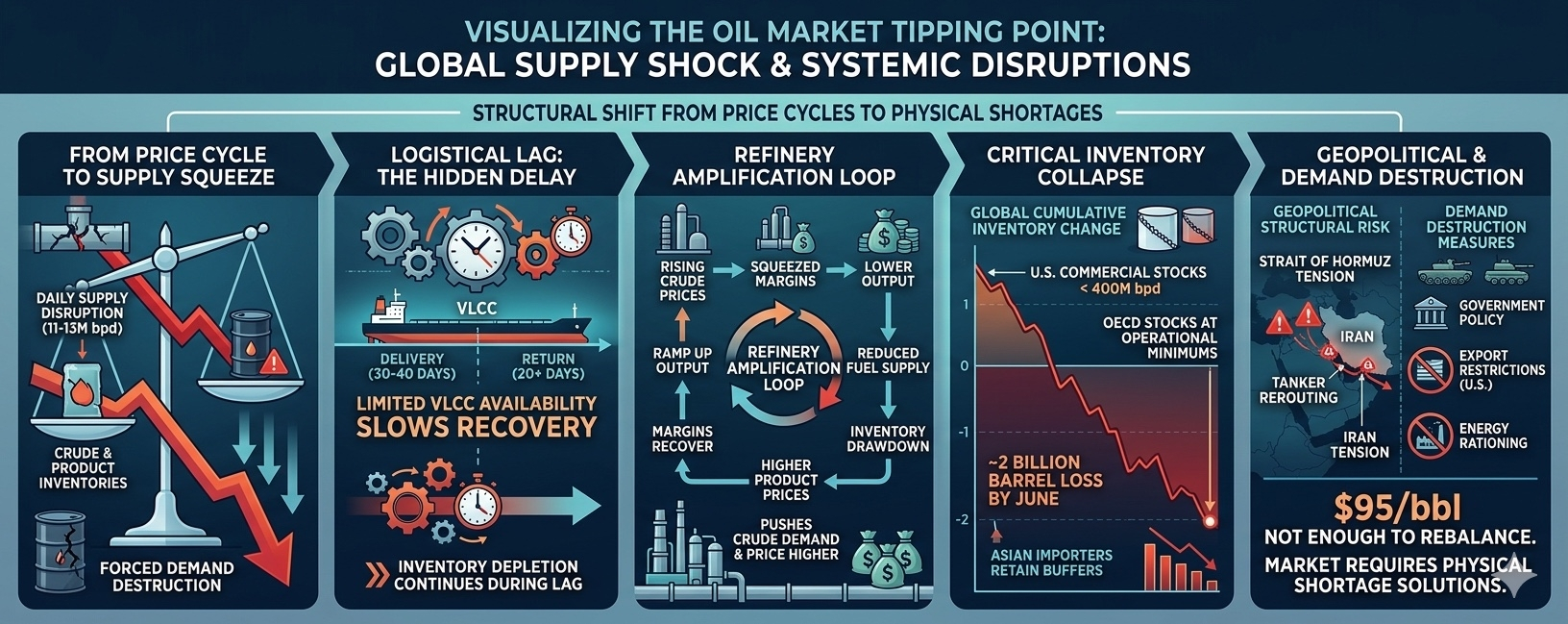
The global oil market appears to be entering a structurally different phase—one driven less by traditional price cycles and more by physical supply constraints and logistical delays. Recent developments suggest that what we’re witnessing is not simply a price rally, but the early stages of a systemic supply squeeze.
1. The Core Shift: From Price Cycle to Supply Disruption
Historically, oil markets rebalance through price:
Higher prices → lower demand
Lower prices → higher demand
However, the current situation challenges this framework. The issue is no longer just pricing—it's availability.
Key driver:
A daily disruption of 11–13 million barrels (a massive portion of global supply)
This creates three unavoidable outcomes:
Falling crude oil inventories
Falling refined product inventories
Forced demand destruction
2. The Hidden Variable: Time Mismatch in Supply Chains
Even if geopolitical tensions ease—especially around the Strait of Hormuz—the market will not instantly stabilize.
Why?
Oil transport relies on long-cycle logistics:
30–40 days for delivery
20+ days return time for tankers
Limited tanker availability (VLCCs) slows recovery
Inventory depletion continues even after supply resumes
➡️ This creates a lag effect, where shortages appear weeks after disruptions begin.
3. Refinery Dynamics: A Self-Reinforcing Price Cycle
Refineries are acting as a market amplifier, not a stabilizer.
Cycle in motion:
Rising crude prices → squeezed refinery margins
Lower refinery output → reduced fuel supply
Inventory drawdown → higher refined product prices
Margins recover → refineries ramp up again
→ pushes crude demand and prices even higher
This loop makes short-term equilibrium extremely difficult.
4. Inventory Collapse: The Real Signal to Watch
The market’s most critical indicator is no longer price—it’s inventory levels.
Projections:
Global cumulative inventory loss approaching ~2 billion barrels by June
U.S. commercial inventories potentially dropping below 400 million barrels
OECD stocks nearing operational minimum levels
At that stage:
Only a few countries (e.g., major Asian importers) retain buffers
Others must compete aggressively in the spot market
5. Geopolitical Risk: A Structural Threat
The tension involving Iran and control over the Strait of Hormuz is not just a temporary disruption—it’s a systemic risk.
Important implications:
Tanker traffic has already shown abnormal behavior (mass rerouting)
Supply routes are vulnerable to military escalation
Resolution is uncertain and may worsen before improving
This transforms oil risk from cyclical → geopolitical structural risk
6. Why $95 Oil Is Not Enough
A key conclusion:
$95 per barrel is insufficient to rebalance the market.
Reasons:
Supply gap is too large (11–13M bpd)
Logistics cannot recover quickly
Inventory buffers are being exhausted
At extreme levels:
Price loses effectiveness as a balancing tool
Market may enter a “physical shortage” phase
7. The Only Real Solution: Demand Destruction
If supply cannot recover fast enough, demand must fall.
This may come through:
Government policy interventions
Export restrictions (especially from the U.S.)
Reduced industrial activity
Energy rationing (similar to pandemic-era measures)
In essence:
The market may require forced demand suppression to restore balance.
8. Market Implications Beyond Oil
This scenario has broader consequences:
Inflation pressure across global economies
Increased volatility in equities and commodities
Stronger correlation between geopolitics and financial markets
Potential upside risk for energy-related assets
Conclusion
The oil market has likely crossed a critical tipping point. What lies ahead is not just higher prices, but a deeper challenge—managing a real-world supply deficit in a fragile geopolitical environment.
Investors and traders should shift focus:
From price targets → to inventory data and policy signals
From short-term moves → to structural supply risks
Because in this phase, the question is no longer “how high will oil go?”
—but rather “how will the shortage manifest?”