
I didn't used to think about survival as a design feature.
Most things in crypto either work or they don't. Projects launch, gain momentum, lose it, disappear. The ones that stick get credited with good timing, strong communities, lucky market cycles. Survival gets explained as circumstance rather than architecture.
Pixels made me question that.
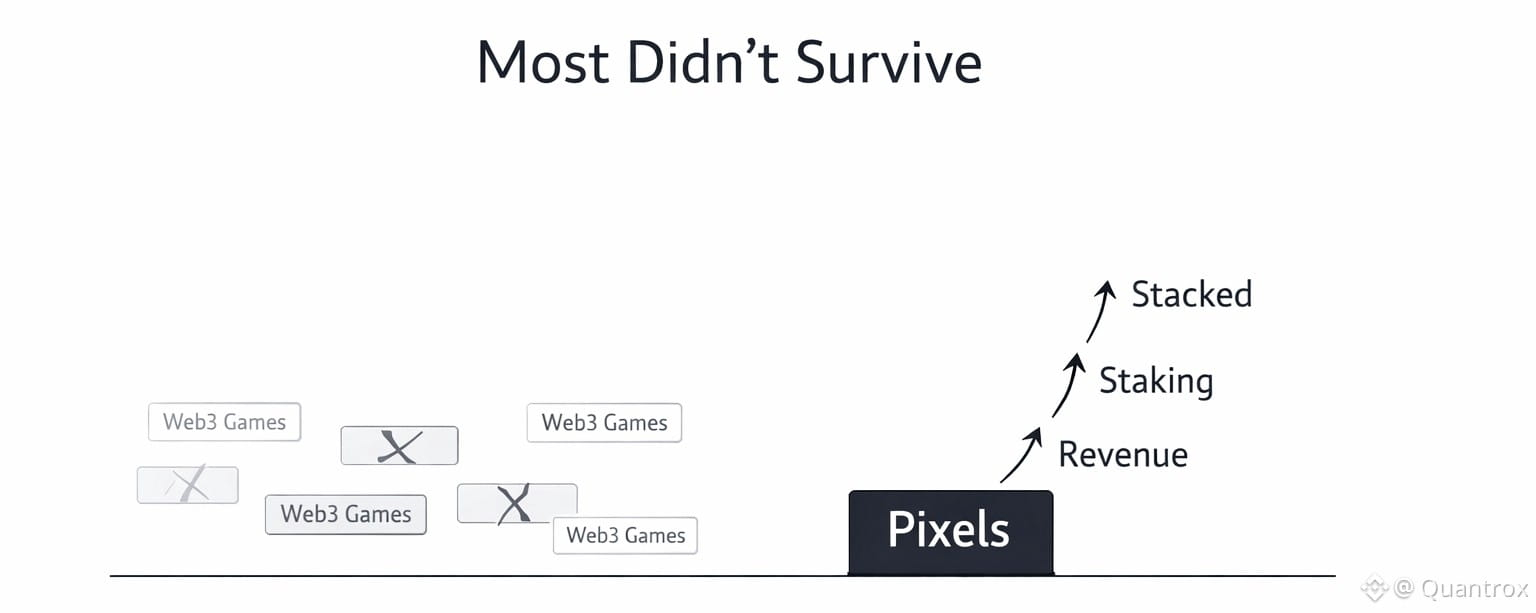
Because Pixels survived something specific that destroyed almost every other Web3 game that launched around the same time. Not a bear market exactly, although that happened too. Something more precise. The moment when the people who came for the token stopped coming, and the game had to decide whether anything real was left underneath.
That moment arrives for every play-to-earn project eventually.
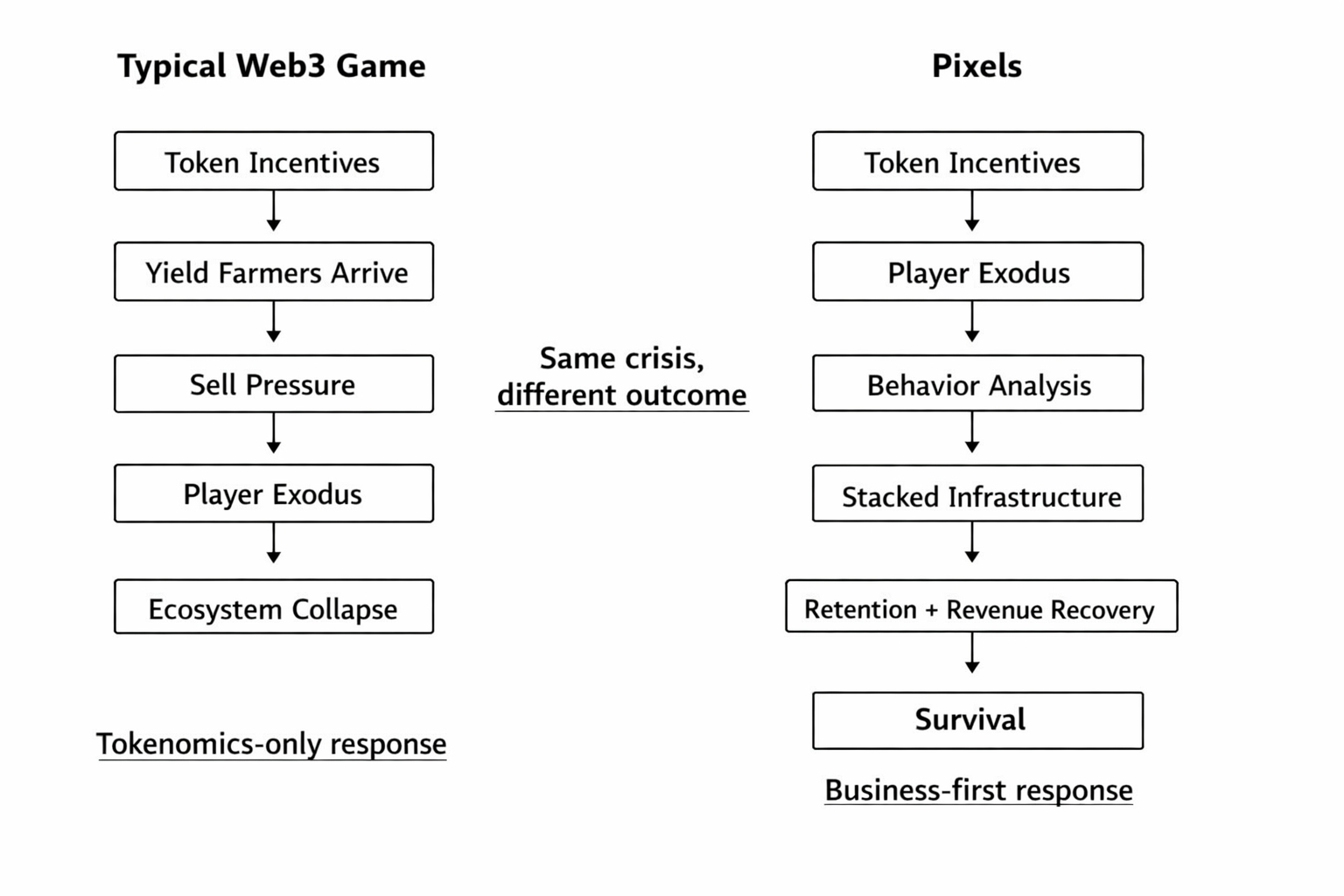
Token incentives attract a specific kind of player. Not a player who loves the game. A player who loves the yield. When the yield compresses — and it always compresses, because emissions are finite and sell pressure is constant — that player leaves immediately. Without friction. Because they were never attached to anything except the number going up.
What remains after that exodus tells you everything about whether a game economy was real or performed.
Most Web3 games collapsed at exactly that moment. The user numbers that looked like community turned out to be yield farmers in disguise. The transaction volume that looked like engagement turned out to be bots optimizing reward extraction. The ecosystem that looked healthy on the dashboard was already hollow underneath.
Pixels lost players during that period. Significantly. The token dropped. The hype cycle ended. Anyone watching the price chart had every reason to write it off.
But something stayed.
I've been trying to understand what that something was for longer than I expected to.
The easy answer is infrastructure. The reward targeting system. The behavioral data layer. The fraud prevention. The shift away from freely farmable emissions toward a more controlled economy. All of that is real and all of it mattered.
But I think there's something underneath even the infrastructure answer that doesn't get stated directly.
Pixels survived because at some point the team stopped treating the economy like a tokenomics problem and started treating it like a business problem.
Those sound similar. They are completely different.
A tokenomics problem gets solved on paper. You adjust emission schedules. You add burn mechanisms. You redesign vesting curves. The fixes live in documents and get announced publicly. Sometimes they work temporarily. They rarely work permanently because they address symptoms rather than causes.
A business problem gets solved in production. You look at which player segments are generating genuine long term value versus which ones are extracting and leaving. You build systems that can tell the difference between a player whose behavior is worth investing in and a player whose behavior costs the ecosystem more than it contributes. And then you act on that difference in real time. Not in the next whitepaper update. Right now. While the game is running.
That shift — from managing tokenomics to running a business — is what I think actually saved Pixels.
And it shows up most clearly in how Stacked works underneath the surface.
Most people look at Stacked and see a rewards app. Something players download to earn cash or crypto for completing missions. That reading is not wrong. It is just looking at the player facing surface and missing what the system is actually doing underneath.
Stacked tracks which players are at genuine churn risk right now. It measures where reward budget is leaking without improving retention. It identifies which cohorts are building genuine long term value versus which ones are cycling through the system without ever really connecting to it. And then it deploys interventions — targeted rewards, winback campaigns, specific incentives at specific moments — based on that measurement.
That is not a rewards app. That is a live business intelligence system running inside a game economy.
The difference matters enormously for understanding what PIXEL actually is.
PIXEL is not just the currency of a game that happened to survive. It is the currency sitting inside infrastructure that was built specifically because surviving required building it. The fraud prevention, the behavioral targeting, the retention measurement — none of that exists because someone thought it would make a compelling whitepaper section. It exists because Pixels needed it to not die.
That origin changes what the infrastructure actually is.
Infrastructure built under survival pressure is different from infrastructure built during a bull market with unlimited runway and no real consequences. It has different tolerances. Different assumptions about what adversarial conditions look like. Different levels of battle testing. Because it was tested against real adversarial conditions rather than theoretical ones.
Over 200 million rewards processed. $25 million in revenue generated. 100 million $PIXEL tokens staked within weeks of the staking system launching. Those numbers did not come from a favorable market environment. They came from a team rebuilding an economy while it was still running, under conditions that would have justified shutting down, choosing instead to understand the problem deeply enough to fix it.
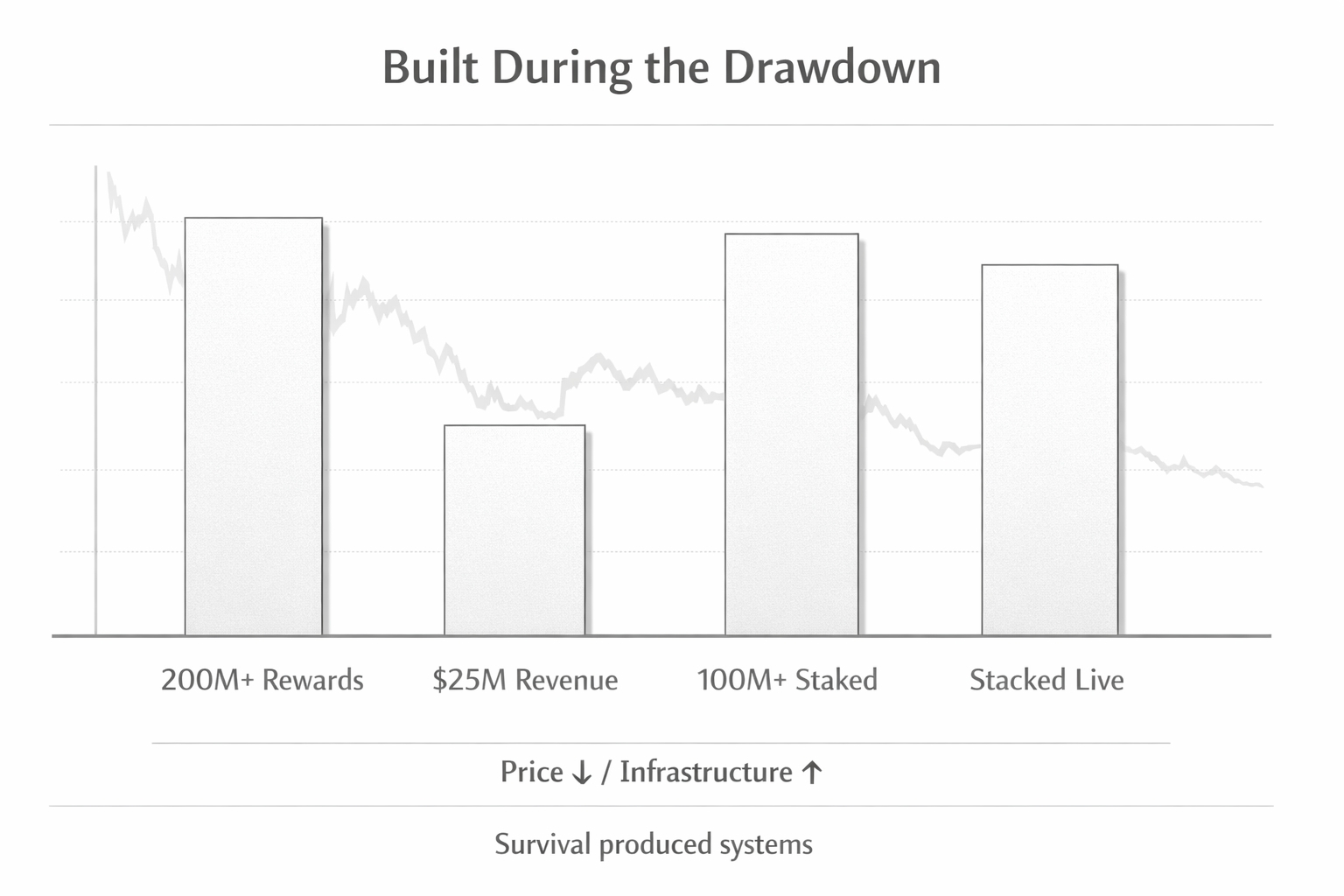
I don't know if any of that translates into price recovery on a specific timeline. Token markets operate on sentiment cycles that have very little to do with infrastructure quality in the short term. The chart looks the way it looks and reasonable people can disagree about what comes next.
But I think the survival story changes what PIXEL fundamentally is underneath the chart.
Not a game token from a project that got lucky with timing.
A currency embedded in infrastructure that exists specifically because luck was never going to be enough.
That distinction is invisible on a price chart. It becomes very visible when you spend enough time inside the ecosystem trying to understand why it is still here when almost everything around it isn't.