
@Pixels There’s a quiet pattern in Web3 gaming that’s hard to ignore: many projects begin with the language of worlds, but end up behaving like machines. They promise immersion, yet subtly train players to think in terms of extraction—time in, rewards out. The result is often efficient, but rarely meaningful. Against that backdrop, Pixels feels like it’s asking a different question, one that’s less about how much value can be pulled from a system, and more about whether a digital space can feel worth returning to even when nothing is being earned.
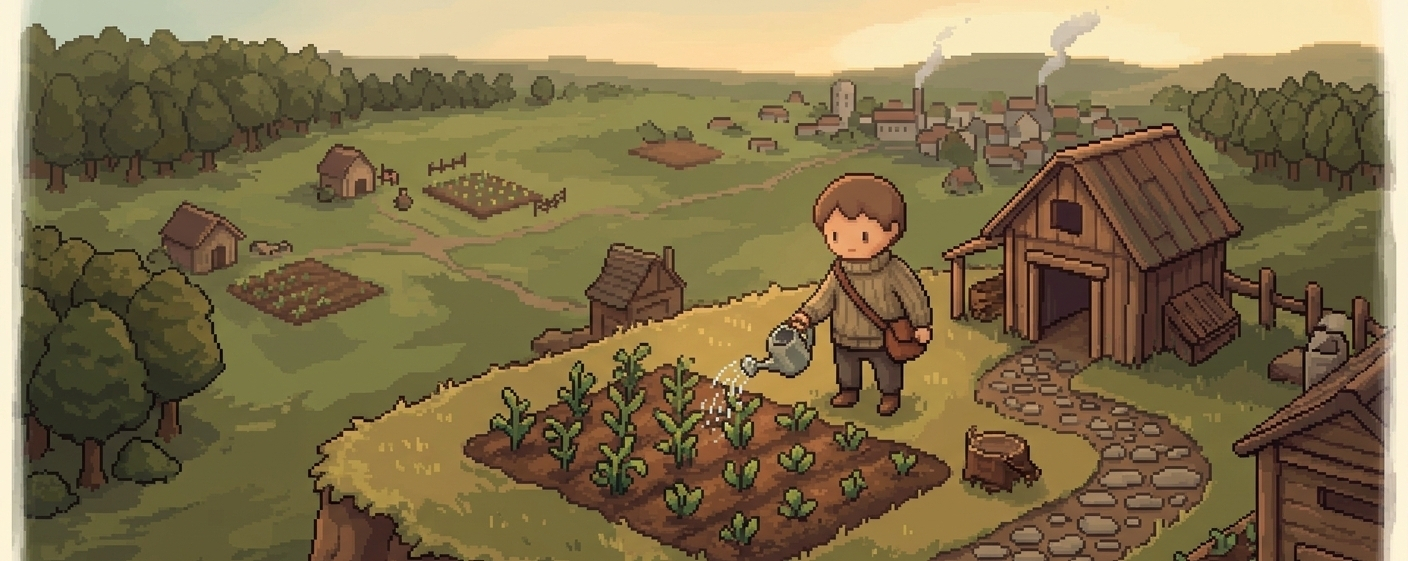
What sets Pixels apart isn’t spectacle or complexity, but a kind of restraint. It doesn’t rush to impress. Instead, it leans into something slower and more familiar—the gentle rhythm of tending land, gathering resources, and shaping a small corner of a shared world. There’s a deliberate softness to its design, as if it understands that attachment doesn’t come from intensity, but from repetition and presence. It feels closer to a lived-in space than a system to be optimized, and that distinction matters more than it might seem at first glance.
The way the game unfolds is simple enough to almost be overlooked. You plant, you harvest, you expand. Progress isn’t driven by sudden leaps but by small, consistent actions that accumulate over time. There’s no overwhelming pressure to compete or extract maximum efficiency from every move. Instead, it invites a quieter kind of participation, where the value of the experience is tied to the act of showing up. That simplicity is not a limitation—it’s a foundation. Many of the most enduring games have relied on loops just as basic, but made meaningful through context and continuity.
The presence of a token, however, introduces a layer of complexity that no design can fully escape. In theory, it aligns effort with reward, giving players a sense that their time carries weight beyond the game itself. In practice, it risks reframing the entire experience. Pixels seems aware of this tension, attempting to weave the economy into the background rather than placing it at the center. Whether that balance can hold is uncertain. Economies have a way of reshaping behavior, often quietly at first, until they become the primary lens through which everything is viewed.
What will ultimately define Pixels isn’t its mechanics, but how people choose to engage with them. There is space here for long-term participation, for routines that feel personal rather than transactional. But that space is fragile. If the community leans too heavily toward short-term gains, the tone of the world can shift, and with it, the reasons people stay. The difference between a place and a system is not just how it is designed, but how it is inhabited.
There’s something quietly compelling about the project’s willingness to stay grounded. It doesn’t try to reinvent gaming or promise a new paradigm. Instead, it explores whether familiar ideas—farming, crafting, social interaction—can exist comfortably within a Web3 framework without being overtaken by it. That modesty might be its most interesting trait. In a space that often equates ambition with scale, Pixels chooses to focus on texture instead.
Still, the risks are real and difficult to ignore. Maintaining a balance between enjoyment and economic incentive is one of the hardest problems in this space, and few have solved it for long. Early engagement can be misleading, especially when incentives are fresh and participation is driven by curiosity. Over time, the question becomes simpler and harder at once: would people still be here if the rewards faded into the background?
Pixels doesn’t answer that question yet. It can’t. What it offers instead is an attempt—a careful, measured exploration of whether a Web3 game can feel less like a marketplace and more like a place people quietly return to. It may not succeed, and it doesn’t need to pretend otherwise. But in the space between what it is and what it’s trying to be, there’s something worth watching—not because it guarantees a future, but because it’s at least asking the right kind of questions.
