
A Farming Game? No. A Market With Better Lighting
Let’s drop the pretence early. Pixels is not a game that happens to have an economy. It is an economy that happens to look like a game.
The farming, the exploration, the gentle pacing—these are not the product. They are the packaging. The real engine is financial.
I’ve watched this script before. Dress speculation in something friendly, lower the barrier to entry, and wait for the cycle to repeat. It usually does.
Pixels is not breaking new ground. It is refining camouflage.
“Ownership” Is the Sales Pitch. Risk Is the Reality
The promise is seductive. Own your land. Own your items. Own your progress.
But ownership here doesn’t liberate the player. It traps them inside the system’s volatility. Once assets have a price, every decision becomes financial. Every action carries consequence beyond the game.
You are no longer playing. You are managing exposure.
Most players don’t realise when that shift happens. By the time they do, they are already invested—financially and psychologically.
Ownership sounds empowering. In practice, it’s a transfer of risk.
Ronin Isn’t a Foundation. It’s a Fault Line
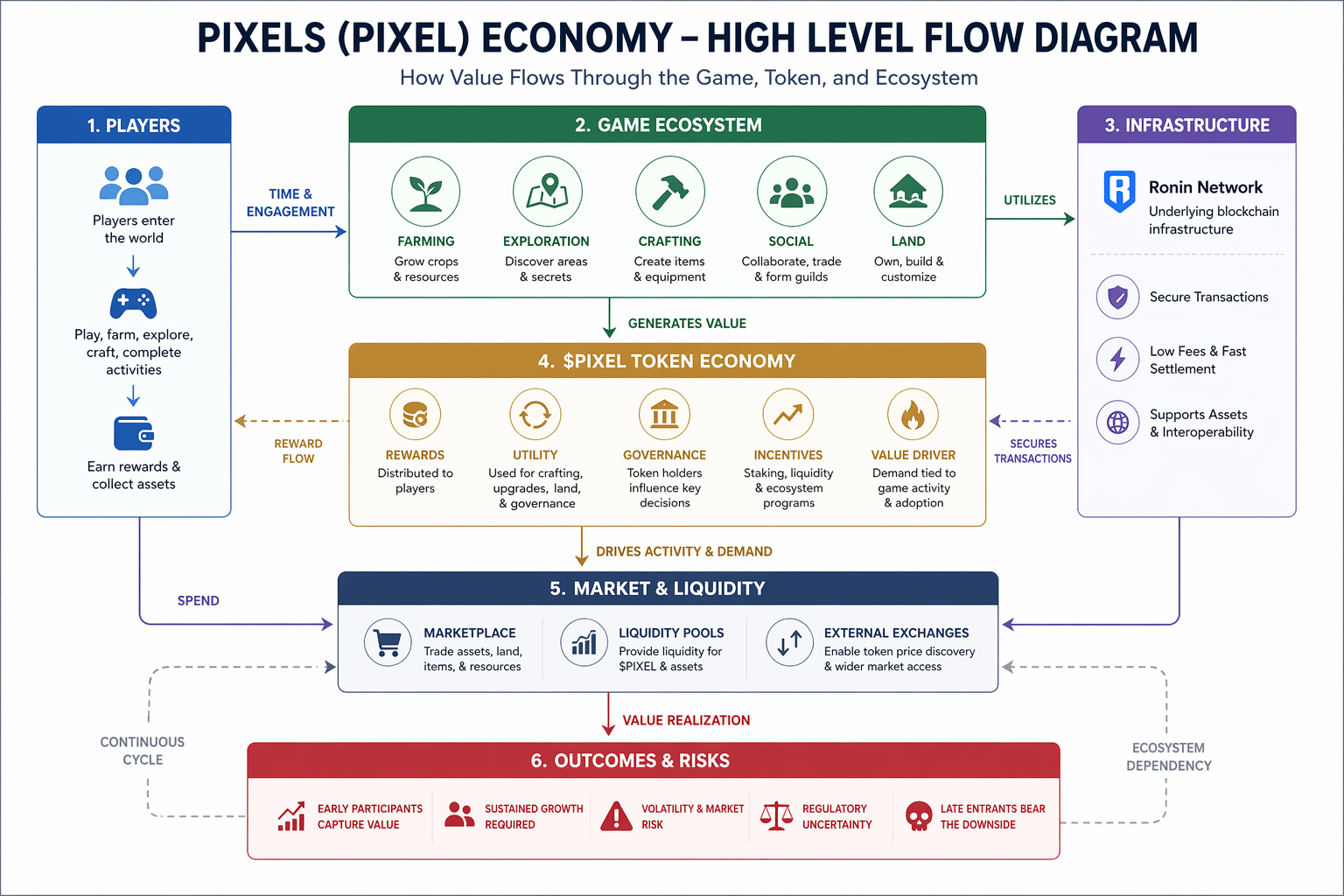
Pixels leans heavily on Ronin. That alone should give pause.
This is a network that has already demonstrated how quickly confidence can collapse. A major exploit. A brutal reminder that “secure enough” in crypto often isn’t.
And yet here we are again, building layered systems on top of it, as if history were a minor inconvenience.
Dependence on a single chain is not decentralisation. It is concentration risk with better branding.
When things break—and they do—players don’t get compensated. They get lessons.
The Token Isn’t Supporting the Game. The Game Is Supporting the Token
Strip away the language and follow the incentives. Everything in Pixels bends toward the PIXEL token.
Rewards, engagement loops, progression systems—each one nudges the player toward participation in a market, not immersion in a world.
This is the inversion at the heart of the model. The game exists to sustain the token, not the other way around.
Early participants understand this. They position accordingly. They accumulate before attention arrives.
Late participants call it fun. They are usually the liquidity.
That dynamic hasn’t changed. It never does.
A Rebrand, Not a Reinvention
We are told this is different from the first wave of “play-to-earn.” Softer language. Better design. Less overt emphasis on profit.
But the mechanics are familiar to the point of fatigue.
Value flows in through new participants. Rewards are distributed to maintain engagement. Price becomes the silent scoreboard.
Call it “play-and-own,” “player-driven,” or whatever the marketing department prefers. The underlying dependency on growth remains untouched.
And that dependency is where these systems fail.
Sustainability Is the Word. Growth Is the Requirement
There is a simple rule in these economies. If players are extracting value, someone else must be providing it.
In Pixels, as in its predecessors, that “someone else” is usually the next wave of users.
This is not incidental. It is structural.
Remove continuous growth and the system tightens immediately. Rewards diminish. Activity slows. Prices follow.
There is no steady state here. Only expansion or contraction.
And expansion, eventually, stops.
Community Is Not a Shield. It’s Part of the Mechanism
The talk of community is constant. Shared spaces. Collaborative play. Social engagement.
It sounds organic. It rarely is.
Communities in these ecosystems often function as retention tools and onboarding funnels. They keep players engaged long enough to sustain the economic loop. They soften the perception of risk.
Players think they are building something together. In reality, they are stabilising a system that depends on their continued participation.
It feels like belonging. It behaves like infrastructure.
Cozy on the Surface, Extractive at the Core
Here lies the central contradiction. Pixels presents itself as a relaxing, low-stakes experience.
It is anything but.
Behind the soft visuals sits a system driven by price sensitivity, liquidity cycles, and speculative behaviour. That tension is not resolved. It is simply obscured.
You cannot design for calm while relying on financial anxiety. The two are incompatible.
Eventually, the economics win.
They always do.
Developers Don’t Just Build Games. They Manage Markets
This is where the model shows its strain.
Developers are not merely creating content. They are managing an economy under constant pressure. Adjusting rewards. Tweaking incentives. Responding to price movements.
Every decision carries financial implications.
That distorts priorities. Gameplay becomes secondary to stability. Design bends around token performance.
At that point, the product is no longer a game in any meaningful sense.
It is a market with a user interface.
The Regulatory Question Is Not Going Away
There is also the matter no one wants to confront directly.
When players buy assets, expect returns, and trade within a structured system, the distinction between “game” and “financial product” starts to look artificial.
Regulators have been slow. They won’t be forever.
If scrutiny arrives, it will not focus on aesthetics or intent. It will focus on structure and incentives.
And the structure here is not ambiguous.
The Exit Is Built In. The Timing Is Not
Every system like this contains an exit mechanism. It just doesn’t advertise it.
Early participants leave with gains. Later participants inherit the positions. Activity declines. Prices settle lower. Attention moves on.
What remains is not a thriving ecosystem. It is a diminished one, sustained by a shrinking base.
Pixels follows the same architecture. There is no credible reason to believe it will produce a different outcome.
Optimism is not a strategy.
This Isn’t a New Model. It’s a Familiar Ending
Pixels wants to be seen as evolution. A gentler, smarter version of what came before.
It isn’t.
It is the same economic structure, repackaged with better aesthetics and more careful language. The incentives are unchanged. The risks are unchanged. The outcome is, in all likelihood, unchanged.
I’ve seen this cycle enough times to recognise the pattern early.
The game will be praised. The token will fluctuate. The community will grow. Then it will thin.
And when it does, the question will no longer be whether this was a game or a market.
It will be who got out in time.
