Pixels (PIXEL) is one of those Web3 games that looks simple on the surface, almost relaxing in a “yeah I could just chill and farm for a bit” kind of way. It runs on Ronin, and it leans hard into that cozy loop: farming, exploring, building stuff, talking to people, repeating the cycle. Nothing intimidating. Nothing screaming “this is finance dressed as a game” at first glance.
And honestly, that’s exactly why it works.
You log in, you plant things, you upgrade stuff, you wander around. It feels light. Even a bit nostalgic if you’ve played older farming sims. There’s this social layer too, where you’re not just alone grinding—other players exist in the same space, doing their own thing. It feels alive in a quiet way.
But here’s the thing. That “quiet” feeling? That’s doing a lot more work than people realize.
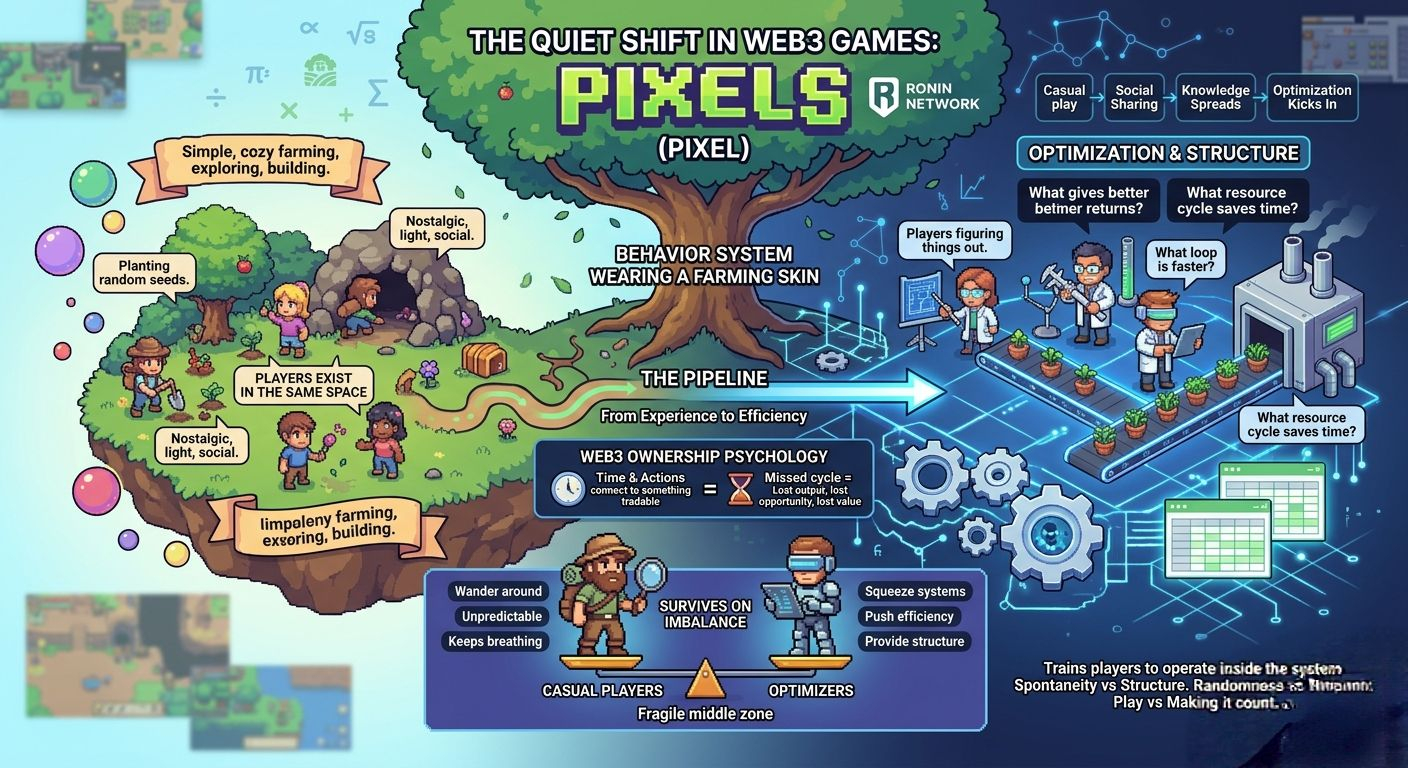
Because Pixels isn’t just a farming game. It’s a behavior system wearing a farming skin.
And yeah, I know that sounds a bit dramatic, but stick with me.
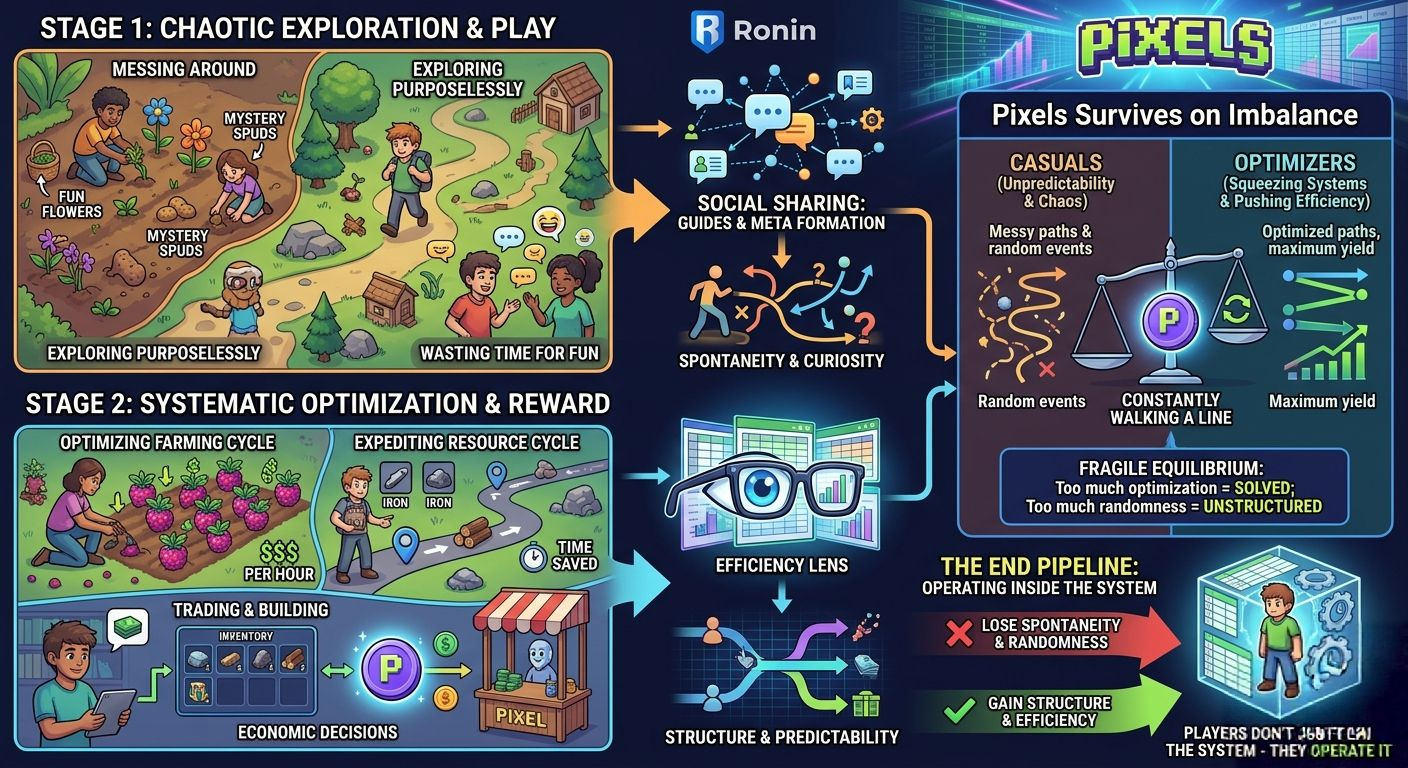
What starts as casual play slowly turns into something more structured. Players don’t stay in “just having fun” mode for long. They start figuring things out. What gives better returns, what loop is faster, what resource cycle saves time. And once that knowledge spreads—and it spreads fast—the whole game starts tightening up.
I’ve seen this pattern before in other Web3 systems. It always starts messy. Then it gets efficient. Then it gets predictable.
And predictable systems change how people behave inside them.
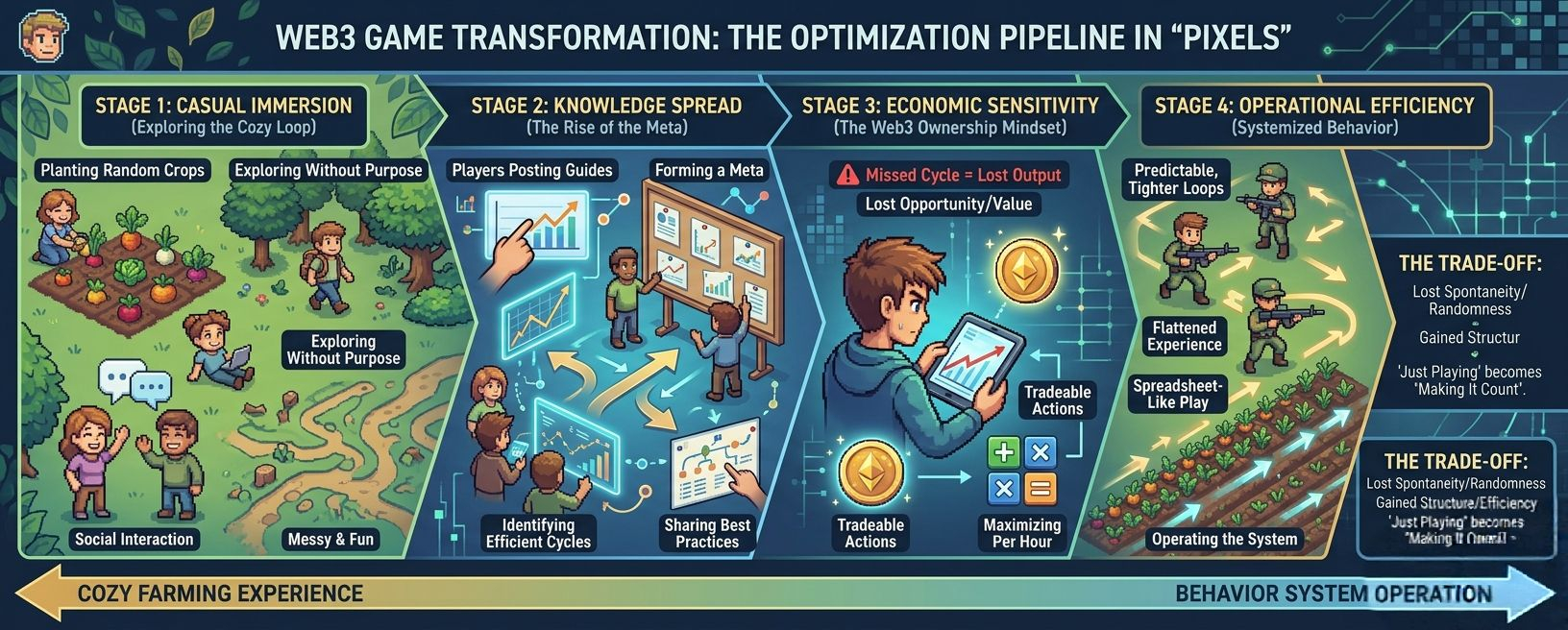
Let’s break it down simply. Early on, people mess around. They plant random crops, explore without purpose, maybe even waste time just because it feels fun. That phase matters. That’s the chaos that keeps everything breathing.
But then someone posts a guide. Then another. Then a whole meta forms.
And boom—optimization kicks in.
Now people aren’t asking “what should I do?” They’re asking “what gives me the most per hour?” That shift is subtle, but it changes everything. The game stops being about experience and starts being about efficiency.
And once efficiency becomes the main lens, you can’t really unsee it.
Look, I’ll be honest—this is where Pixels gets interesting and a bit uncomfortable at the same time. Because the system doesn’t force optimization. It doesn’t need to. Players do it to themselves. Social sharing just speeds it up.
It’s like watching a casual space slowly turn into a spreadsheet without anyone explicitly deciding that’s the plan.
And Web3 ownership makes it sharper. Not in a flashy way, but in a psychological one. When players know their time and actions connect to something tradable or economically relevant, even loosely, they start treating decisions differently. A missed farming cycle doesn’t feel like “oh well, I’ll do it later.” It starts feeling like lost output. Lost opportunity. Maybe even lost value.
That mindset creeps in quietly.
And once it’s there, it doesn’t really leave.
Now here’s the part people don’t talk about enough: Pixels survives on imbalance.
Yeah, imbalance. Not harmony. Not perfect design. Imbalance.
You need casual players who just wander around and keep things unpredictable. You also need optimizers who squeeze systems and push efficiency to the edge. If everyone optimized perfectly, the game would flatten out. If everyone stayed casual, the economy wouldn’t have structure.
It only works because both types exist at the same time.
That’s fragile. More fragile than it looks.
And this is where things get tricky. Because the game has to constantly walk a line it can’t really control. Too much optimization, and everything becomes solved. Too much randomness, and nothing feels meaningful or structured.
So it ends up sitting in this middle zone. Not fully a game. Not fully a system either. Something in between.
Kind of uncomfortable, if you think about it too long.
I keep coming back to this idea: Pixels doesn’t just respond to players. It trains them. Slowly. Quietly. Without asking permission.
At first it feels like freedom. Then it becomes routine. Then it becomes optimization. And at the end of that pipeline, you’ve got players who don’t just play the system—they operate inside it.
So yeah, it works. Clearly it does. People are in it, engaging, building, trading, all of that.
But the cost of that success isn’t obvious unless you zoom out a bit.
You lose some spontaneity. You gain structure. You lose randomness. You gain efficiency. You lose “just playing.” You gain “making it count.”
And maybe that’s fine. Maybe that’s the trade.
But let’s not pretend it’s just a cozy farming game anymore.