
I don’t know if it’s just me… but every time @Pixels drops one of these events something feels slightly different under the surface.
Yeah, on paper it’s simple.
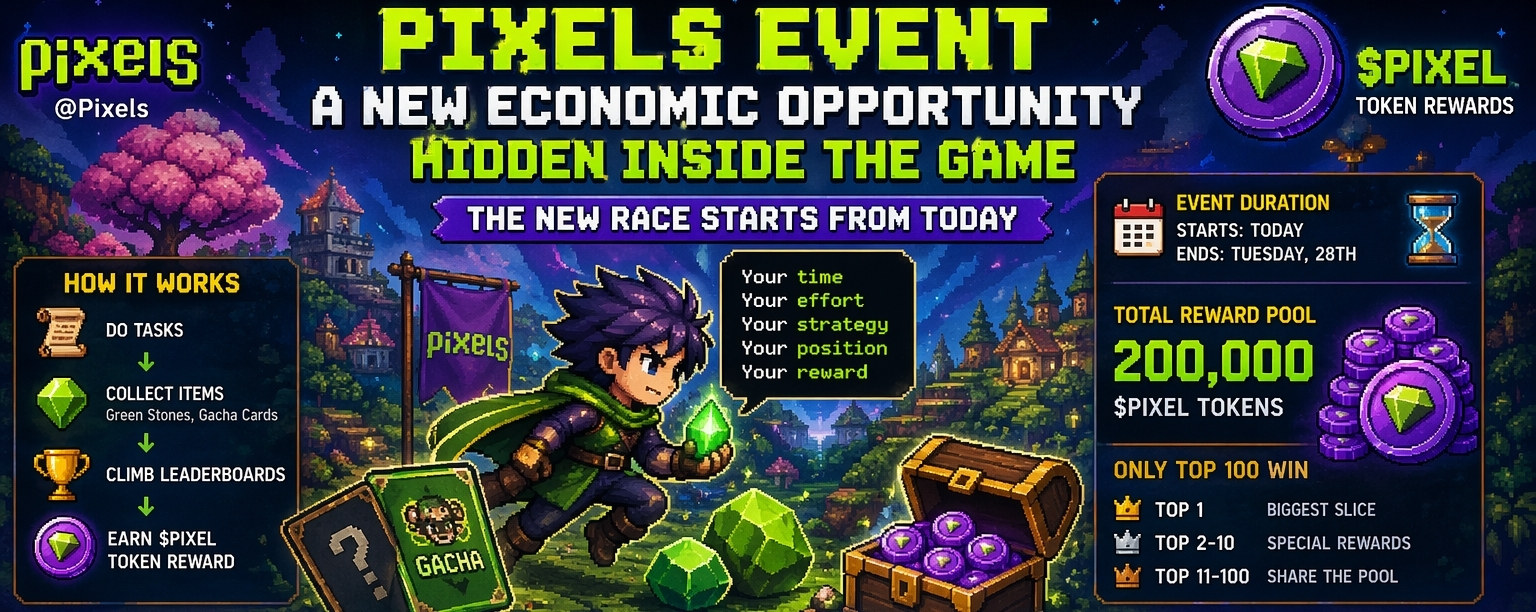
Do tasks → collect items → climb leaderboard → earn $PIXEL .
We’ve all seen this loop before.
But this one… starting today… doesn’t feel like just another event.
It feels like a reset button.
At first I thought it’s just another grind cycle. Green Stones, gacha cards, daily loops… nothing new right? But then I stopped for a second and looked at what’s actually happening.
This isn’t just farming anymore.
It’s conversion.
Your time → turns into actions
Your actions → turn into points
Your points → turn into position
And that position? That’s everything.
Because this event isn’t open-ended. It has a deadline. Next Tuesday, 28th. That time limit changes everything. Suddenly it’s not “I’ll play later”… it’s “if I don’t start now I’m already behind.”
That quiet pressure… that’s where the system kicks in.
What really caught my attention is how the competition is structured.
200,000 $PIXEL in rewards sounds decent… but when you break it down it’s tight. Only top 100 actually win. And inside that, top 10 is a completely different level.
So realistically… most people will grind, but only a small percentage will actually extract value.
Sounds harsh but it’s true.
And that’s where strategy starts to matter more than effort.
Then comes the part people don’t always talk about openly… NFTs.
If you’re holding Pixels NFTs you’re not playing the same game as everyone else. Same actions… but your output is higher. Multipliers quietly shift the entire balance.
At first glance it feels unfair.
But if you think deeper… it’s not about fairness.
It’s about positioning.
The system is rewarding commitment not just participation.
But honestly… the most interesting part for me isn’t rewards or NFTs.
It’s behavior.
Because this event is not just tracking what you do… it’s reading how you do it.
How fast you move
What you prioritize
Where you spend time
When you log in
This is no longer just gameplay.
This is pattern recognition.
And when a game starts measuring efficiency instead of just activity… it stops being just a game.
Still… I can’t deny one thing.
It’s addictive in a weird way.
Not because rewards are huge… but because the system feels alive. Everyone is playing differently inside the same structure. Some are optimizing some are grinding blindly some are experimenting.
Same map… different minds.
If I had to say it simply:
This isn’t just a new event.
It’s a new cycle starting.
A small economy resetting itself… and watching how players react.
And honestly?
I’m not even thinking about winning or losing.
I’m more curious to see…
how far this system can push players without them even realizing it.
Because from outside, it still looks like “play and earn”…
But inside?
It’s time vs strategy vs awareness.
And yeah… I’ve been waiting for this one.
The current Pixels event represents more than just a leaderboard race; it is the evolution of gaming into a functional micro-economic system. By transforming time and effort into measurable "activity representations" like Green Stones and gacha cards, the game shifts from casual play to competitive optimization. This structure creates an intense "loyalty layer" where NFT holders benefit from point multipliers, effectively rewarding ecosystem commitment over pure grind.
Ultimately, the event serves as a behavior tracking loop that prioritizes efficiency patterns and strategic participation. With a controlled pool of 200,000 $PIXEL tokens reserved primarily for the top 100 performers, the campaign moves away from simple "routine participation" toward a high stakes battle of strategy. It is a reset of a small digital economy where the cycle of play is strengthened through structured chaos and calculated incentives.What makes Pixels stand out is how it connects gameplay with ownership and incentives. Players can use land NFTs to expand production, participate in crafting cycles, and earn rewards tied to in-game activity rather than just passive play. The introduction of systems like “Stacked” has further shifted the focus toward sustainable participation, where rewards depend on how players interact with the ecosystem.
In short, Pixels is not just about playing—it’s about positioning within an evolving digital economy where behavior, strategy, and resource management shape long-term value.
@Pixels $PIXEL #pixel $Floki $Pepe


