
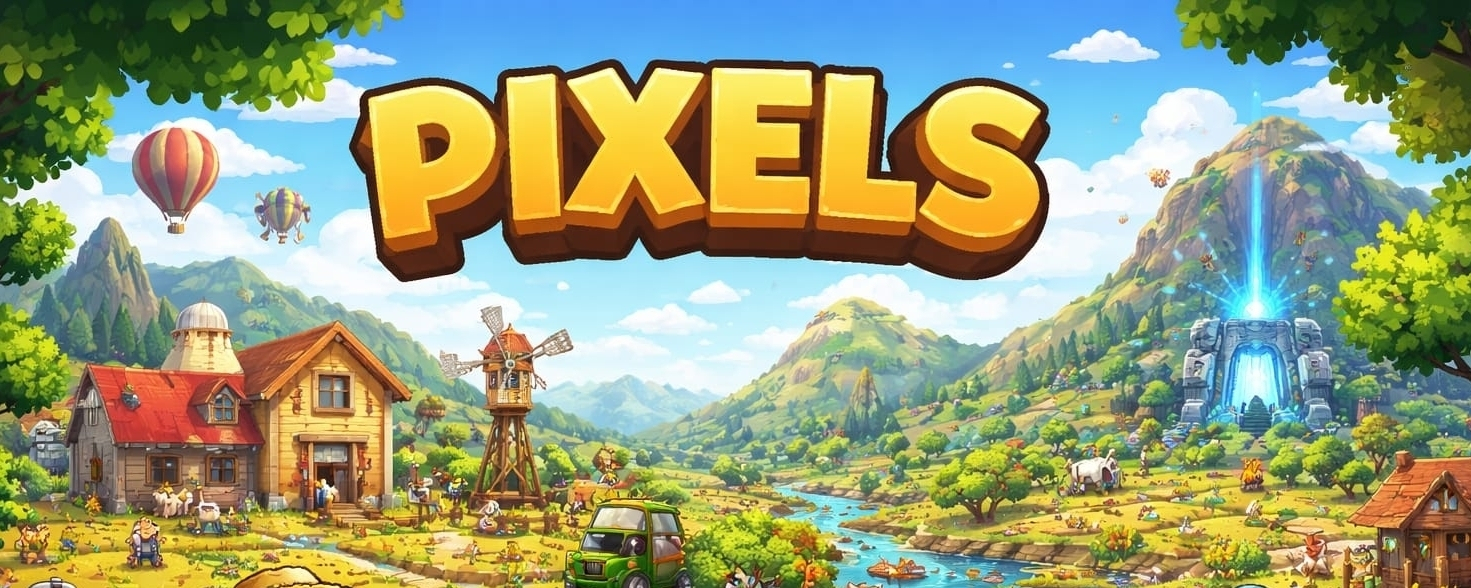
Recently One day night, I was mindlessly farming in Pixels when it hit me: I wasn’t really playing the game anymore.
It wasn't because I was bored. My mind was just somewhere else entirely. I found myself wondering, "If I harvest just enough right now, will the system flag me as an 'active player'? Will my activity from the past week be picked up as a positive signal?" I wasn't entirely sure who or what was watching, but I knew something was.
That’s when the reality of what Hivemind AI is actually doing to the game finally clicked for me.
For context, Pixels uses Hivemind AI—a multi-agent system designed to track player behavior, gauge community sentiment, and feed all that data back to the devs for design tweaks. On paper, it sounds perfectly reasonable. It's just a tool to help the team understand us better and bridge the gap between hard data and intuition. But that official pitch overlooks a massive trap that any observation system falls into once it gets powerful enough.
It’s what I call a "cognitive tipping point"—the exact moment a community realizes an AI is studying their habits, and they instinctively start acting in ways specifically designed to be read favorably. Before that moment, the AI is just observing. After it? It becomes a target to be gamed.
Here’s how it usually goes down. At first, everyone plays normally: farming because they need resources, trading to make a profit, complaining when things genuinely suck. Hivemind takes that raw data, summarizes it, and the devs use it to improve the game. If it stopped there, it would be a healthy loop.
But it never stops there.
Once people catch on, the mindset shifts. You stop asking, "What do I want to do in the game today?" and start asking, "How is the AI reading me right now, and how can I manipulate that?" It’s not some grand conspiracy or organized plot. It’s just enough players realizing that "looking good" to the AI is a resource you can farm.
Suddenly, player behavior splits into two distinct layers. You have your actual behavior (what you genuinely want to do) and your performative behavior (what you do just to send a specific signal to the system). They don't always conflict on a personal level, but on a macro level, the ratio gets totally skewed.
I call this "signal compression." The AI sees both layers of gameplay but can’t tell the difference between natural behavior and players just acting for the algorithm. To the AI, it’s all just normal data. But to the players, some of us are playing an entirely different game.
You can actually see this happening in Pixels right now. Players know Hivemind tracks engagement, so they log in during peak hours just to keep their activity streak alive, even if they have zero interest in farming. You’ve got players spamming low-value tasks on the board just to make it look like the player base is hyper-active. Others hoard land and keep it visible without ever developing it, treating it more like a status signal for the algorithm than an actual in-game asset.
Are they cheating? Not really. They’re just playing by the system's hidden rules. It's just that the designers don't realize these are the rules the players are actually following.
And this is where it becomes a massive headache for the developers.
Hivemind eats up all this performative data—high engagement, active task boards, stable land use—and tells the devs, "Hey, the game is super healthy!" So the team doubles down, adding more mechanics and rewards to these "successful" areas. The problem is, they are basing real game updates on fake behavior.
By the time the devs realize a new feature isn't creating real engagement, a few months have passed. The causality is lost. They might think the mechanic itself was flawed, but the real issue was that the data was poisoned from the start.
So, an arms race begins. The devs make the AI smarter, cross-referencing more signals to try and uncover how we are actually playing. And players—at least the sharp ones—adapt right back, tweaking their performative gameplay to match the new detection layer. They aren't doing it to ruin the game; it’s just a logical response when real money ($PIXEL), valuable land, and VIP perks are on the line. Where there’s a financial incentive, optimization is inevitable.
What we end up with isn't a dev team winning or players losing. It’s a game evolving based on manipulated signals rather than actual fun, and the gap between the two widens with every update.
Hivemind was supposed to bridge the communication gap between the devs and the community. But in a live environment where players constantly learn and adapt, a strong enough observation tool inevitably turns into a second, invisible game—with its own rules, strategies, and winners, none of which are written anywhere in the UI.
Pixels might be trying to build a digital economy, but Hivemind has accidentally created a perception economy running right next to it. And in this new economy, the signals you feed the AI are just as valuable as the crops you harvest. The only difference is that market prices are fixed, while the value of your signals is judged by an AI that we are slowly learning to control.
Not everyone has realized this is happening yet. But the ones who have? They stopped just "playing Pixels" a long time ago.
