
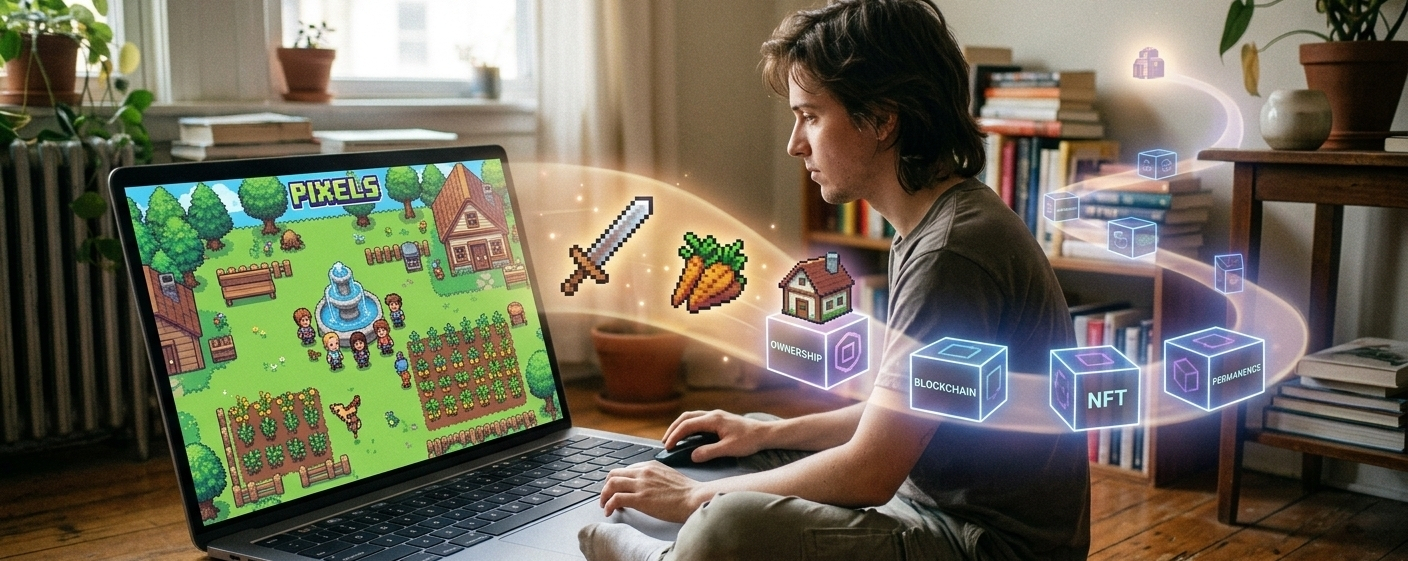
I keep thinking about a simple idea: when I spend time building something in a game, where does it actually go when I log out for the last time?
For most of gaming history, the answer has been straightforward. It stays inside the game. My progress, my items, my effort—all of it lives on a server I don’t control. If the game disappears, so does everything I made in it. That’s just how it has always worked, even if I never really questioned it before.
At some point, I started noticing how normal that feels. I can spend weeks in a game world, build something I’m proud of, and still know deep down it doesn’t really belong to me in any lasting way. It’s more like I was visiting a space temporarily.
Pixels.xyz comes into this picture as one of those projects trying to challenge that assumption. It presents itself as a simple online farming-style world where I can gather resources, build, and interact with others. At first glance, nothing feels unusual about it. It looks like a relaxed, familiar type of game.
But underneath that familiar surface, there’s a different structure. Some of what I do in the game is connected to blockchain-based ownership systems. That means certain items or progress aren’t just stored in one company’s database—they can exist in a more independent, transferable form.
What makes this interesting is not just the technology itself, but how quietly it changes the experience. I don’t always notice it immediately, but once I understand it, my way of playing starts to shift a little. I think differently about time, effort, and even small decisions.
A simple farming action, which would normally feel like routine gameplay, starts to carry another layer of meaning. Not because the game forces it, but because I know that what I do might not be completely tied to the game anymore.
At the same time, Pixels doesn’t remove the traditional feeling of gaming. I can still just play it casually if I want to. I can farm, explore, and interact without constantly thinking about ownership. That balance seems intentional, like it’s trying not to overwhelm the player with its deeper system.
Still, that second layer is always there in the background. It introduces a different kind of weight to the experience. Not necessarily pressure, but awareness. I become more conscious of what I’m doing, even when I’m trying not to think about it.
There’s also something I can’t ignore about how this changes motivation. In traditional games, I play mostly for fun, progression, or curiosity. Here, there’s an added awareness that time and effort might have persistence outside the game itself. That can subtly change how I approach even simple tasks.
But I also see the trade-offs clearly. A system like this depends on more than just gameplay. It relies on blockchain infrastructure, external networks, and economic systems that are not fully controlled by the game itself. That adds complexity and dependency that older games never had to deal with.
And not everyone experiences it the same way. Some players might completely ignore the ownership side and just treat it as a casual game. Others might engage more deeply with the systems underneath. That difference in perspective creates different versions of the same experience.
There’s also the question of who this actually fits best. People who are already familiar with crypto tools might find it natural. Others might feel like there’s an extra layer they never asked for. That can quietly shape who stays and who doesn’t.
What stays with me the most is not whether this model is good or bad, but what it is slowly changing in the background. Games used to be temporary spaces I could enter and leave without consequence. Now, some of them are starting to carry a sense of permanence.
And I’m not fully sure how I feel about that yet.
If games start to remember everything I build forever, does that make my time inside them more meaningful—or does it change the reason I played in the first place?
