
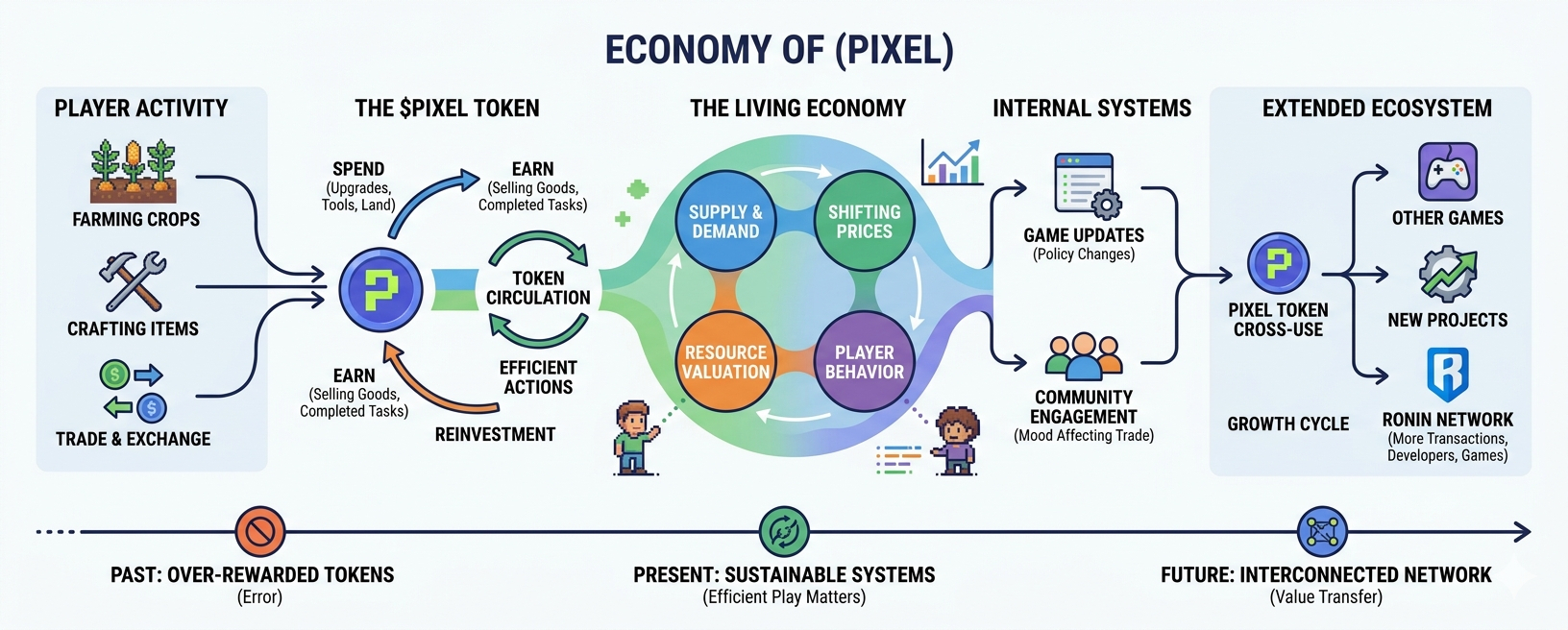
At first, Pixels feels familiar. You log in, plant crops, wander around, maybe chat with a few players. It has that relaxed, almost nostalgic farming-game vibe. Nothing about it screams “complex system.” But if you stay a little longer, something starts to feel different.
You notice that what you do actually matters.
Not in the usual “level up” sense, but in a quieter way—your actions seem to affect how things move around you. Prices shift, resources feel more or less valuable, and the whole world doesn’t just sit there waiting for you. It responds. That’s when it clicks: Pixels isn’t just a game loop. It’s closer to a living economy that players are constantly shaping.
One of the biggest changes Pixels brings is how it handles rewards. A lot of earlier Web3 games made the same mistake—they handed out tokens easily to attract players. It worked at first, but eventually too many tokens flooded the system, and everything lost value. Pixels is clearly trying not to repeat that.
Here, earning isn’t automatic. You actually have to do something useful. Farming efficiently, crafting items people need, participating in trade—these things matter. It creates a different mindset. You’re not just logging in to collect rewards; you’re contributing to something that only works if players keep it moving.
That’s where the $PIXEL token comes in. It doesn’t behave like something you just buy and hold. You need it. You use it. You spend it to upgrade your land, unlock better tools, and interact with other parts of the game. And once you use it, you often need to earn it again. It keeps circulating.
In a strange way, it feels less like money and more like energy. It only has meaning when it’s flowing through the system.
If you look at how people are actually playing, the activity tells its own story. At peak times, Pixels has pulled in around a million daily players, which is massive for a Web3 game. But what matters more is that these players aren’t idle. There’s constant movement—trading, crafting, exchanging items. It doesn’t feel like a place where everyone is waiting for prices to go up so they can leave. It feels active, like something people are genuinely involved in.
Another interesting pattern is how closely the token reacts to what’s happening inside the game. When updates roll out or new features drop, you often see a ripple effect—more discussion, more activity, and then movement in the token itself. It’s not purely driven by hype from outside. It’s tied to what players are actually doing.
Even the community plays a bigger role than you’d expect. When conversations pick up—on social platforms or inside the game—it often leads to more trading and engagement. It’s almost like the mood of the players feeds directly into the economy.
What’s quietly happening in the background is even more important. Pixels is starting to extend beyond its own world. Its token is showing up in other projects within the Ronin ecosystem. That changes the long-term picture in a big way.
Instead of being locked inside one game, $PIXEL is slowly becoming something that can move across different experiences. Imagine starting on a farm, then stepping into another game and still carrying value with you. It turns a single game into part of a larger network.
And that has a ripple effect on Ronin itself. More players in Pixels means more transactions. More activity makes the network more attractive for developers. More developers bring more games. And those games, in turn, create more ways for the token to be used. It’s a cycle that feeds itself.
But none of this comes without tradeoffs.
Making the system more controlled and sustainable means rewards aren’t as easy as they used to be. That can turn away people who are just looking for quick gains. At the same time, as the economy becomes more structured, it also becomes more complex. Not everyone wants to think about systems and efficiency while playing a game.
There’s always a risk it leans too far in one direction. If it becomes too focused on economics, it might start to feel like work. If it loosens up too much, it could fall into the same trap other games did.
That balance—keeping things fun while keeping the system stable—is the hardest part. And it’s something Pixels is constantly adjusting.
Maybe the best way to understand Pixels is to stop thinking of it as just a game. It’s closer to a small digital world where people produce, trade, and interact. The token moves like a currency. Updates act like policy changes. And everything depends on how people behave inside it.
What stands out is that it doesn’t feel empty. Players aren’t just holding assets—they’re using them. The system isn’t frozen—it’s moving. And the world itself isn’t isolated—it’s slowly connecting to something bigger.
It’s still early, and there’s no guarantee it all works long term. But Pixels is trying something different. Instead of chasing short bursts of excitement, it’s building something that might actually last.
And if it succeeds, it won’t just be remembered as a farming game.
It’ll be remembered as one of the first places where playing a game quietly meant participating in an economy that depended on you.