
What started as a simple pixel-art farming experiment has evolved into one of the most dominant revenue engines in Web3 gaming. Pixels—a social farming MMO built on the Ronin Network—is now redefining how blockchain games scale, monetize, and retain millions of players.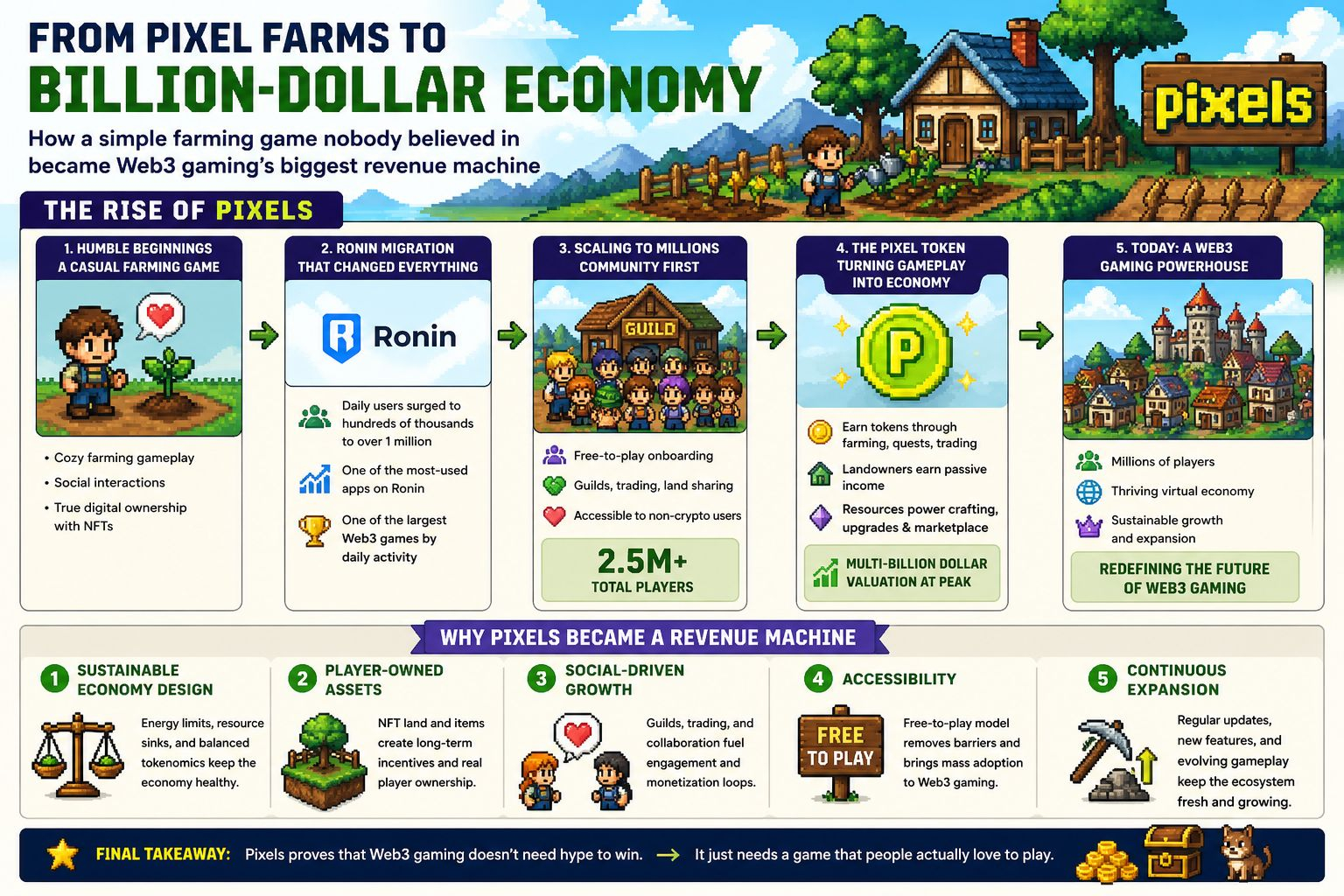
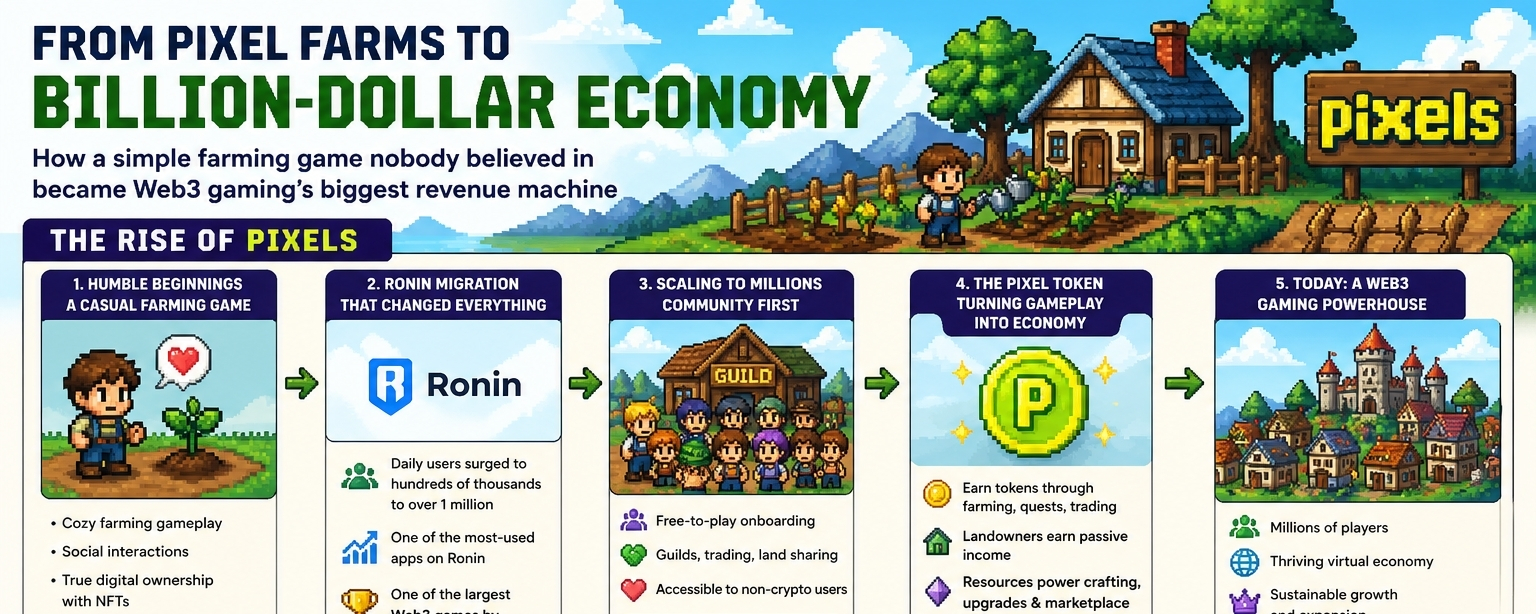
Humble Beginnings: A Casual Farming Game
At its core, Pixels was never designed to be a high-finance ecosystem. It began as a cozy, open-world farming game where players plant crops, gather resources, and interact socially—similar to traditional titles like Stardew Valley.
But unlike Web2 games, Pixels introduced true digital ownership. Players could own land, pets, and in-game assets as NFTs, giving real value to time spent in-game.
This combination of familiar gameplay + blockchain ownership became its first breakthrough.
The Ronin Migration That Changed Everything
The real turning point came when Pixels migrated from Polygon to Ronin in 2023. This move dramatically improved performance, reduced transaction costs, and plugged the game into one of the most active Web3 gaming ecosystems.
After the migration:
Daily users surged into the hundreds of thousands to over a million
The game became one of the most-used applications on Ronin
It established itself as one of the largest Web3 games by daily activity
This wasn’t just growth—it was network effect acceleration.
Scaling to Millions: Community First, Not Speculation
Unlike many Web3 projects that focus on token hype, Pixels prioritized gameplay and community:
Free-to-play onboarding lowered entry barriers
Social systems (guilds, trading, land sharing) increased retention
Simple mechanics made it accessible to non-crypto users
The result is a player base that has grown into the millions, making it one of the most widely played blockchain games.
This “fun-first” strategy proved more sustainable than pure play-to-earn models.
The PIXEL Token: Turning Gameplay Into Economy
The introduction of the PIXEL token transformed Pixels into a full economic ecosystem:
Players earn tokens through farming, quests, and trading
Landowners generate passive income from other players
In-game resources fuel crafting, upgrades, and marketplace activity
When the token launched, it quickly gained traction across the crypto market, signaling strong demand and engagement.
At peak momentum, the project reached multi-billion-dollar valuation levels, showing how virtual economies can scale into real financial ecosystems.
Why Pixels Became a Revenue Machine
Several key factors explain its dominance:
1. Sustainable Economy Design
Instead of unlimited token emissions, Pixels introduced systems like energy limits and resource sinks to balance supply and demand.
2. Player-Owned Assets
NFT land and items created long-term incentives, turning players into stakeholders.
3. Social-Driven Growth
Guilds, trading, and collaboration increased engagement and monetization loops.
4. Accessibility
Being free-to-play removed the biggest barrier that affected earlier Web3 games.
5. Continuous Expansion
Regular updates, new gameplay systems, and evolving features keep the ecosystem fresh and engaging.
Redefining Web3 Gaming
Today, Pixels stands as proof that Web3 gaming doesn’t need complex mechanics or heavy speculation to succeed.
By combining:
simple farming gameplay
strong community design
real asset ownership
and a balanced token economy
…it transformed from a “game nobody took seriously” into a category-defining platform.
Final Thought
The success of Pixels signals a shift in Web3:
The future isn’t about flashy tech—it’s about games people genuinely enjoy.
And in that sense, a quiet farming simulator didn’t just succeed—it reshaped the entire industry.