

Habibies! Do you know that, I didn’t expect a farming game to quietly teach me more about coordination than most multiplayer systems I’ve used, but that’s exactly where I ended up the first time I paid attention to how Pixels frames something as simple as “play with friends.”
On the surface, it looks familiar. You manage crops, raise animals, harvest resources, and somehow that loop turns into energy you use to expand your land. That’s the visible layer, the one anyone can understand in five minutes. Plant, wait, collect, repeat. But what struck me wasn’t the loop itself, it was how quickly that loop starts to bend once other people enter it.
Because the moment you introduce friends into a system built on time, production, and limited attention, everything stops being individual. Your land might be yours, but your efficiency isn’t anymore.
That’s where the design starts to show its real intent. Most crops in Pixels operate on timed cycles that sit somewhere between a few minutes and several hours. On paper, that sounds manageable. But stretch that across 20, 30, or even 50 active plots, and suddenly you’re not playing a casual farming loop anymore, you’re managing a schedule. Now add animals, which often require care every 6 to 12 hours, and you start to feel the pressure of missing cycles.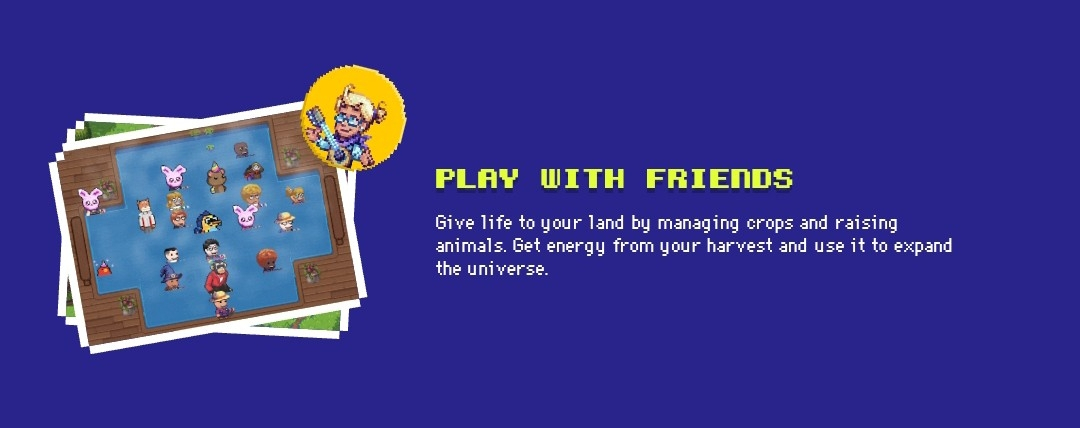
Alone, that pressure becomes friction. With friends, it becomes coordination.
That shift is subtle but important. Instead of optimizing your own time, you start distributing it. One player logs in during the morning, another checks in later, someone else handles harvesting before cycles expire. The system doesn’t explicitly force this behavior, but it quietly rewards it. Energy output stabilizes, production becomes more consistent, and wasted cycles drop.
If you look at the numbers, even small inefficiencies add up quickly. Missing a single harvest window on a high-yield crop might cost you 10 to 15 percent of its potential output. Over a day, across dozens of plots, that can compound into a 25 to 30 percent drop in total productivity. That’s not a minor loss. That’s the difference between slow progression and steady expansion.
Understanding that helps explain why “play with friends” isn’t just a social feature. It’s an economic layer.
Meanwhile, the reward system reinforces this behavior in ways that aren’t immediately obvious. Collaboration isn’t just about sharing labor, it’s also about shaping outcomes. When players work together, they don’t just produce more, they produce more reliably. And reliability, in a system tied to energy and expansion, is what allows players to take on larger, more complex goals.
That’s where the second layer appears. On the surface, you’re farming. Underneath, you’re stabilizing a resource pipeline.
And once that pipeline stabilizes, it unlocks something else entirely. You stop thinking in terms of daily tasks and start thinking in terms of projects. Expanding land, experimenting with layouts, optimizing resource chains. The game shifts from reactive to intentional.
But this is also where the system reveals its trade-offs. Coordination sounds efficient, but it introduces dependency. If your group falls out of sync, if one player drops off, or if time zones don’t align as cleanly as expected, the whole structure weakens. What felt like shared momentum can quickly turn into uneven contribution.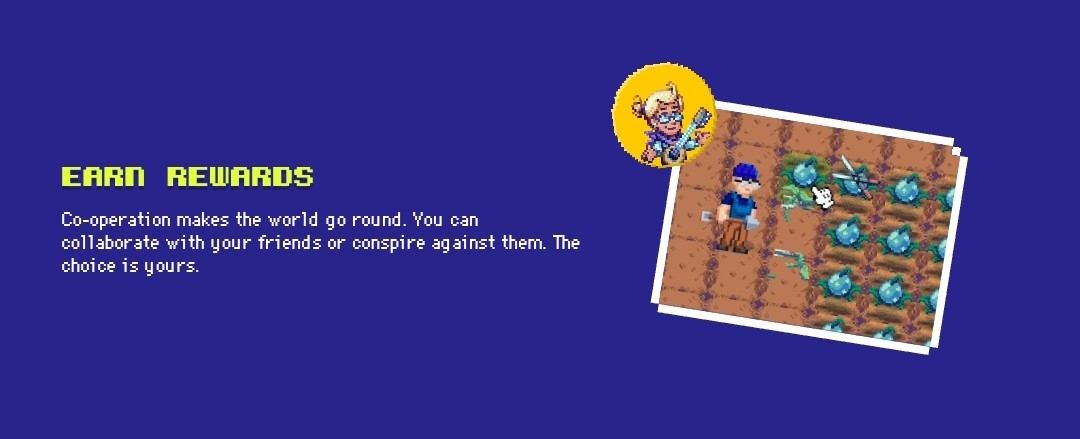
That tension is real. It’s the difference between a system that scales smoothly and one that becomes fragile under pressure.
Still, early signs suggest most players adapt around it rather than abandoning it. They form smaller clusters, tighter loops of two or three players instead of larger groups. That keeps coordination manageable while still capturing the benefits of shared effort. It’s not perfect, but it’s practical.
And that practicality extends into the reward layer as well. When the game talks about earning rewards through cooperation or even competition, it’s not just presenting a choice for flavor. It’s reflecting two different economic behaviors.
Collaboration tends to produce steady, predictable gains. Competition, on the other hand, introduces volatility. Players who push harder, optimize faster, or take risks can outperform others, but they also expose themselves to inefficiencies if those risks don’t pay off.
Both paths exist, but they feel different in texture. One is quiet and steady. The other is sharper, less stable.
What makes this interesting is how it connects back to the idea of building your own world. At first glance, that sounds like pure creativity. Designing land, arranging objects, shaping environments. But once you understand the systems underneath, you realize creativity here is constrained by economics.
Every design choice has a cost. Every expansion requires energy. Every aesthetic decision competes with efficiency.
That tension creates a kind of balance. Players who focus purely on optimization might end up with highly efficient but visually flat lands. Players who prioritize creativity might sacrifice output for expression. Most settle somewhere in between, and that middle ground is where the system feels most alive.
Because it reflects real decision-making. Not just what you can do, but what you choose to prioritize.
Zoom out a bit, and this starts to look less like a simple game loop and more like a small-scale simulation of coordinated economies. Not in a heavy, theoretical sense, but in a practical one. Time management, resource allocation, collaboration trade-offs. These are patterns that show up everywhere in digital systems right now, especially in Web3 gaming.
The difference is how quietly Pixels introduces them.
It doesn’t start with complexity. It starts with something familiar, almost calm. Plant a crop. Feed an animal. Visit a friend’s land. And then, gradually, it layers systems on top of that foundation until players are participating in something much more structured than it first appeared.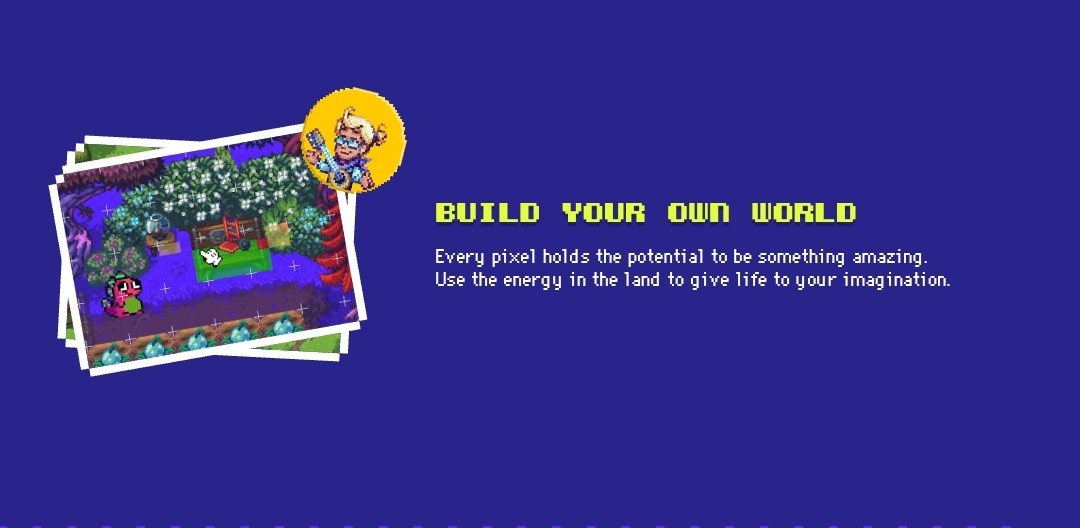
That layering matters. It lowers the barrier to entry while still allowing depth to emerge over time.
But it also raises a bigger question. If systems like this continue to evolve, where does the balance settle between play and coordination? At what point does optimization start to overshadow enjoyment?
It’s too early to say. Player behavior is still forming, and systems are still being adjusted. If this holds, we’ll likely see cycles of tightening and loosening. More tools for coordination, followed by adjustments to reduce dependency. More incentives for collaboration, balanced by ways to maintain individual agency.
That push and pull is probably unavoidable.
What feels clear, though, is that the real value here isn’t in the farming loop itself. It’s in how that loop becomes a framework for shared activity. A structure that turns individual actions into collective outcomes without forcing it.
And that’s a difficult thing to design well.
Most games either lean too heavily into solo progression or overcorrect into rigid group mechanics. Pixels sits somewhere in between, where cooperation is encouraged but not mandatory, and where efficiency emerges naturally rather than being imposed.
That balance is fragile. It can tip in either direction depending on how the system evolves.
But right now, there’s something quietly effective about it. A sense that the game isn’t trying to tell players how to play together, it’s just creating the conditions where playing together makes sense.
And maybe that’s the real shift here.
Not that games are becoming more social, but that they’re learning how to make coordination feel earned instead of required.