
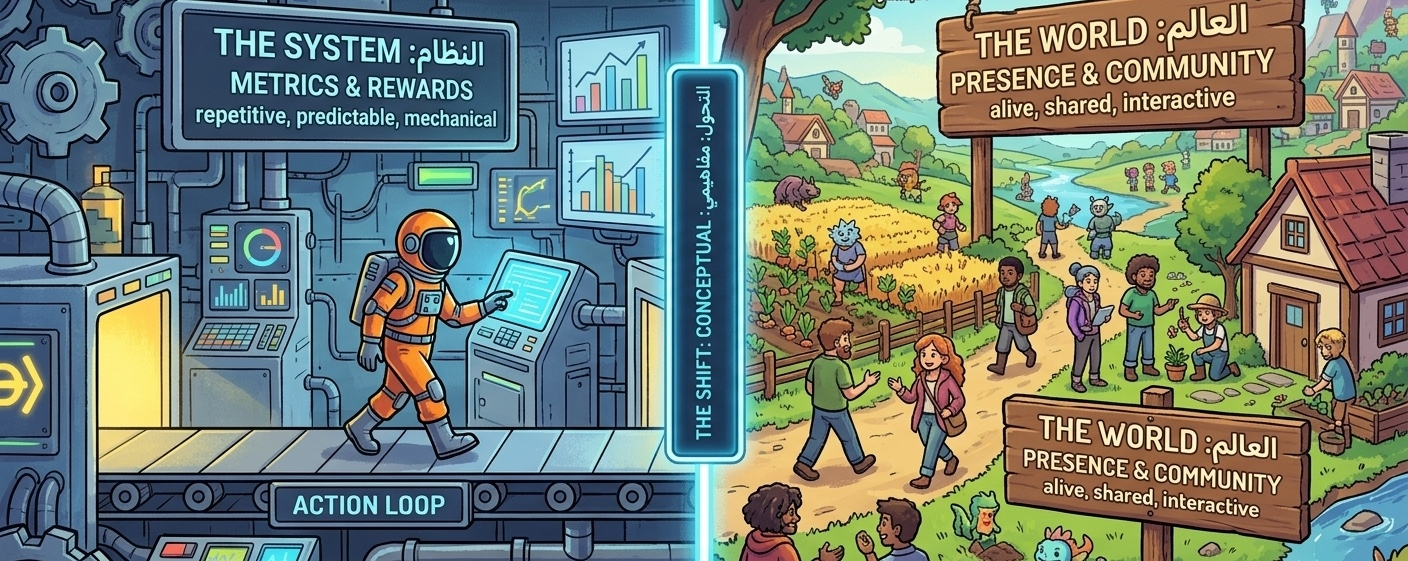
There’s a subtle difference between a system and a world, but it changes everything about how a game is experienced.
A system is something you interact with.
You follow steps, complete actions, and move through structured mechanics. Everything is predictable, optimized, and often repetitive. It works, but it rarely feels alive.
A world is something you exist in.
It’s not just about what you do, but how the environment responds around you. There’s movement, interaction, and a sense that things continue beyond your own actions.
Most Web3 games lean heavily toward systems.
They are built around mechanics, rewards, and efficiency. Players are guided through loops designed to maximize activity. On the surface, this creates engagement, but over time, it starts to feel mechanical.
You’re not exploring.
You’re executing.
That’s where the experience begins to fade.
Pixels moves in a different direction.
Instead of focusing only on systems, it puts more weight on the feeling of being inside a world. The gameplay is simple, but the environment feels shared and active. Other players are visible, interactions happen naturally, and the space doesn’t feel static.
That creates presence.
You’re not just clicking through actions.
You’re moving through something that feels ongoing.
This difference affects behavior more than most metrics show.
When a game feels like a system, players optimize it. They look for the fastest way to extract value, complete tasks, and move on. The relationship becomes transactional.
When a game feels like a world, players spend time in it
They don’t always have a specific goal. They log in, explore, interact, and exist within the environment. The relationship becomes more natural and less forced.
Pixels leans into that second model.
It doesn’t overload the player with complexity. It doesn’t push constant pressure to stay active. Instead, it creates a space that feels easy to return to without effort.
From a technical perspective, running on Ronin supports this by reducing friction. Interactions are smoother, and the experience stays consistent, which helps maintain immersion.
But the real shift is not technical It’s conceptual.
Pixels is not trying to build the most efficient system.
It’s trying to build something that feels alive.
And that difference is what keeps players around longer than expected.
Because in the end, people don’t stay in systems.
They stay in places that feel real.
