
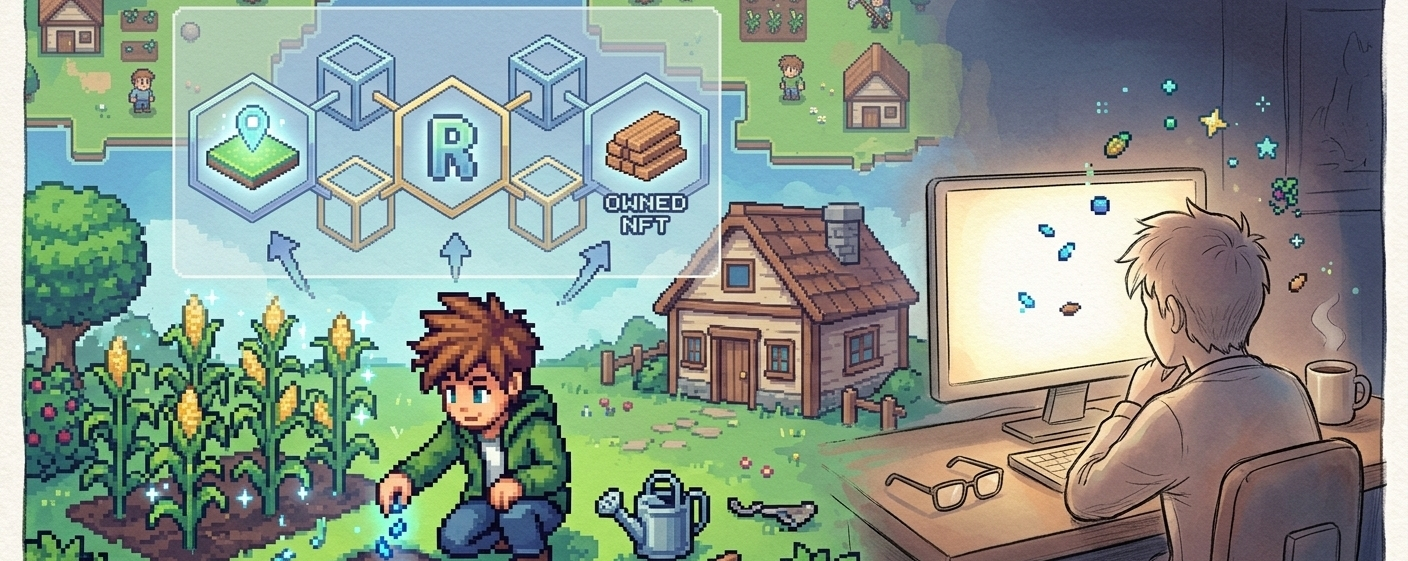
I keep thinking about how strange it is that in most online games, I can spend weeks building something, and then one day it just stops mattering outside that world. The farms I grow, the tools I collect, the time I put in every day—it all feels meaningful while I’m inside the game, but the moment I leave, it’s like none of it ever existed anywhere else. That used to feel normal, but lately it doesn’t sit the same way with me anymore.
Before projects like Pixels.xyz, almost every game I played worked like a closed space. I could progress, trade, upgrade, and even compete with others, but everything was still locked inside one company’s system. Even when there were marketplaces, I never really owned anything in a strict sense. If the servers shut down or the rules changed, everything I built would disappear without any real way to take it with me. I just accepted that as part of gaming, even though it always felt a bit temporary.
Over time, different attempts were made to fix this feeling. Some games tried adding trading systems that gave items value between players. Others built economies that made rare items feel more “real.” Then blockchain games came in and promised actual ownership, where items and progress could exist outside the game itself. But in many cases, those early versions felt more like financial systems wrapped inside a game. Instead of focusing on fun, they sometimes turned play into something closer to constant trading and optimization.
Pixels.xyz comes into this space as another attempt, but it doesn’t feel like it’s trying to reinvent everything at once. It’s a social farming and exploration game where players grow, build, and interact in a shared world. On the surface, it feels simple—almost familiar. I still plant, collect, upgrade, and move around a pixel-style environment like many other farming games I’ve played before. But underneath that, some parts of my progress are tied to blockchain systems, meaning certain assets can exist outside the game’s internal structure.
What I notice most is that it doesn’t force the blockchain side into my face. I can play without thinking about it constantly. It’s just there in the background, quietly handling ownership for specific items. That makes the experience feel less technical and more like a normal game with an added layer I can choose to care about or ignore.
Still, I find myself questioning what that really changes. When I play farming games, I usually enjoy them because they feel low-pressure and temporary. I log in, do a few tasks, see progress, and log out without carrying anything heavy with me. But when ownership becomes part of the system, even quietly, it slightly changes how I look at what I’m doing. It adds a sense that what I earn might matter beyond the moment I’m playing.
There’s also something interesting and a bit uncomfortable about how control works here. Even if I “own” certain assets, the game itself is still run by developers. They can adjust systems, rebalance mechanics, or change how things function over time. So my ownership exists, but only inside a structure that can still shift around it. It feels like ownership with conditions rather than something fully independent.
I also notice that not everyone will experience the game the same way. Some people might treat it like a relaxed farming world and never engage with the ownership layer at all. Others might focus more on progression systems and external value. That creates two very different ways of playing the same game, which is interesting but also a bit fragmented.
Another thing I keep coming back to is sustainability. Systems like this depend heavily on ongoing participation. If players lose interest or if the balance of rewards changes too much, the internal economy can start to feel uneven. It’s not just about keeping a game fun anymore—it’s also about keeping a system stable over time, which is a much harder problem than it sounds.
At the same time, I don’t think it’s fair to dismiss what projects like Pixels are trying to do. They’re experimenting with a question that games have avoided for a long time: should time spent in a digital world leave something behind that still exists outside it? There’s no simple answer to that, because it changes what “playing” even means.
What stays with me most is that Pixels.xyz doesn’t really give a final answer. It sits somewhere in between a normal game and a digital economy, trying to connect two ideas that don’t always fit comfortably together. And I keep wondering—if what I build in a game can follow me beyond it, does that make the experience more meaningful, or does it quietly change the reason I was playing in the first place?
